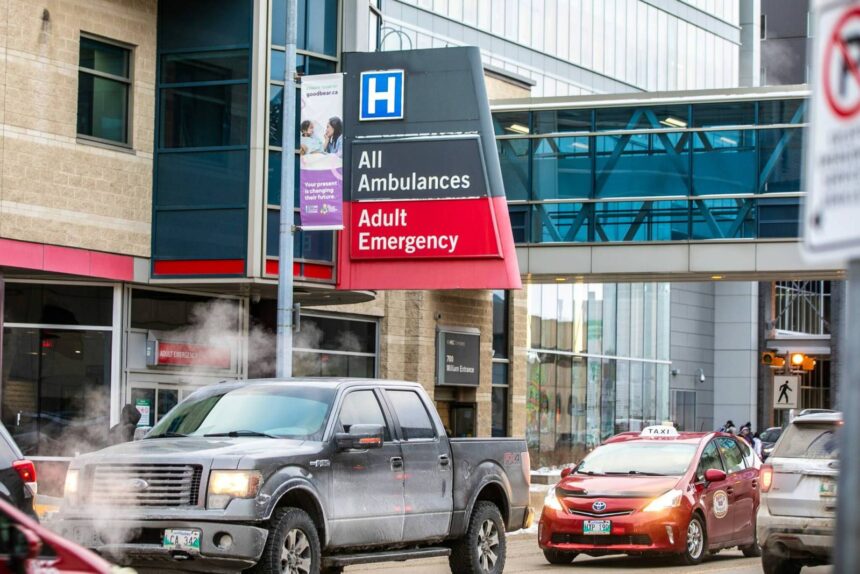
The nurse who spoke to me last spring didn’t want her name used. She’d worked at Health Sciences Centre for eleven years, mostly in the ER, and had just given her notice. Not for another job in health care. She was leaving the field entirely. “I can’t even tell my kids when I’ll be home anymore,” she said. “And I don’t know if what we’re doing is actually helping anyone. We’re just… firefighting. Every single shift.”
That conversation keeps coming back as Manitoba’s health-care system continues to buckle under pressure that everyone can see but no one seems able to quantify. Emergency departments overflow. Surgical wait times stretch into seasons. Diagnostic imaging appointments are booked months out. Staff leave faster than they can be replaced. And despite announcement after announcement promising more hires, more training seats, more resources, the system never quite catches up.
According to documents obtained through a freedom of information request, Shared Health, the provincial agency created in 2018 specifically to coordinate health workforce planning, has no approved workforce model. No forecast of future staffing needs. Not for doctors. Not for nurses. Not for diagnostic technologists or allied health professionals. The plan, Manitobans are told, is still “in development.”
This isn’t a minor administrative gap. Workforce planning is the skeletal structure that holds a health system upright. Without it, recruitment becomes reactive. Training programs operate in the dark. Budgets get allocated based on political urgency rather than actual need. And the people working inside the system, already stretched dangerously thin, are left to improvise solutions to problems that were foreseeable years ago.
The math isn’t complicated. Manitoba’s population is growing, driven largely by immigration and interprovincial migration. It’s also aging. Older populations tend to live longer than previous generations, but often with multiple chronic conditions that require ongoing, coordinated care. Diabetes, heart disease, respiratory illness, dementia. These aren’t one-time interventions. They demand physicians, nurses, home care workers, long-term care beds, and a functioning diagnostic and surgical infrastructure.
Demographers have been flagging these trends for decades. Yet the central body responsible for health workforce planning in Manitoba cannot produce a clear, data-driven projection of how many workers the system will need, not just today but five or ten years from now. When the provincial government announces it has hired a certain number of nurses or lab technologists, the obvious question becomes: how many does the system actually require? And the answer, at present, is that no one seems to know.
If you don’t know how many workers you need, those hiring numbers become political talking points rather than evidence of meaningful progress. It also becomes impossible to determine whether shortages are improving or worsening. The fragments of data that do exist paint a troubling picture. Vacancy rates among diagnostic technologists and technical assistants are approaching twenty percent. Nurses are leaving at an alarming rate. One report indicated that for every one hundred nurses gained, fifty-seven departed over roughly a year.
Even more concerning is who is leaving. Mid-career nurses, the ones with a decade or more of experience, the institutional memory and clinical judgment that can’t be taught in a classroom, are walking away. Darlene Jackson, president of the Manitoba Nurses Union, has warned repeatedly that this represents a profound and difficult-to-reverse loss. You can recruit new graduates. You can bring in workers from other provinces or countries. But you cannot instantly recreate years of bedside experience, the kind that allows a nurse to recognize subtle changes in a patient’s condition before they become emergencies.
Health Minister Uzoma Asagwara is correct that workforce planning for more than fifty-five thousand employees across hundreds of distinct roles is genuinely complex. There is no single formula. Different regions have different needs. Rural communities face unique recruitment challenges. Specialists are not distributed evenly. Indigenous communities often lack consistent access to primary care, let alone specialized services. These are real complications that deserve serious attention.
But complexity should not be a shield for inaction. Other provinces have managed to produce detailed, public workforce plans for allied health professions. British Columbia, Ontario, and Alberta all have frameworks, however imperfect, that project future needs and align training capacity accordingly. Manitoba, despite having a centralized agency specifically designed to do this work, remains in a state of perpetual data compilation.
The political context doesn’t help. Long-term planning rarely aligns with election cycles. Governments are far more inclined to announce short-term fixes with immediate, visible results than to invest in strategies that may take years to show results. Ribbon cuttings and funding announcements make for better optics than spreadsheets projecting staffing needs in 2035. But health care doesn’t operate on election timelines. It operates on demographic realities and biological inevitabilities.
If Manitoba needs two hundred and forty more doctors just to reach the national average, as Doctors Manitoba has suggested, that gap didn’t appear overnight. It’s the cumulative result of years of underestimating demand, underinvesting in training capacity, and failing to retain the professionals already working in the province. The same is true across the system. When there aren’t enough family doctors, people end up in emergency departments for primary care issues. When diagnostic wait times stretch too long, conditions worsen, requiring more intensive and expensive interventions later.
Shared Health was supposed to address these problems. It was created, in part, to bring a provincewide perspective to planning and eliminate the fragmentation that plagued the old regional health authority model. Centralization was sold as a way to better align resources with population need, to think strategically rather than reactively. Without a workforce plan, that promise rings hollow.
What should be in such a plan isn’t mysterious. It should include current vacancy rates, turnover trends, retirement projections, training program capacity, graduate retention rates, population growth forecasts, and evolving health needs based on demographic and epidemiological data. It should map out where the gaps are now and where they will be in five, ten, and twenty years. And crucially, it should be public. Transparency matters. Health-care workers, educators, students considering careers in health care, and the public all deserve to see the road map and to hold government accountable for following it.
Right now, there is no road map. Just a system straining under pressure, with too few people trying to do too much work, and no clear sense of when, or if, relief is coming. The nurse I spoke to last spring is gone now. She’s working in administration for a non-profit. She misses patient care, she told me later, but not the chaos. Not the sense that no matter how hard she worked, the system was designed to fail her.
So the next time Manitobans wonder why emergency room waits remain stubbornly high, why surgeries are delayed for months, why staff seem perpetually stretched thin, the answer isn’t all that complicated. You can’t fix a system when you haven’t bothered to diagnose the problem. You can’t order the right parts when you don’t know what’s broken. And you can’t meet demand if you refuse to figure out what demand actually is.