I’ve spent enough time in Denver to know that when local business owners start using words like “recipe for ruin,” something fundamental has shifted. A year after Trump’s so-called Liberation Day, the economic reality on the ground tells a story far removed from the administration’s triumphant messaging. What began as a promise to protect American manufacturing and force trading partners to shoulder costs has morphed into what Colorado officials now describe as economic devastation hitting families, farmers, and small manufacturers hardest.
The numbers coming out of Colorado paint a stark picture. State Treasurer Dave Young reports that tariffs have jumped sevenfold in a single year, climbing from roughly 3% to 21%—the highest level in over a century. Colorado businesses alone paid $1.1 billion in tariffs throughout 2025, according to state data. A Denver retailer mentioned losing $25,000 just last fall to tariff costs. For Nathan Peterson, who runs Vederra Modular, material costs climbed 6-7%, but the real killer has been supply chain chaos and the capital strain of carrying extra inventory. “It’s ultimately driving up the cost of housing in Colorado,” he told officials recently. That’s the kind of cascading effect economists warn about but politicians often ignore.
Governor Jared Polis convened a roundtable last week with small-business owners and manufacturers alongside the Colorado Office of Economic Development and International Trade. His assessment was blunt. “Tariffs are a tax increase that raises costs, creates uncertainty, and makes it harder to grow and hire talent,” Polis said. Even as courts have struck down portions of Trump’s tariff regime, businesses continue wrestling with fallout from a year of policy whiplash. Young echoed this during a Wednesday call with state fiscal officers nationwide, describing the situation as “tariff whiplash” where policies get announced, changed, reversed, and escalated with minimal warning. Try running a business when you can’t predict your input costs from one quarter to the next.
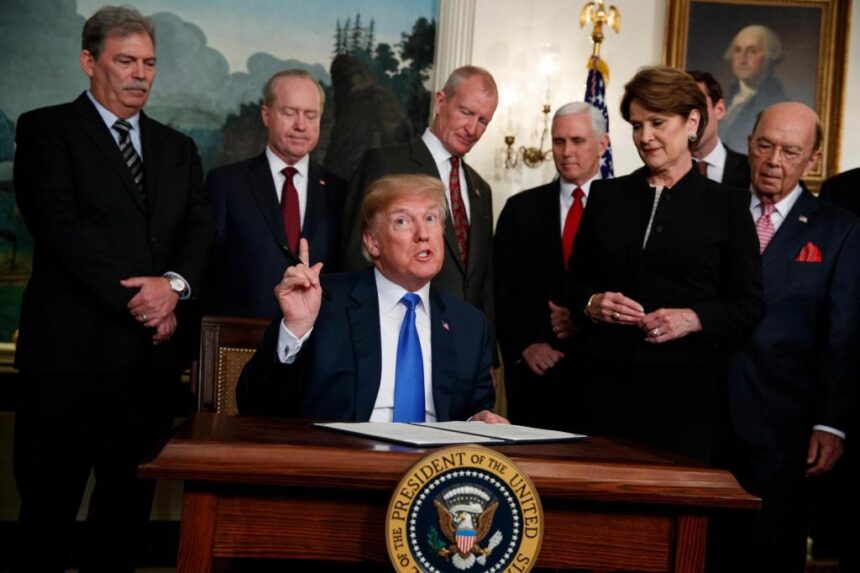
Trump invoked the International Emergency Economic Powers Act of 1977 to impose these tariffs, beginning with a blanket 10% rate on all countries before embarking on a year of constantly shifting policy. The legal basis for using IEEPA this way has been questionable from the start. It’s a statute designed for genuine national security emergencies, not economic negotiations disguised as crisis management. The Supreme Court eventually agreed, striking down major portions of the tariff structure, but only after billions had already been collected from American businesses.
A new report from For the Long Term, a nonprofit focused on economic policy, calculated that American families have paid over $1,700 each in tariff costs over the past year. Nearly 200,000 blue-collar jobs vanished, including approximately 89,000 in manufacturing and nearly 124,000 in transportation and warehousing. The report found that about 96% of the tariff burden fell on U.S. consumers, with foreign exporters absorbing just 4%. That directly contradicts Trump’s repeated claims that China and other countries would pay. Trump’s tariffs also pushed retail prices for domestic goods up nearly 5% on average, while economic growth flatlined to just 0.7% in the fourth quarter of 2025.
Not everyone opposes the tariffs, of course. The Steel Manufacturers Association praised the administration’s recent decision to strengthen tariffs on imported steel, aluminum, and copper. “By right-sizing the derivatives list and updating the valuation of steel-containing goods, these measures reinforce President Trump’s signature trade achievement,” said SMA President and CEO Philip K. Bell. Peter Navarro, senior counselor for trade and manufacturing, celebrated Liberation Day on social media, claiming “real results, putting more money in the pockets of American workers.” He also touted plans for a 100% tariff on patented pharmaceutical products, arguing it would bring pharma jobs home and reduce reliance on foreign supply chains.
The reality for most Colorado businesses has been far less rosy. Chad Franke, president of the Rocky Mountain Farmers Union, told reporters his members don’t oppose all tariffs, but they need to be “done in a thoughtful and methodical way.” Agriculture has been particularly vulnerable. Farmers depend on predictable export markets and stable input costs for everything from equipment to fertilizer. When trading partners retaliate with their own tariffs on American agricultural products, Colorado farmers get squeezed from both directions.
The refund process for tariffs ruled unlawful by the Supreme Court has become its own bureaucratic nightmare. The federal government is working to return roughly $166 billion in illegally collected duties, but the process requires detailed claims and data submissions expected to take months or longer. U.S. Senator John Hickenlooper, alongside 18 Democratic colleagues, sent a letter last month to Customs and Border Protection Commissioner Rodney S. Scott demanding automatic refunds using existing records rather than forcing small businesses through an opt-in process. “Small businesses should not have to do additional work to receive refunds on what amounted to illegal tariff payments,” the senators wrote. They warned that the proposed Consolidated Administration and Processing of Entries system creates unnecessary burdens favoring large corporations and Wall Street firms with legal resources to navigate complex claims.
Hickenlooper has introduced two pieces of legislation aimed at relief: the Tariff Refund Act of 2026, which would fully refund businesses that paid Trump’s tariffs, and the Small Business RELIEF Act to exempt small businesses from sweeping tariffs going forward. Whether either bill gains traction in a divided Congress remains uncertain. In the meantime, Colorado’s Office of State Planning and Budgeting projects an effective tariff rate of 8.8% for 2026 and 7.7% for 2027, slightly below national expectations but still dramatically higher than historical norms.
We Pay the Tariffs, a grassroots coalition of over 1,100 small businesses advocating against tariffs, calculated that American businesses have paid $265 billion in overall presidential tariffs. Even after the Supreme Court decision, impacts continue rippling through supply chains and balance sheets. In response, Colorado has expanded resources through the Office of Economic Development and International Trade and World Trade Center Denver, offering regular tariff updates, one-on-one advising, and specialized consulting.
Walking through this wreckage, what strikes me most is the disconnect between political rhetoric and economic reality. Trump branded the tariff rollout as Liberation Day, suggesting Americans would be freed from unfair trade practices and foreign exploitation. One year later, the liberation looks more like disruption. Families are paying more for everyday goods. Small manufacturers are burning through capital to maintain inventory buffers against supply chain uncertainty. Blue-collar workers in manufacturing and logistics have lost jobs by the tens of thousands. Meanwhile, the federal government collected tariffs ruled illegal by the highest court in the land and now faces the administrative challenge of returning billions.
Trade policy is complex, and reasonable people can disagree about the right balance between protecting domestic industries and maintaining open markets. But policy conducted through emergency powers, constant reversals, and legal overreach doesn’t serve anyone well. Colorado businesses now face the task of rebuilding amid continuing uncertainty, hoping that whatever comes next might offer the predictability they need to plan, invest, and grow. For many, a year after Liberation Day, the burden feels less like freedom and more like an anchor.