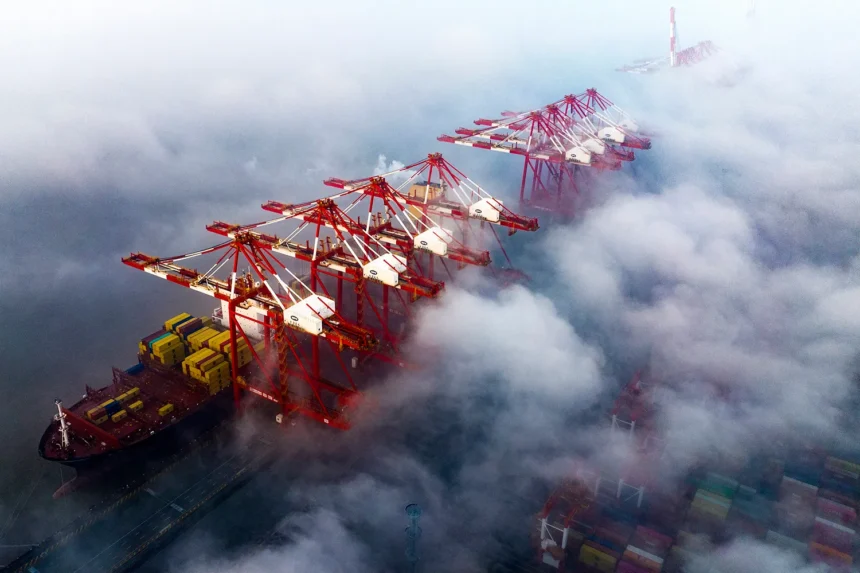
I watched a shipping container get unloaded in Long Beach last month, stacked with auto parts stamped “Made in Vietnam.” The dock supervisor told me half of those components used to come straight from China. Now they take a detour through Southeast Asia, get repackaged, and land here with a lower tariff rate. That’s the new geography of American trade policy—less about efficiency, more about who you’re willing to cut deals with and who you’re trying to box out.
Free trade, as Washington understood it for decades, is effectively dead. What’s replacing it isn’t exactly protectionism in the old sense, but it’s not the borderless optimism of the 1990s either. It’s something harder to define: a mix of targeted tariffs, sector-specific agreements, and a gnawing anxiety about China that both parties share, even if they won’t admit it in the same breath. The U.S. Trade Representative now operates less like a dealmaker and more like a strategic coordinator, trying to rebuild supply chains one mineral deposit at a time.
Donald Trump didn’t invent this shift, but he’s made it impossible to ignore. His tariff threats land like grenades in diplomatic cables—25 percent on steel here, 60 percent on Chinese goods there. Yet beneath the noise, there’s a bipartisan consensus forming that would have been unthinkable during the Obama years. Democrats and Republicans both now see trade policy as inseparable from national security. The dividing line isn’t whether to use tariffs, but how hard to swing the hammer and who gets hit.
Michigan Governor Gretchen Whitmer, a Democrat, made that clear in a Washington Post op-ed last November. She criticized Trump’s approach but was careful to add, “To be clear, I am not against tariffs outright.” That hedge speaks volumes. Scott Lincicome, a trade analyst at the Cato Institute and one of the few remaining free-trade voices in Washington, told me it took two world wars and seventy years to build a system that let China into the World Trade Organization. We’re not flipping a switch back to that era, he said. The architecture is crumbling, and no one’s in a rush to rebuild it the old way.
Peter Harrell, who worked on economic policy in the Biden White House, thinks a coherent consensus could emerge within five to eight years, even after Trump leaves office. The details will differ—Democrats push labor and environmental standards, Republicans want tax breaks for U.S. firms—but the structure is taking shape. Trade deals will be smaller, faster, and aimed at specific sectors like semiconductors or rare-earth minerals. They’ll come with strings attached, requiring partners to align against China in ways that traditional agreements never did.
China’s rise is the ghost at every negotiating table. The country used the free-trade system to become the world’s largest exporter, subsidizing industries and protecting markets in ways that violated the spirit, if not always the letter, of WTO rules. The United States complained, filed cases, and won some. But Beijing didn’t change course, and its exports kept climbing. By the late Obama years, frustration had curdled into a realization: the old tools didn’t work anymore.
Obama’s team started blocking Chinese acquisitions of U.S. semiconductor firms and froze appointments to the WTO’s appeals panel, which they saw as too lenient on China. Trump ramped up the pressure with a two-year trade war, slapping tariffs on three-quarters of Chinese imports. COVID-19 then turned theory into crisis—suddenly the U.S. couldn’t produce enough face masks or ventilators because supply chains ran through Shenzhen and Wuhan. Economic security stopped being an abstraction.
Biden kept most of Trump’s China tariffs and added new ones, targeting electric vehicles and solar panels. He tightened export controls on advanced chips, working with Japan, Taiwan, and the Netherlands to choke off Beijing’s access to cutting-edge technology. His administration never brought a major trade deal to Congress, preferring executive actions that didn’t require legislative approval. The International Monetary Fund noted in a 2024 report that U.S. tariffs had reached levels not seen since the 1930s, a comparison that would have horrified policymakers a generation ago.
Trump’s second term has pushed tariffs even higher. After a Supreme Court decision limited his emergency powers, average U.S. tariffs on Chinese goods still climbed to nearly 30 percent, up from about 21 percent when he took office. He’s preparing for a May meeting with Xi Jinping in Beijing, and negotiators have floated the idea of a “Board of Trade” to balance exports and imports between the two countries. It’s managed trade dressed up in diplomatic language, the kind of deal Reagan cut with Japan in the 1980s to limit fuel-efficient car imports. Detroit pocketed the profits back then and kept losing market share. History doesn’t repeat, but it rhymes.
The new trade deals coming out of Washington look nothing like NAFTA or the Trans-Pacific Partnership. They’re bilateral, narrow, and explicitly tied to national security. Geoffrey Gertz, a former Biden National Security Council official now at the Center for a New American Security, called them “the most detailed commitments on economic security ever included in a legally binding trade agreement.” Pacts with Taiwan, Malaysia, Indonesia, and others all include language requiring partners to align their trade policies with U.S. interests, meaning against China.
In Malaysia, that language sparked a backlash. Opposition leader Mohamed Azmin bin Ali called the agreement “a surrender of sovereignty,” warning it could drag Malaysia into conflicts that aren’t its own. From Washington’s perspective, that’s exactly the point. The U.S. wants leverage, and these deals provide a legal basis for complaints if a country gets too cozy with Beijing. A former Trump trade official, speaking anonymously, told me it gives the U.S. room to maneuver without firing the first shot.
The rare-earth minerals push shows how far this has gone. China controls most of the global supply of elements used in batteries, magnets, and advanced electronics. When Beijing slowed exports in April 2025, U.S. automakers panicked. Vice President JD Vance responded by announcing a “preferential trade zone for critical minerals” involving dozens of countries. The plan sets a minimum price for minerals to encourage mining and processing outside China, with tariffs blocking cheaper Chinese alternatives.
It sounds logical until you follow the subsidy chain. Chad Bown, a trade expert at the Peterson Institute for International Economics, pointed out that miners need the price floor, processors need subsidies to compete, and manufacturers like Ford need incentives to buy more expensive batteries. It’s subsidies all the way down, he said. Super-ugly, but there’s no easy alternative.
Wendy Cutler, a longtime U.S. trade negotiator now at the Asia Society Policy Institute, told me economic security has become a necessary component of trade agreements. Countries aren’t willing to rely on global markets when a rival power can shut off supply at will. That shift predates Trump and will outlast him. The question isn’t whether tariffs stay, but how they’re used and who pays the price.
Consumers are already paying. Tariffs raise prices on everything from washing machines to steel, hitting lower-income families hardest. Manufacturers dependent on imported parts face higher costs, undermining competitiveness. Trump’s approval ratings have suffered as grocery bills climb. But the political pain hasn’t changed the trajectory. Both parties see China as an economic and military threat that justifies short-term costs.
Jake Sullivan, Biden’s national security advisor, recently criticized Trump’s decision to ease some chip export restrictions in exchange for unspecified payments to the U.S. government. We’re solving China’s problem for it, he told The Wire China. The complaint highlights a real tension: Trump’s transactional approach undermines the united front Biden tried to build with allies. Yet both administrations rely on the same tools—tariffs, export controls, and narrow trade deals designed to counter Beijing.
The old global trade rounds that brought dozens of countries together are finished. The Uruguay Round took seven years to negotiate in the 1990s, a timeline no modern administration would tolerate. Sector-specific deals move faster and avoid the political minefield of comprehensive agreements. Taiwan Semiconductor Manufacturing Company got subsidies under the CHIPS Act to build plants in Arizona, a move Trump initially called horrible but hasn’t reversed. Instead, he’s added tariffs on semiconductor imports to sweeten the deal further.
Allies are watching this shift with unease. U.S. trade policy now swings wildly depending on who occupies the White House, making long-term planning nearly impossible. Trump’s threats to impose tariffs on allies like Canada and the European Union have driven some to explore trade deals that exclude Washington. The risk is that heavy-handed tactics push partners toward exactly the kind of independence the U.S. wants to prevent.
History offers a warning. Reagan’s protectionism in the 1980s, from car import quotas to steel tariffs, didn’t revive American industry. Companies raised prices, margins improved, but innovation lagged. Japanese carmakers built plants in the U.S. and kept gaining ground. Protection bought time, not solutions. Whether today’s tariffs and subsidies produce different results depends on choices not yet made—investments in research, workforce training, infrastructure that goes beyond political talking points.
Whoever wins the White House in 2028 will inherit this framework: high tariffs on China, sector-specific trade deals, and a domestic political environment that punishes any hint of weakness toward Beijing. There’s room to lower tariffs on allies as a bargaining chip, the way the U.S. used market access to shore up alliances against the Soviet Union. But the era of championing global free trade is over. Washington’s new consensus is narrower, more defensive, and built on the assumption that economic competition with China is a generational struggle that requires tools the WTO was never designed to handle.
I think about that shipping container in Long Beach, the one that traveled an extra thousand miles to avoid a tariff. It’s inefficient, more expensive, and exactly what U.S. policy now encourages. The goods still move, the global economy still functions, but the logic has changed. Trade isn’t about mutual gains anymore. It’s about who you trust and who you’re trying to contain. That’s the new reality, and it’s not going away anytime soon.