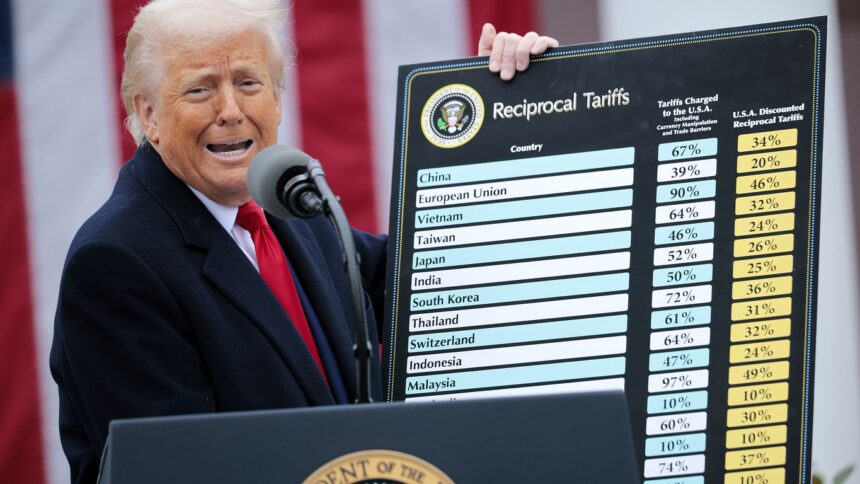
Twelve months ago, the world watched as President Trump declared “Liberation Day,” unleashing a tariff regime intended to rebalance decades of trade flows. What followed wasn’t just economic disruption. It was structural fracture—one that still reverberates through boardrooms in Shanghai, manufacturing floors in Michigan, and diplomatic corridors across three continents. Even after judicial rollback and political compromise, the landscape remains permanently altered.
The numbers tell part of the story. America’s effective tariff rate—the actual duties collected relative to total imports—hovered around 2% for years before Trump took office. By the days following Liberation Day, it had rocketed to 21%, a level unseen since the 1930s. Today it sits at 11%, according to new tracking data from the Budget Lab at Yale. That middle ground reflects not coherence but chaos: more than 50 distinct policy changes in a single year, each one sending tremors through global supply chains that took decades to build.
I’ve reported from trade zones in Vietnam and industrial hubs in Germany over the past year. What strikes me isn’t just the scale of disruption. It’s the permanence. CEOs I’ve interviewed don’t talk about waiting out the storm anymore. They’re redesigning operations for a world where trade barriers aren’t temporary policy but enduring geography.
The Trump administration insists tariffs have delivered results. White House spokesperson Kush Desai told reporters that the president has “powerfully used tariffs to lower our goods trade deficit, renegotiate trade deals, secure trillions in manufacturing investments and lower drug prices.” That’s the official line. The ground truth is messier, more contradictory, and more consequential than any single narrative can contain.
Consider manufacturing employment, often cited as the primary beneficiary of protectionist policy. In nine of the ten months since Liberation Day, U.S. manufacturing jobs have declined. The sector shed a net 89,000 positions during that stretch, according to Bureau of Labor Statistics data. Meanwhile, the Institute for Supply Management reported its third consecutive month of manufacturing expansion in March—a sign of activity, but at what cost? The same survey showed its prices index at the highest level since 2022, a direct consequence of tariff-inflated input costs now rippling through to consumers.
I spoke with a mid-sized steel fabricator outside Pittsburgh last month who requested anonymity to avoid jeopardizing relationships with the administration. His raw material costs jumped 40% after aluminum tariffs kicked in. He’s passed along about half that increase to customers, mostly in construction. The other half came out of his margins and his workforce. He let go of eight people in January. “We voted for tariffs,” he told me bluntly. “We didn’t vote for this version of them.”
That sentiment captures a broader reality. The tariff regime was supposed to bring clarity and leverage. Instead it brought whipsaw. The Wall Street Journal reports the administration may shift the structure of steel and aluminum tariffs again, potentially raising costs further. Trump himself has vowed to elevate the 10% blanket tariff imposed after the Supreme Court struck down major portions of his original framework. Trade officials promise to reconstruct those tariffs using alternative legal authorities before current measures expire in July.
The Supreme Court decision changed everything and nothing. It dismantled the legal architecture of Liberation Day tariffs, ruling the framework violated constitutional limits on executive trade authority. But it didn’t reverse the psychology. Countries that scrambled to negotiate exemptions, sign investment pledges, or restructure supply chains can’t simply undo those decisions. The tariffs may be diluted, but the distrust is baked in.
Wilbur Ross, Commerce Secretary during Trump’s first term, offered a surprisingly ambivalent assessment when I reached him by phone. “Liberation Day was on its way to being a great success until the Supreme Court,” he said. The ruling now “limits his ability to make tariffs fluctuate,” though Ross suggested that constraint might inadvertently help. “Businesses can adjust to bad news,” he argued. “It’s hard for businesses to adjust to uncertainty.”
That uncertainty has already redrawn the global trading map in three critical ways. First, new trade alliances have emerged, often improvised and fragile. Countries from Southeast Asia to Latin America are forging bilateral deals that route around U.S. markets or hedge against future tariff volatility. Vietnam and Mexico, both major manufacturing exporters, have signed agreements with European and Asian partners that would have been unthinkable five years ago. These aren’t ideological realignments. They’re survival strategies.
Second, China has adapted faster and more effectively than Washington anticipated. Despite Trump’s insistence that tariffs would force Beijing to capitulate, China ended 2025 with a record $1.2 trillion trade surplus, according to Chinese customs data verified by the International Monetary Fund. Chinese exporters found new buyers, rerouted shipments through third countries, and diversified away from U.S. dependence. In Shenzhen, I watched electronics manufacturers pivot toward African and South American markets with a speed that stunned even their own logistics partners. One factory manager told me through a translator that U.S. tariffs were “an inconvenience, not an emergency.”
Third, multinational corporations are treating the shift as structural, not cyclical. Volkswagen CEO Oliver Blume told investors last month that “trade barriers mean our model no longer works as intended and a structural reset is required.” He wasn’t talking about tweaking supply chains. He was describing a fundamental rethinking of where to invest, produce, and sell. Blume later added that future U.S. investment depends entirely on tariff refunds: “We can’t both pay, on the one hand side, a high amount of tariffs, and on the other side heavily invest” in America.
That calculus is playing out across industries. A senior executive at a Japanese automaker, speaking on condition of anonymity, told me his company has frozen plans for a $2 billion U.S. plant expansion pending clarity on trade policy. Clarity, he emphasized, doesn’t mean favorable terms. It means knowing the rules won’t change every six weeks.
The human costs are harder to quantify but impossible to ignore. I met workers in Ohio whose factories closed not because of foreign competition but because their employers couldn’t absorb tariff costs on imported components. I interviewed Mexican farmers whose exports to the U.S. collapsed under threat of agricultural tariffs, leaving harvests to rot. These aren’t statistics. They’re lives upended by policy made at a level of abstraction that rarely survives contact with reality.
The broader question isn’t whether tariffs worked. It’s what “working” means in a globally integrated economy where borders are legal fictions and supply chains are decades-long investments. Trump’s trade war was premised on the idea that America’s market size gives it unilateral leverage. That assumption overlooked a basic truth: leverage is mutual. When you fracture a system, you don’t control how it reassembles.
What comes next is unclear. The administration promises new tariff structures before July. Trade partners are preparing countermeasures and contingency plans. The World Trade Organization, already weakened by years of U.S. hostility, struggles to mediate disputes in a system where the largest economy has essentially opted out of multilateral rules.
One year after Liberation Day, the only certainty is impermanence. The tariff rates will change. The political rhetoric will evolve. But the trust required to sustain complex, interdependent trade relationships doesn’t reset with a policy announcement. It erodes slowly and rebuilds even more slowly. In that gap between disruption and reconstruction, real people—workers, consumers, business owners—bear costs that never appear in official statements or economic models.
From where I sit, having watched this unfold across three continents, the most striking outcome isn’t what tariffs achieved or failed to achieve. It’s the recognition, dawning now in capitals from Brussels to Beijing, that the trading system of the past generation is gone. What replaces it will depend less on any single country’s policy than on how the world learns to manage fragmentation without descending into outright economic warfare. That lesson is still being written.