The diplomatic corps in Brussels has a running joke these days. When someone mentions “rules-based trade order,” they wait to see if anyone can keep a straight face. Most can’t. That tells you everything about where international commerce stands in 2025—somewhere between memory and mythology.
Donald Trump’s tariff blitz didn’t just shake up global markets. It buried an economic gospel that survived two world wars, the Cold War, and the 2008 financial collapse. The orthodoxy of free trade, championed by institutions like the World Trade Organization for decades, now looks like a relic from a different civilization. What replaced it isn’t chaos exactly, but it’s not order either. Call it gunboat economics—where leverage matters more than treaties and power trumps principle.
Trump branded April 2, 2024, as “Liberation Day” when he unleashed tariffs ranging from 10 percent on most imports to a staggering 100 percent on Chinese goods. The justification was simple, almost nostalgic: American factories had been gutted while BMW showrooms multiplied across suburban strip malls. The rhetoric sounded like William McKinley channeling reality television. Chinese imports now face average duties around 48 percent, according to Peterson Institute for International Economics data. Even after the Supreme Court ruled parts of the regime unconstitutional in February, Trump simply rebranded a 15 percent global baseline as necessary for national security.
The courtroom defeat barely registered. Within days, the administration reimposed levies through executive authority loopholes that trade lawyers are still parsing. Bernd Lange, chair of the European Parliament’s trade committee, called it “Tariff Chaos Day” on social media last week. He’s not wrong, but chaos implies lack of intention. This feels more deliberate—a stress test on institutions built for a world that no longer exists.
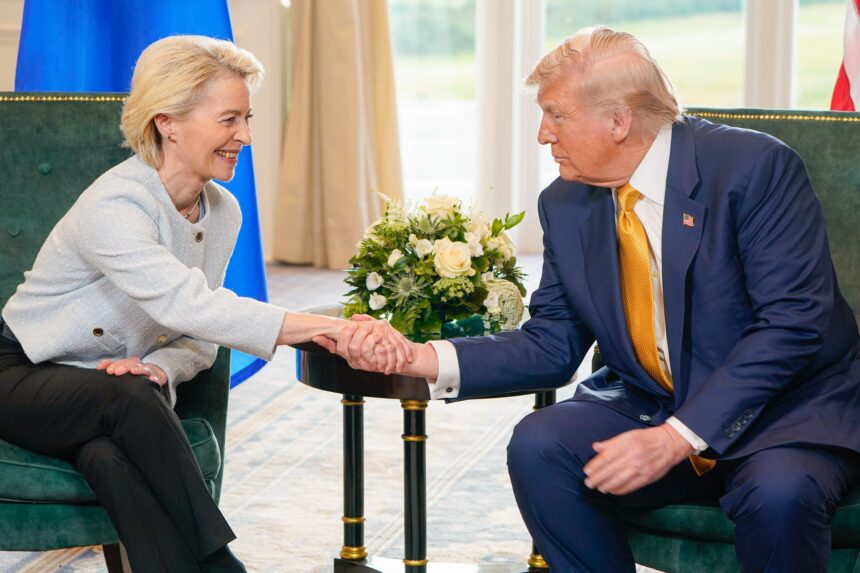
What surprises analysts isn’t that Trump imposed tariffs. It’s that everyone else normalized them. The European Union, despite public outrage from parliamentarians, approved a deal in March accepting 15 percent duties on all exports to the United States through 2028. That’s not negotiation. That’s capitulation dressed in diplomatic language. EU trade commissioner Valdis Dombrovskis called it “pragmatic engagement” during a press conference in Strasbourg. Diplomats in the room reportedly stifled laughter.
Brussels insists it remains the global defender of multilateral trade rules. The same week it swallowed Trump’s terms, the Commission fast-tracked agreements with India and Australia. More deals are coming with Thailand, the United Arab Emirates, and South Africa. The pace is frantic, almost panicked. Officials describe it as diversification strategy. Critics call it forum shopping—finding partners willing to overlook the EU’s weakening bargaining position.
That desperation showed at the WTO’s biannual summit in Cameroon, which ended March 30 after four days of procedural gridlock. Director-General Ngozi Okonjo-Iweala opened with brutal honesty: “The world order and multilateral system we used to know has irrevocably changed. We will not get it back.” She urged delegates to focus forward. Instead, they argued about whether to extend a moratorium on e-commerce tariffs. Brazil blocked it. The United States conditioned digital trade access on broader reforms. China defended the “Most Favored Nation” principle—equal treatment for all trading partners—that built postwar prosperity.
The MFN debate is where ideology meets reality. America and Europe now want to rewrite that core principle, creating flexibility to punish rivals and reward allies. That approach has a name: managed trade. It also has a history, mostly involving colonial extraction and spheres of influence. Smaller economies watched the Cameroon summit with alarm. If MFN falls, they lose the legal shield preventing powerful nations from playing favorites or demanding political concessions for market access.
Okonjo-Iweala’s candor reflects institutional exhaustion. The WTO has always moved slowly—consensus among 164 members guarantees that. But even during the 1990s peak of globalization fervor, agricultural subsidy negotiations dragged for years without resolution. Now the organization faces existential questions about its purpose. Former WTO appellate body member Jennifer Hillman told reporters the institution risks becoming “a debating society where countries perform for domestic audiences rather than negotiate seriously.”
The speed of this collapse surprises even skeptics. Ten years ago, the EU negotiated with the Obama administration on the Transatlantic Trade and Investment Partnership. Brussels demanded ambitious provisions beyond tariff elimination—harmonized regulations, mutual recognition of standards, integrated supply chains. The talks failed, but the ambition was real. Compare that with the current EU-US arrangement, which essentially accepts American terms in exchange for avoiding worse punishment. The 2015 EU-Canada deal remains the high-water mark of what Brussels once hoped to achieve.
Trade economics tell a messier story than political theater suggests. US consumers pay the tariffs, not China or Europe. Estimates from the Tax Foundation show American households facing $1,200 in additional annual costs from current duties. Inflation remains stubborn partly because import prices rose. Yet polling shows ambivalence rather than outrage. A March survey by the Chicago Council on Global Affairs found 52 percent of Americans support “using tariffs to protect jobs,” even if prices increase. That’s a dramatic shift from 2016, when only 38 percent agreed.
Manufacturing employment offers context. The Midwest saw 200,000 factory jobs return between 2024 and early 2025, according to Bureau of Labor Statistics data. Economists debate how much tariffs contributed versus other factors like reshoring trends and automation investments. Workers in Ohio and Michigan don’t care about the academic argument. They see paychecks and reopened plants. Trump’s political instinct—that tangible local gains outweigh abstract efficiency losses—proved correct electorally, whatever the economic textbooks say.
Europe’s contradictions run deeper than Brussels admits. The EU maintains enormous agricultural subsidies through the Common Agricultural Policy while preaching free trade to developing nations. It imposes complex regulatory requirements that function as non-tariff barriers, then complains when America does the same. French farmers blocked roads last year demanding protection from Mercosur imports. German automakers quietly lobbied for carve-outs from US tariffs while publicly supporting free trade principles. Hypocrisy is bipartisan and bilateral.
Developing economies face the harshest consequences. When major powers abandon multilateral rules, smaller nations lose leverage and predictability. Kenya’s trade minister told journalists in Nairobi last week that African countries now face impossible choices—align with Washington, Beijing, or Brussels and risk retaliation from the others. The old system had flaws, but at least disputes went to arbitration rather than economic coercion.
What comes next isn’t a return to 1990s globalization. That required American hegemony, Chinese compliance, and European unity—three conditions that no longer exist. Instead, expect regional blocs, bilateral arrangements, and constant renegotiation. Trade will happen, but under different terms. Efficiency matters less than security. Comparative advantage takes a back seat to domestic politics.
The WTO will likely survive as a forum and data repository. Its dispute settlement function is already paralyzed after Washington blocked appellate appointments. Member states will maintain its shell while conducting real business elsewhere. That’s not reform. It’s a slow institutional death that nobody wants to officially acknowledge.
Trump’s tariffs didn’t create this shift. They revealed and accelerated changes already underway. China’s state capitalism model never fit free trade assumptions. European unity frayed after Brexit and migration crises. American workers grew skeptical of arrangements that enriched coastal elites while hollowing out industrial towns. The system broke because its benefits became too concentrated and its costs too visible.
Whether gunboat trade policy produces better outcomes than multilateral cooperation remains uncertain. History suggests that might-makes-right commerce breeds resentment and eventual conflict. Economic interdependence isn’t just about efficiency—it creates incentives against war. Then again, interdependence didn’t prevent 1914 or avoid current great power tensions. Maybe the old orthodoxy deserved its funeral.
Brussels diplomats still struggle to discuss trade without invoking rules and norms. Old habits die hard. But in Washington and Beijing, the conversation moved on. Power, leverage, and national advantage now structure negotiations. The question isn’t whether that’s right or wrong. The question is whether smaller economies and ordinary workers fare better when giants negotiate freely or follow rules. So far, 2025 offers no comforting answers.