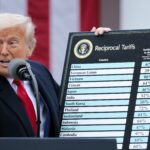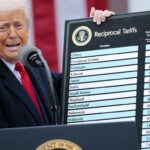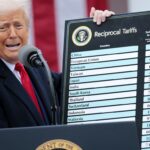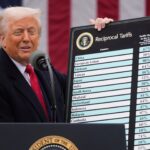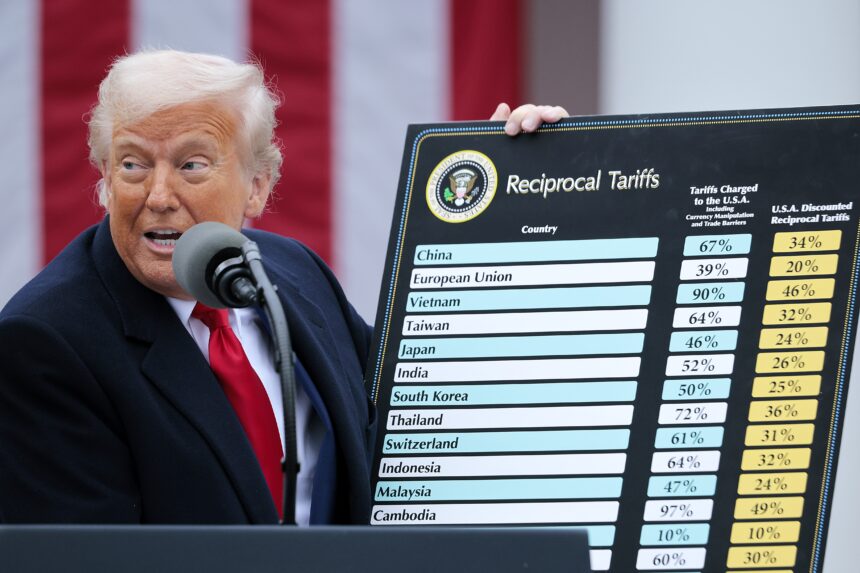
When Donald Trump stood in the White House Rose Garden twelve months ago and declared April 2 “Liberation Day,” he promised a new American economic golden age. Tariffs on imports, he said, would reverse decades of industrial decline. Factories would return. Jobs would multiply. Consumer prices would drop as the nation became self-sufficient again.
A year later, the data tells a different story. The tariffs remain in place, though in diminished form after legal challenges. But the economic transformation Trump predicted has not materialized. Instead, American businesses face uncertainty, consumers shoulder higher costs, and the manufacturing renaissance remains more aspiration than reality.
I’ve covered trade wars from Beijing to Brussels, and one pattern emerges clearly: tariffs rarely produce the outcomes politicians promise. This anniversary provides a crucial checkpoint to assess whether Trump’s aggressive protectionism has defied historical precedent—or confirmed it.
The revenue flowed in, then had to flow back out. Between October and February, U.S. Customs collected $151 billion in tariff revenue, nearly quadrupling the previous year’s intake. That windfall came directly from American importers—the companies that bring foreign goods into the country. Many passed those costs to consumers through higher prices on everything from electronics to clothing.
Then the Supreme Court intervened. In a February ruling that stunned the administration, the justices determined Trump had exceeded his executive authority with portions of his tariff regime. Now the Treasury Department faces an unprecedented logistical challenge: refunding approximately $166 billion in duties that were improperly collected. Customs officials are scrambling to develop a refund mechanism by mid-April, but the process has created administrative chaos for businesses that paid the tariffs months ago and may wait months more for reimbursement.
This isn’t just an accounting problem. Small importers who paid tariffs upfront now face cash flow crises. Several business owners I spoke with in Baltimore’s port district described the situation as “financial limbo”—they’ve absorbed costs they’ll eventually recover, but the delay has forced them to delay hiring and cancel expansion plans.
The manufacturing boom Trump promised has not arrived. Factory employment has actually declined since Liberation Day, with 89,000 fewer manufacturing jobs in February compared to April of last year, according to Bureau of Labor Statistics data. Those losses concentrate in sectors that depend on imported components—automakers, electronics assemblers, and machinery manufacturers.
Trump frequently claims that foreign companies are pouring investment into American facilities to avoid his tariffs. At a recent Mar-a-Lago event, he cited figures approaching $2 trillion in new commitments. The actual number, tracked meticulously by the Bureau of Economic Analysis, tells a more modest story: $288 billion in foreign direct investment during 2025, slightly below the previous year and well under the ten-year average.
“Companies don’t make billion-dollar facility decisions based on policy that might change tomorrow,” explains Dr. Rebecca Stein, senior fellow at the Peterson Institute for International Economics. “They need regulatory stability, and that’s exactly what this tariff approach hasn’t provided.”
Stein points to the volatility as particularly damaging. The Tax Foundation documented more than fifty changes to tariff rates between April 2025 and March 2026. Duties on Chinese goods peaked at 145 percent, essentially halting trade, before being reduced. European tariffs fluctuated between 10 and 34 percent depending on ongoing negotiations. This unpredictability makes long-term business planning nearly impossible.
Inflation remains stubbornly elevated, and tariffs bear significant responsibility. While overall price increases have cooled from the 2022 peak of over 9 percent, February’s inflation rate of 2.4 percent exceeds the Federal Reserve’s 2 percent target. Federal Reserve Chair Jerome Powell stated explicitly last month that “elevated readings largely reflect inflation in the goods sector, which has been boosted by the effects of tariffs.”
Walk through any retail store and the impact becomes tangible. Washing machines cost 12 percent more than last year. Furniture prices rose 8 percent. Even clothing, where retailers typically absorb cost increases to remain competitive, has seen sustained price growth. These aren’t abstract statistics—they represent real purchasing power lost by American families.
The situation may worsen dramatically. The recent escalation of conflict between the U.S., Israel, and Iran has sent energy prices soaring. Crude oil futures jumped 23 percent in two weeks. If sustained, this spike will ripple through every sector of the economy, compounding the inflationary pressure tariffs already created.
The trade deficit—ostensibly the target Trump’s tariffs aim to reduce—has barely budged. Despite taxing imports at historically high rates, Americans imported $3.4 trillion in goods during 2025, a 4 percent increase over the previous year. Exports grew slightly faster at 6 percent, reaching $2.2 trillion, but the overall goods trade deficit still expanded by roughly 2 percent to $1.24 trillion.
This outcome shouldn’t surprise anyone familiar with trade economics. Tariffs don’t eliminate demand for foreign products—they just make them more expensive. American consumers and businesses still need the goods they’ve always imported because domestic alternatives often don’t exist or can’t match the price even with tariffs applied.
Consider semiconductors. The U.S. imports the vast majority of advanced chips from Taiwan and South Korea because American fabrication capacity, despite recent investment, remains years away from meeting domestic demand. Tariffs on semiconductors simply increased costs for every industry that uses them—automakers, medical device manufacturers, defense contractors—without creating a single American chip facility.
The current average tariff rate sits at approximately 10 percent, according to Tax Foundation calculations. That’s half the peak rate from last summer but still four times higher than the pre-Trump baseline of 2.5 percent. This represents a massive tax increase on the American economy, one that generates revenue but also creates drag.
Erica York, who leads federal tax policy analysis at the Tax Foundation, describes the economic impact as extending beyond the direct cost. “On top of the significant tax increase the tariffs caused, they also had this added uncertainty tax,” she told me. “It’s going to weigh on hiring. It’s going to change investment plans.”
That uncertainty manifests in tangible ways. Economic growth slowed to 1.8 percent in 2025, down from 2.5 percent the previous year, according to Commerce Department data. Job creation averaged 142,000 per month, well below the 225,000 monthly average from 2023 and 2024. Consumer confidence, as measured by the University of Michigan, declined steadily throughout the year.
I spoke with Manuel Reyes, who manages a mid-sized furniture import business in North Carolina. His company sources hardwood components from Vietnam and assembles finished products domestically. The tariff volatility has been devastating. “We price a container shipment based on one tariff rate, and by the time it arrives six weeks later, the rate has changed twice,” he explained. “We’ve had orders where we lost money because tariffs increased after we locked in customer pricing.”
Reyes laid off twelve employees last fall and canceled plans to open a second assembly facility. His experience reflects a broader pattern: businesses caught between unpredictable policy and competitive pressure simply freeze expansion and cut costs where possible.
The irony is that Trump’s stated goals—revitalizing American manufacturing, reducing trade deficits, lowering consumer costs—are broadly popular across the political spectrum. The disagreement centers on whether tariffs can achieve those objectives. One year of evidence suggests they cannot, at least not as implemented.
Alternative approaches exist. Targeted incentives for strategic industries, workforce development programs, and infrastructure investment might build domestic capacity more effectively than blanket import taxes. The European Union’s industrial policy combines selective trade protection with substantial public investment in research and worker training. Results have been mixed but show more promise than America’s current trajectory.
The political reality, however, is that Trump remains committed to tariffs despite mounting evidence of their limitations. At a recent cabinet meeting, he dismissed criticism as coming from “globalists who want to see America fail.” His core supporters appear willing to accept higher prices as the cost of challenging China and reshaping global trade relationships.
Whether this political gamble pays off may depend on factors beyond Trump’s control. If the U.S.-Iran conflict expands, energy-driven inflation could overwhelm any tariff policy debate. If China’s economy continues weakening, American exports might suffer regardless of tariff rates. If Europe retaliates more aggressively, U.S. manufacturers could lose crucial overseas markets.
What’s clear after twelve months is that Liberation Day did not liberate the American economy from its structural challenges. Manufacturing competitiveness requires more than tax policy—it demands innovation, education, infrastructure, and long-term strategic vision. Tariffs alone cannot resurrect industries that declined over decades due to complex global forces.
The question now is whether policymakers will acknowledge this reality and adjust course, or whether political commitments will override economic evidence. For American workers, businesses, and consumers, the answer matters enormously. The next year of Trump’s tariff experiment may prove even more consequential than the first.