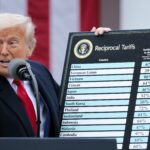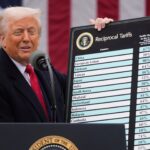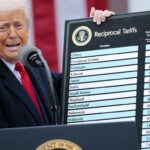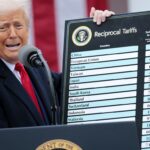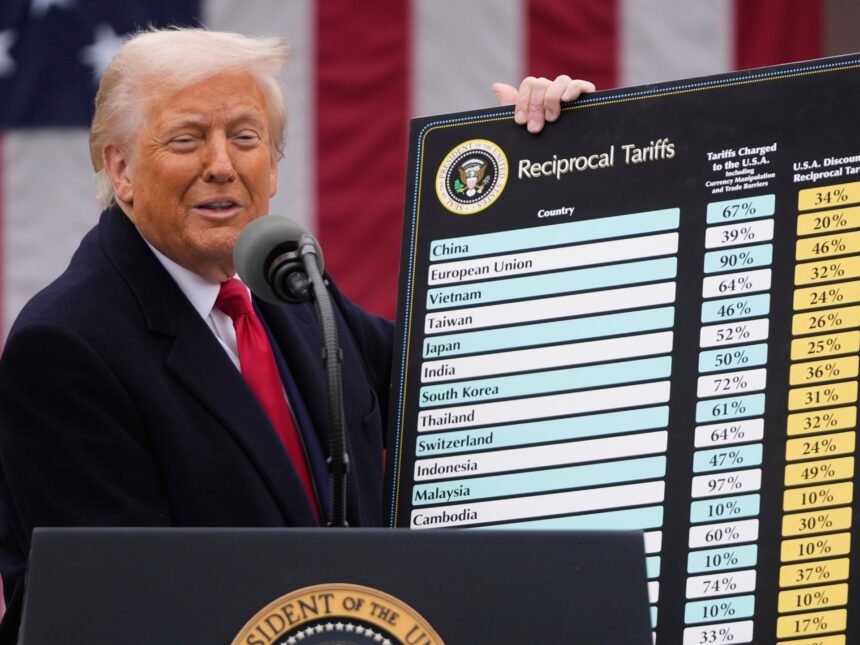
I’m staring at spreadsheets in a cramped Brussels office, cross-referencing numbers that tell a story the Rose Garden speech didn’t mention. One year after Donald Trump stood beside perfectly trimmed hedges and announced what he called “Liberation Day,” the economic reality looks nothing like liberation. It looks like a $1,000 bill landing on kitchen tables across America, uninvited and relentless.
The announcement came with fanfare and executive confidence. A sweeping 10 percent global tariff would protect American workers, shrink the trade deficit, and make foreign competitors pay their fair share. Markets didn’t celebrate. The stock market plunged harder than any day since COVID-19 lockdowns emptied city streets. Trading floors in New York went silent, then frantic. Within 48 hours, finance ministers from Berlin to Beijing were on secure calls, drafting retaliatory measures or scrambling for exemptions.
What followed was a year of economic whiplash. The Supreme Court ruled on February 20 that most of Trump’s tariffs were illegal, noting the president overstepped his authority by invoking national emergency powers for broad, open-ended trade barriers. Commerce Secretary Howard Lutnick stood beside Trump in the White House briefing room as they addressed the ruling, but the damage was already embedded in price tags nationwide. Hours later, the administration invoked a different statute to launch temporary tariffs set to expire in July. The legal maneuvering bought time, but it didn’t erase what American families had already paid.
Between implementation and the court’s intervention, the average effective US tariff rate surged from 2.6 percent to over 13 percent, according to economists at the New York Federal Reserve. That’s the highest rate since World War II, a threshold not crossed in eight decades. Even with some rollbacks, the effective rate remains historically elevated. Trade barriers that were supposed to punish China and the European Union ended up reshaping American consumer behavior in ways nobody in the administration anticipated.
Tariffs aren’t new. Nearly every president has used them selectively to shield vulnerable industries, counter dumping practices, or gain leverage in multilateral negotiations. But there’s a difference between targeted measures and blanket policies. A tariff is essentially a tax imposed by a government on imported goods, designed to make foreign products more expensive and encourage domestic purchasing. In theory, it protects local jobs. In practice, it depends entirely on whether domestic alternatives exist at competitive prices. When they don’t, consumers simply pay more.
The administration promised tariff revenue would enrich the nation and rebalance trade flows. The Penn Wharton Budget Model shows the US collected more than $287 billion in customs duties in 2025 and an additional $64 billion so far in 2026. Those are impressive figures until you realize who actually paid them. Following the Supreme Court ruling, the government may be required to refund as much as $175 billion to businesses that paid under now-invalidated tariffs. That potential refund represents a staggering legal and fiscal mess, with importers already filing claims and lobbying Congress for expedited processing.
The core promise was that foreign exporters would absorb the cost. Trump and his advisors repeatedly framed tariffs as a tax on China, on Europe, on trade partners taking advantage of American markets. Economists at the New York Fed found the opposite. Nearly 90 percent of the economic burden fell on US businesses and consumers. Foreign exporters absorbed only a marginal slice, often by slightly lowering prices or accepting thinner profit margins. But the bulk of the cost moved downstream, landing squarely on American balance sheets.
Surveys conducted by the Fed revealed that roughly half of businesses subject to tariffs raised their prices in response. They didn’t have a choice. Import costs spiked, and profit margins couldn’t absorb the difference. Retailers, wholesalers, and manufacturers passed the expense directly to customers. Checkout totals climbed. Grocery bills swelled. Clothing, electronics, and car parts all became measurably more expensive.
According to the Tax Foundation, US households paid an average of $1,000 more in 2025 for the same goods they were already buying. That’s not an increase driven by inflation or supply chain disruptions. It’s a direct result of tariff policy. But the burden wasn’t shared equally. Lower-income households, which allocate a higher proportion of their earnings to essentials like food, clothing, and transportation, felt the impact most acutely. A $1,000 increase for a family earning $35,000 a year is not the same as a $1,000 increase for a family earning $150,000. The former cuts into rent money, medical bills, and school supplies.
I spoke with Elena Morales, a single mother working two jobs in Phoenix, who told me she stopped buying fresh fruit last summer. “Oranges used to be cheap,” she said. “Now they’re a luxury.” Her story isn’t unique. Across the country, families recalibrated their spending, cutting back on nutrition, delaying car repairs, and skipping doctor visits to accommodate higher prices on everyday goods.
In November, the administration blinked. An executive order exempted more than 237 categories of food imports from the tariff regime. Coffee, beef, and oranges were suddenly tariff-free. It was a significant reversal, a quiet acknowledgment that the policy was hurting the wrong people. The move didn’t come with a press conference or an admission of miscalculation, but it spoke volumes. Economists had been warning for months that tariffs on everyday goods would hit Americans hardest, and the administration’s pivot confirmed they were right.
With Trump’s original tariffs replaced by a flat 10 percent rate under the temporary statute, the Tax Foundation projects the average cost to US households will fall to about $600. That’s an improvement, but it’s still a $600 annual tax on consumption that didn’t exist before. For families already stretching paychecks, it’s a persistent drain.
The broader economic consequences are still unfolding. Trade relationships with key partners have been strained. The European Union imposed retaliatory tariffs on American whiskey, motorcycles, and agricultural products. China redirected supply chains toward Southeast Asia and Latin America, bypassing US markets altogether. Companies that relied on just-in-time manufacturing faced delays and higher costs, some relocating production abroad to avoid tariff exposure entirely. The promised protection of American jobs became more complicated when factories couldn’t afford the imported components they needed to stay competitive.
International organizations have weighed in. The International Monetary Fund warned that escalating trade barriers could shave half a percentage point off global GDP growth. The World Trade Organization opened dispute resolution proceedings, though those processes move slowly. Meanwhile, American diplomats in Brussels and Geneva have been working behind the scenes to negotiate bilateral deals that might ease tensions, but progress has been incremental at best.
What’s clear now, one year on, is that tariffs designed to punish foreign competitors ended up taxing American households. The legal battles aren’t over. The economic fallout continues to ripple through supply chains and family budgets. And while the administration insists the policy will pay long-term dividends, the short-term price is being paid at grocery stores, gas stations, and kitchen tables across the country. Liberation Day turned out to be expensive.