Donald Trump stood at the National Republican Congressional Committee dinner last Wednesday and did what he’s been doing for weeks now—complaining about a Supreme Court decision he fundamentally doesn’t seem to understand. His frustration with the February ruling that struck down his tariff scheme has turned into something more revealing: a public misreading of how constitutional law, trade policy, and judicial restraint actually work.
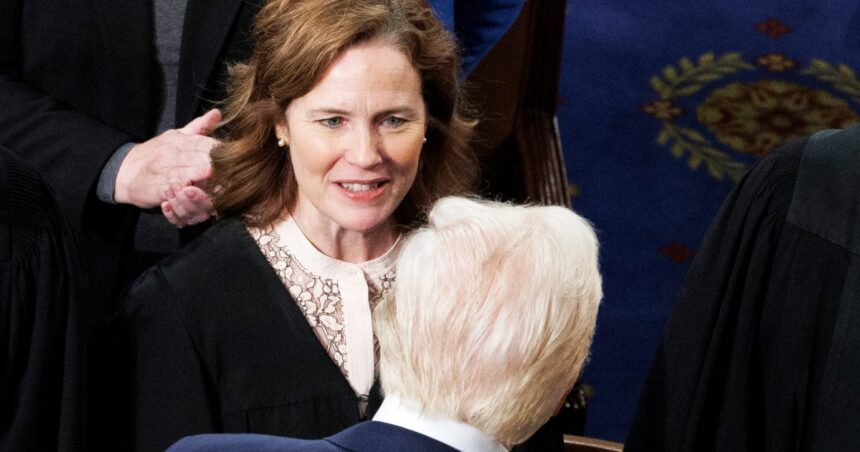
The president directed his ire at two justices he personally appointed—Neil Gorsuch and Amy Coney Barrett—saying they “sicken me” for ruling against him in the 6-3 decision. But his real confusion centers on refunds. Trump can’t grasp why Chief Justice John Roberts didn’t simply add “one little sentence” declaring that money already collected didn’t need to be paid back. It’s a complaint that sounds reasonable until you understand why courts don’t work that way—and why his own Justice Department already promised those refunds would happen.
Roberts didn’t write that sentence because he didn’t need to. The legal framework governing illegal tax collection already dictates what happens when the government takes money without authority. When tariffs are deemed unconstitutional or outside executive power, the Treasury doesn’t get to keep the haul. Trade law has operated this way for over a century, rooted in the principle that the government can’t profit from its own legal violations. The Supreme Court wasn’t making new policy in its silence—it was applying settled doctrine.
What makes Trump’s frustration particularly hollow is that his own legal team acknowledged this reality long before the high court ruled. When the administration fought to keep the tariffs in place during the litigation process, government lawyers explicitly told lower courts that importers would face no irreparable harm if the tariffs continued temporarily. Their reasoning was straightforward: if the government ultimately lost, plaintiffs would “assuredly receive payment on their refund with interest.” That wasn’t a concession—it was a statement of legal fact used to defend the administration’s position.
Justice Brett Kavanaugh, Trump’s third appointee, noted in his dissent that the majority “says nothing today about whether, and if so how, the Government should go about returning the billions of dollars.” But Kavanaugh wasn’t questioning whether refunds were owed. He was pointing out a procedural gap—how the refund process would unfold administratively. That distinction matters. The court’s silence wasn’t an oversight; it was an acknowledgment that existing refund mechanisms under trade law would handle the logistics.
The misunderstanding reflects a broader tension in how Trump views judicial power. He seems to believe the Supreme Court should have crafted language to shield his administration from financial consequences, as if the judiciary’s role is to protect the executive branch from the fallout of illegal actions. But courts don’t rewrite fiscal outcomes to soften political blows. They rule on legality, and the downstream effects—including financial ones—flow from that determination.
Trade experts and former customs officials have pointed out that refund procedures are well-established under the Tariff Act of 1930 and subsequent amendments. When duties are found to be improperly assessed, the U.S. Customs and Border Protection has clear protocols for issuing refunds with interest. The Government Accountability Office has reported on these mechanisms in audits dating back decades, noting that while the process can be slow and bureaucratic, it’s legally mandated. Trump’s administration participated in these systems throughout his first term—his current confusion suggests either willful ignorance or a failure of his staff to brief him properly.
The economic stakes are substantial. Estimates from the Peterson Institute for International Economics suggest the refunds could total between $12 billion and $18 billion, depending on final calculations of interest and which specific tariff actions are ultimately unwound. Those costs will hit the Treasury during a period when Trump has simultaneously promised tax cuts and increased military spending. The fiscal contradiction is politically inconvenient, but it stems directly from his administration’s decision to impose tariffs that courts found exceeded executive authority.
What’s striking about Trump’s public statements is how they reveal a president who believes outcomes should bend to his preferences rather than legal structure. His complaint about “one little sentence” imagines a Supreme Court that could simply declare past government actions retroactively legitimate, erasing obligations through judicial fiat. But American constitutional design deliberately prevents that kind of power. Courts interpret law—they don’t grant absolution for past violations to spare political leaders from inconvenient consequences.
Trade lawyers who represented importers in the case have noted that the refund issue was never in doubt among practitioners. Michael Cone, a partner at a Washington trade firm, observed that the government’s own litigation strategy created a clear record of acknowledgment. “They told us, in writing, in multiple court filings, that refunds would issue if they lost,” he said in an interview with Trade Law Daily. “Now they’re acting surprised by the very thing they promised.”
The confusion may also reflect Trump’s transactional view of judicial appointments. He appointed Gorsuch, Kavanaugh, and Barrett, and seems to have expected loyalty rather than independent jurisprudence. But Supreme Court justices don’t function as political operatives once confirmed. Gorsuch, in particular, has a well-documented originalist approach to executive power that frequently limits presidential authority—a judicial philosophy Trump apparently didn’t anticipate would apply to his own actions.
The broader implications extend beyond this single case. If a president can’t accept that illegal revenue collection must be reversed, it signals a willingness to ignore fundamental checks on government power. Tariffs are taxes, and the Constitution grants Congress—not the president—the authority to levy them. When executives overstep, refunds aren’t optional. They’re the mechanism that makes constitutional limits real rather than theoretical.
Trump’s continued mischaracterization of the ruling also undermines public understanding of how courts work. When a president tells supporters that justices should have written “one little sentence” to change a legal outcome, it suggests judicial decisions are arbitrary rather than rooted in doctrine. That’s particularly corrosive coming from someone who appointed a third of the current Court and claims to champion constitutional governance.
The refund process will take months, possibly years, to fully execute. Importers must file claims, agencies must verify amounts, and interest calculations will be disputed. But the outcome was never in question. The Supreme Court didn’t need to say what was already embedded in a century of trade law and explicitly acknowledged by the government itself. Trump’s inability to grasp that distinction says more about his relationship with legal constraint than it does about John Roberts’ drafting choices.