Tariffs imposed by Donald Trump aimed at crippling Chinese manufacturing have instead revealed something Washington didn’t anticipate: how nearly impossible it is to replicate China’s industrial ecosystem. For one electronics maker caught in the crossfire of escalating trade wars, 2025 became a year of disruption, panic, and ultimately, reaffirmation of China’s grip on global supply chains.
Agilian Technology, a $30-million-a-year manufacturer producing goods for Western brands, watched more than half its revenue evaporate overnight. US orders froze. Clients demanded the company abandon China entirely. Midnight calls flooded in from panicked buyers after Trump’s re-election, each one urging the same thing: get out, now. But getting out proved far more complicated than political rhetoric suggested.
The tariffs created immediate chaos across China’s manufacturing belt. The country’s official purchasing managers’ index contracted for much of 2024, hitting its weakest point in April 2025 since December 2023. Factories in Dongguan, Shenzhen, and Shanghai faced order cancellations as American buyers scrambled to restructure their supply chains. Trump’s successive tariff increases, including a brutal 34-percentage-point hike in April, pushed levies above 100 percent on both sides. Goods piled up in warehouses with nowhere to go.
Beijing didn’t sit idle. Export controls on critical minerals and metals essential to US manufacturers became China’s retaliatory weapon of choice. Denis Depoux, an analyst tracking the trade war’s evolution, described China’s control over rare earths as a powerful trade lever that Washington couldn’t ignore. The pressure worked. By March 2025, after Washington reduced some levies, China’s official PMI recorded its fastest growth in a year.
“The data confirms that Trump’s tariffs indeed haven’t derailed the momentum we’ve seen in China’s manufacturing sector,” said Nick Marro, an economist monitoring the situation. He acknowledged the levies “resulted in a restructuring of trade linkages and supply chains,” but not the collapse American policymakers envisioned.
The numbers tell a story of resilience bordering on defiance. China’s trade surplus for the first two months of 2026 climbed to $213.6 billion, up from $169.21 billion a year earlier. The 2025 surplus swelled to a record $1.2 trillion, even as exports to the US plummeted 20 percent. The tariffs didn’t kill Chinese manufacturing. They redistributed it, pushed it through third countries, and forced Chinese companies to become more sophisticated in navigating trade barriers.
For Agilian chief executive Fabien Gaussorgues, speaking from the company’s factory in Dongguan, the experience became a crash course in geopolitical risk management. Clients rushed shipments to North American warehouses in 2024, driving storage costs sharply higher, according to vice-president Renaud Anjoran. The scramble created its own dysfunction as companies tried to outrun tariff deadlines.
Agilian explored what Trump’s rhetoric promised would be easy alternatives. Malaysia seemed viable on paper. India, with its massive labor pool and government incentives, appeared attractive. The reality proved messier. “India takes time,” Gaussorgues noted, explaining it took a full year just to establish a legal entity there. Production delays, infrastructure gaps, and quality control issues plagued both locations. Attempts to shift manufacturing to the US ran into incomplete supply chains and labor costs that made products uncompetitive.
After Trump took office in January 2025, the situation deteriorated rapidly. Goods accumulated at Agilian’s 12,000-square-meter Dongguan facility as tariffs escalated beyond any rational economic calculation. “Things were frozen,” Anjoran said, describing months when the company’s future looked genuinely uncertain. Orders vanished. Planning became impossible when tariff rates changed faster than production cycles.
Then diplomacy, however fragile, intervened. A Washington-Beijing deal in May removed most tariffs, providing temporary relief. A subsequent meeting between Trump and Xi Jinping reduced them further, though nobody believed the détente would last. He Yadong, a Chinese foreign ministry spokesman, urged both sides to implement agreements reached in previous talks, a plea that reflected Beijing’s frustration with the on-again, off-again nature of negotiations.
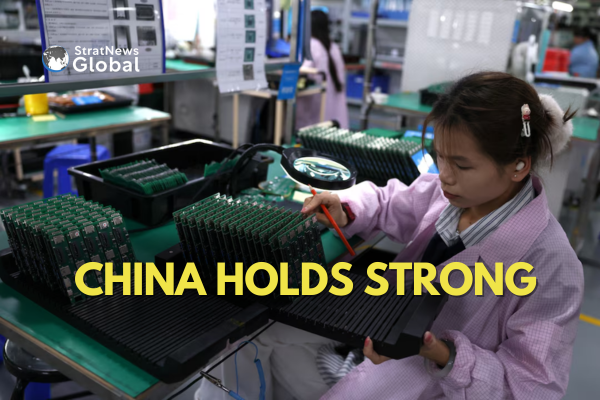
The second half of 2025 became Agilian’s busiest period ever. Production hours jumped 29 percent from the first half as orders resumed and clients regained enough confidence to commit to purchases. The company recovered, but the experience left scars and lessons. Diversification efforts continue in India and Malaysia, but Agilian’s Dongguan base remains indispensable. Chinese components cost less and maintain higher quality than alternatives elsewhere. The ecosystem built over decades—suppliers within driving distance, skilled workers, logistics infrastructure—can’t be replicated quickly regardless of political pressure.
Gaussorgues aims to grow revenue 30 percent over the next three years, though concerns about future tariff escalations never fully disappear. “I started in January saying, okay, this might be a good year and then the Iran war started,” he said, acknowledging how quickly geopolitical shocks can derail business planning.
The International Monetary Fund has warned repeatedly about the economic damage from prolonged trade conflicts, noting they disrupt investment and slow global growth. The World Trade Organization documented how tariffs triggered retaliatory measures that hurt consumers and businesses on both sides. Yet political logic often overrides economic rationality in trade policy.
Marro’s analysis points to the best-case scenario from Trump’s expected visit to China in May: continued dialogue. “The best we can hope for is probably a pledge for both sides to keep talking,” he said, setting expectations appropriately low. Nobody expects a comprehensive trade agreement or permanent resolution. The goal has shrunk to managing the conflict rather than ending it.
What Trump’s tariff offensive revealed isn’t Chinese weakness but American vulnerability. Decades of offshoring created dependencies that can’t be unwound with executive orders. China’s manufacturing ecosystem represents accumulated knowledge, infrastructure investment, and supplier networks built through patient industrial policy. Replacing it requires years of investment and coordination that market forces alone won’t provide.
For manufacturers like Agilian, Trump’s tariff policies now serve as a guide for handling future shocks rather than a reason to abandon China entirely. The company learned to maintain multiple production sites, manage client panic, and navigate sudden policy shifts. These skills matter more than any single market location because geopolitical turbulence appears permanent rather than temporary.
China’s manufacturing momentum continues despite the tariffs’ intended purpose. The sector adapted, found new markets, and proved more resilient than Washington anticipated. Whether that resilience ultimately benefits Chinese workers, constrains American foreign policy options, or simply reflects economic realities independent of political preferences remains an open question. What’s clear is that tariffs alone can’t reshape global manufacturing geography built over a generation.