I’m standing in a cramped processing facility near the Port of Long Beach watching pallets of smartphones clear customs without a single tariff stamp. A manager shrugs when I ask him about Liberation Day’s legacy. “We adapted,” he says, scrolling through exemption codes on a battered tablet. “The noise was louder than the actual disruption.”
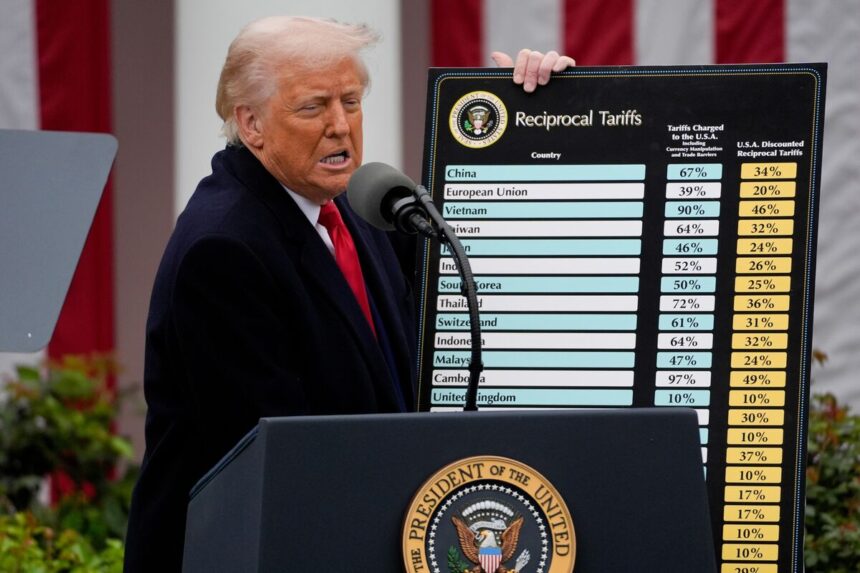
It’s been twelve months since Donald Trump strode into the Rose Garden and declared economic war on the global trading system. What he called Liberation Day—April 2nd of last year—was supposed to reshape how America does business with the world. The largest tariff wall in a century, he promised. Markets would bend. Factories would return. Jobs would flood back.
The reality turned out messier and far more negotiable than anyone expected.
By February, the Supreme Court had ruled Trump’s sweeping tariffs unconstitutional. A $170 billion refund process is grinding through federal bureaucracy. His approval numbers on trade policy now sit somewhere between his handling of the Iran war and last week’s taco shortage jokes on social media. Robert Armstrong at the Financial Times coined the phrase that won’t die: “Trump Always Chickens Out.” It started as market analysis and became a cultural meme.
Yet Trump and his trade team aren’t retreating. They’re rebuilding the tariff architecture piece by piece while Beijing sharpens its retaliation strategy. Mid-term elections loom in November. The global economy has absorbed the shock and moved on in ways Washington didn’t anticipate.
Most anniversary coverage this week will fall into predictable camps. Free-trade evangelists will declare vindication. Protectionists will claim moral victory despite setbacks. A third group will argue the world fundamentally changed and American influence collapsed forever. I’m not interested in any of those narratives. Instead, I want to offer two numbers that cut through the rhetoric and reveal what actually happened.
The first number is forty-three percent.
Nicole Gorton-Caratelli at Bloomberg Economics calculated that nearly half of all imports entering the United States remain untouched by Trump’s new tariffs. Based on 2024 trade values, roughly $1.4 trillion in goods flow across American borders without facing any of the duties imposed since his return to office. Smartphones, laptops, and semiconductor chips for data centers escaped the tariff hammer entirely. So did critical components for the artificial intelligence boom driving corporate investment.
Trump publicly denies granting tariff exclusions. Yet an entire exemption system was born the day he announced his trade war. As I’ve reported previously, that system overwhelmingly favors large corporations with lobbying muscle. Small importers get crushed while Fortune 500 companies navigate loopholes with help from well-connected consultants charging six-figure fees.
Understanding this exemption landscape explains why the economic impact wasn’t catastrophic. Imports represent about thirteen percent of U.S. GDP. When nearly half of those imports avoid tariffs altogether, the macroeconomic disruption gets contained. Consumer prices rose in specific categories but the predicted inflation spiral never materialized. Factory construction announcements made headlines but actual groundbreaking remained modest.
The second number is $288.4 billion.
That’s the foreign direct investment the United States attracted last year, according to Bureau of Economic Analysis data released last week. FDI measures long-term capital commitments—factories, infrastructure projects, research facilities—plus reinvested earnings from existing operations. It’s the clearest indicator of whether Trump’s tariff strategy is genuinely pulling manufacturing back to American soil.
The figure represents a modest decline from 2024 levels. It’s lower than every year during Joe Biden’s presidency. More striking, it’s down significantly from the $480 billion in FDI the United States attracted in 2016 when Trump first won the White House.
Jonathan Samford runs the Global Business Alliance representing foreign companies operating in America. He pointed me toward a crucial shift in FDI composition. In 2016, less than twenty percent came from reinvested earnings. Last year that figure hit seventy percent. Translation: existing investors stuck around and plowed profits back into their American operations. But new foreign investors largely stayed away.
“There’s a difference between commitment and confidence,” Samford told me over coffee near his Washington office. “Reinvestment shows companies aren’t abandoning assets. But new investment signals belief in future stability. We’re not seeing much of that belief.”
The White House counters with a list of $10.5 trillion in investment promises extracted from foreign governments and multinational corporations since Trump returned. Saudi Arabia pledged funds for energy projects. Taiwan’s semiconductor manufacturers announced expansion plans. European automakers discussed production facilities. Those commitments span multiple years and may eventually materialize in economic data.
But promises aren’t paychecks. Announcements aren’t factories. The gap between White House press releases and actual capital flows remains enormous.
I spent two days last month interviewing trade lawyers, corporate strategists, and supply chain managers trying to navigate this landscape. Every conversation revealed the same tension between public posturing and private adaptation. Companies learned to game exemption processes. Trade routes shifted to avoid tariff exposure. Lobbying expenditures surged as industries competed for favorable treatment.
A procurement director for a major electronics retailer described the situation as “managed chaos.” Her team maintains spreadsheets tracking hundreds of product codes, calculating which items face tariffs and which slip through exemptions. “We’ve essentially created a second procurement department just to handle tariff compliance,” she said. “That’s inefficiency priced into every product we sell.”
Meanwhile, the rest of the world recalibrated around American unpredictability. The European Union deepened trade relationships with Southeast Asian nations. China accelerated industrial policy supporting domestic consumption over export dependence. Regional trade blocs expanded without U.S. participation.
According to International Monetary Fund assessments, global trade volumes recovered faster than projected after Liberation Day. Supply chains demonstrated remarkable resilience. What Trump intended as economic leverage became a case study in how quickly markets route around obstacles.
None of this suggests tariffs had zero impact. Specific industries suffered genuine disruption. Steel and aluminum producers saw temporary benefits before facing retaliation. Agricultural exports to China collapsed under retaliatory duties. Small manufacturers without lobbying resources absorbed costs they couldn’t pass to customers.
But the apocalyptic predictions didn’t materialize. Neither did the promised renaissance of American manufacturing dominance. What emerged instead was a more complicated reality of partial implementation, strategic exemptions, and global adaptation.
As Liberation Day’s first anniversary passes, the tariff wall Trump envisioned looks more like Swiss cheese. Forty-three percent of imports untouched. Foreign investment declining despite rhetorical claims of success. A Supreme Court ruling that declared the entire framework unconstitutional. Refund checks slowly making their way to importers who paid duties the government had no legal authority to collect.
Trump’s trade team insists the strategy requires patience. Factories take years to build. Investment commitments need time to convert into employment. Retaliation from trading partners will eventually force negotiation. Perhaps they’re right. Economic transformations don’t align neatly with political calendars.
But one year in, the data tells a different story than the one sold in the Rose Garden. The global economy absorbed the shock, adapted its logistics, and kept moving. American leverage proved more limited than advertised. And the gap between tariff policy rhetoric and economic reality remains as wide as the Port of Long Beach where those smartphones still clear customs without paying a dime.