Toronto families are about to spend nearly $1,000 more on groceries this year than they did last. That’s not a rounding error—it’s rent money, daycare fees, or a couple of monthly transit passes disappearing into shopping carts.
Canada’s Food Price Report 2026 pegs the average family of four at $17,571 in annual grocery spending, a jump fueled by tariffs, supply chain snarls tied to Middle Eastern conflict, and the slow grind of inflation that refuses to quit. For a city already stretched thin by housing costs and stagnant wages, the question isn’t whether food is expensive. It’s how to eat without going broke.
The answer, for many Torontonians, lies in a scattered network of discount grocers, ethnic markets, and surplus outlets that operate outside the polished aisles of the big chains. These spots don’t advertise during prime time or sponsor hockey arenas. But they move volume, sell imperfect produce, and cater to communities that have always known how to stretch a dollar. Here’s where to find them.
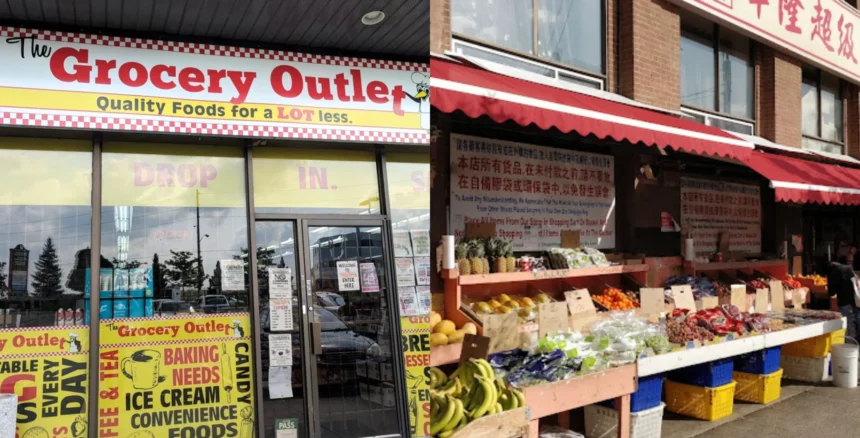
Kai Wei Supermarket sits on Spadina Avenue in the heart of Chinatown, where foot traffic is constant and turnover is fast. This is not a store designed for leisurely browsing. It’s a place where yellow onions, green onions, strawberries, and blueberries can leave the till for six dollars total, according to social media posts that have turned the shop into something of an open secret. Fresh meat and seafood move quickly here, and the shelves stock imported teas, sauces, and condiments that are hard to source elsewhere. The model is simple: high volume, low margin, and a customer base that knows value when they see it.
The Grocery Outlet operates on a different premise. With a North York location on Sheppard Avenue West and others scattered across Southern Ontario, the chain functions as a clearinghouse for overstock, close-dated, and rebranded goods. Discounts range from 30 to 70 percent off suggested retail, and inventory turns over daily. What arrives Monday may be gone by Wednesday. It’s a model that rewards flexibility—shoppers who can adjust meal plans on the fly do well here. Frozen proteins, shelf-stable staples, and refrigerated items all cycle through, and the lack of predictability is part of the value proposition.
Economy Fruit in Bloorcourt Village has carved out a niche by selling only produce, and only the kind that large retailers reject. Misshapen tomatoes, bruised apples, and oddly sized peppers end up here instead of in dumpsters. The pricing reflects that reality: five clementines for a dollar, a bag of tomatoes for $1.49. For households cooking from scratch, where appearance matters less than flavor and nutrient density, this is where the math starts to work. The store doesn’t carry packaged goods or processed food. It’s produce or nothing, and that focus keeps overhead low and prices lower.
Lucky Moose Food Mart on Dundas Street West near the Art Gallery of Ontario serves Chinatown’s core with a mix of everyday staples and imported specialty items. Google reviews consistently mention affordable produce and discounted meat, though the real draw is the selection of Asian pantry goods that larger chains either ignore or price at a premium. For immigrants and first-generation families cooking traditional meals, access to ingredients at reasonable prices isn’t a luxury—it’s a baseline need. Lucky Moose fills that gap without the markup.
Raise the Root in Leslieville has taken a more confrontational approach. The organic market posts side-by-side price comparisons with Loblaws, often showing savings of 50 percent or more on identical items. March deals include limes at $3.99 per pound, onions at $2.99, and two pounds of carrots for $3.49. The store updates its Instagram monthly with promotions, leaning into transparency as a competitive edge. It’s a strategy that resonates in a city increasingly skeptical of grocery oligopolies and their explanations for rising prices. Raise the Root isn’t just undercutting—it’s making a point.
Odd Bunch doesn’t have a storefront. It’s a subscription service that rescues cosmetically imperfect produce and boxes it for delivery. Small boxes start at $28, or $20 with a promotional code, and typically include apples, mandarins, cucumbers, and seasonal additions like melons in warmer months. The model addresses two inefficiencies: food waste at the farm level and price sensitivity at the consumer level. For households with predictable produce consumption, it’s a way to lock in savings without driving across the city.
The common thread across these outlets isn’t just price. It’s a willingness to operate outside the conventions of mainstream retail. They don’t rely on national ad campaigns or loyalty points programs. They move product fast, accept slimmer margins, and serve neighborhoods where cost consciousness isn’t a trend—it’s a fact of life.
The broader economic forces driving grocery inflation aren’t going away soon. Tariffs add friction to cross-border supply chains. Geopolitical instability disrupts shipping routes and commodity prices. Climate shocks hit crop yields unpredictably. And in Canada, where three companies control roughly 80 percent of the grocery market, competitive pressure remains muted. That concentration gives retailers pricing power and limits downward pressure on margins.
For individual households, the response is tactical. Buying misshapen produce, shopping ethnic markets, chasing daily deals at clearance outlets—these aren’t solutions to systemic problems. They’re adaptations. But in a city where the average family is spending nearly $18,000 a year on food, those adaptations add up. A few dollars saved per trip becomes hundreds over a year, and hundreds can mean breathing room.
Toronto’s discount grocery landscape is fragmented and uneven, but it’s also resilient. These stores exist because demand exists, and demand exists because mainstream pricing has left a gap. Whether that gap widens or narrows in the coming years will depend on forces far beyond any single shopper’s control. In the meantime, the till keeps ringing, and the search for value continues.