The chaos unfolding across America’s tire industry isn’t rooted in sound trade policy or economic strategy. It’s the byproduct of impulsive governance, where tariffs arrive without warning, bypass established legal frameworks, and land hardest on the people they were ostensibly designed to protect. President Donald Trump’s use of executive authority to impose sweeping import duties has created a ripple effect that’s squeezing farmers, independent dealers, and working-class consumers who were already operating on the thinnest of margins. Meanwhile, tire imports to the United States surged across nearly every category in 2024, raising an uncomfortable question: what exactly did these tariffs accomplish?
The confusion begins with process, or the lack of it. Traditionally, new tariffs follow a clearly defined path through the U.S. Department of Commerce. Petitions are filed, evidence is gathered, hearings are held, and only after months or even years of review do duties take effect. During Trump’s first term, antidumping tariffs on tires from several Southeast Asian nations followed this playbook. The United Steelworkers filed a petition, the Commerce Department investigated, and two years later, targeted duties were imposed based on verifiable dumping practices. That’s how the system is supposed to work: deliberate, transparent, and grounded in evidence.
But in 2024, Trump invoked the International Emergency Economic Powers Act of 1977, a statute designed for genuine national security crises, to unilaterally impose tariffs on tire imports. The move bypassed Congress, sidestepped the Commerce Department’s investigative machinery, and left importers scrambling to calculate costs on shipments already en route to U.S. ports. The unpredictability has been devastating. One day a container of tires is priced at one rate; by the time it clears customs, the duty structure has changed. Wholesalers, distributors, and independent tire dealers have been forced to absorb costs they never budgeted for, passing portions along the chain until the burden finally lands on the consumer.
Yokohama Tire Corp., in a statement to Tire Business, described the situation bluntly. The company cited “a significant amount of unbudgeted cost thrust upon our business in 2025” and noted the market volatility caused by the “on-again, off-again nature of the implementation period.” Those waves, as Yokohama put it, are still being navigated by all manufacturers. The uncertainty isn’t just a logistical headache. It’s a structural threat to businesses that depend on predictable pricing and stable supply chains.
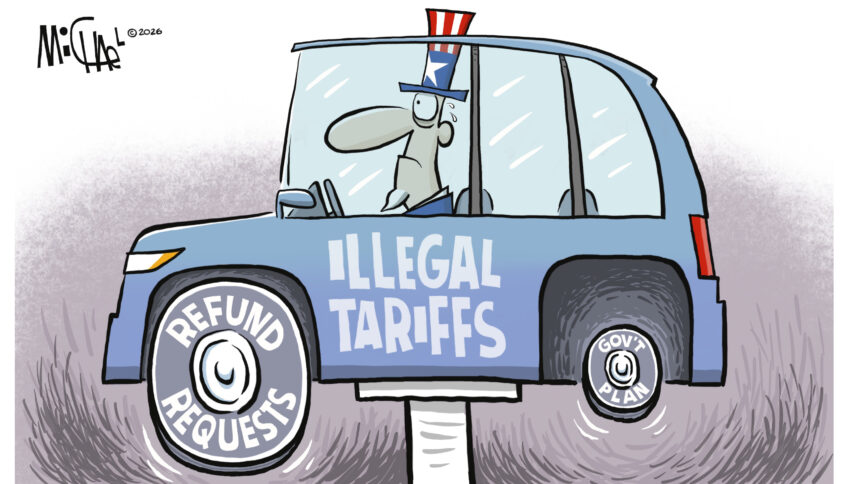
Then came the legal reckoning. On February 20, the Supreme Court ruled that Trump lacked the authority to levy those tariffs under the IEEPA. The statute, the justices found, was never intended to be wielded as a blanket trade enforcement tool. Days later, the U.S. Court of International Trade ordered that companies who paid the disputed duties be refunded, with interest. At least 15 lawsuits have been filed by tire makers and distributors seeking to reclaim what they now argue were illegal payments. The government, in effect, collected revenue it had no legal right to take.
Trump’s response was swift and predictable. He immediately imposed a new global tariff of 10 percent, this time invoking Section 122 of the Trade Act. The new duties hit tire exports from Brazil, India, China, Thailand, Vietnam, Cambodia, Indonesia, Japan, South Korea, Malaysia, the European Union, and Serbia. For some countries, the new rate was lower than what they faced under the IEEPA tariffs. For others, it represented yet another cost increase. Either way, the whiplash continued.
The specialty tire sector, which includes agriculture, construction, and mining tires, felt the brunt of the original tariffs. These segments rely almost entirely on imports because domestic production capacity is minimal to nonexistent. Yet despite the tariffs, specialty tire imports increased sharply in 2024. According to U.S. Department of Commerce data, specialty tire imports were valued at $2.6 billion, up 2 percent from the prior year. Shipments climbed 12 percent to 48.5 million units. The data suggests that tariffs didn’t curb demand or shift production onshore. They simply raised costs and created market distortions.
Paul Reitz, president and CEO of Titan International Inc., offered a candid assessment during a February 26 investor call. He noted that the off-road tire market was flooded early in 2024 as importers rushed to beat the tariffs. Competitors absorbed much of the added cost to maintain market share, undercutting domestic manufacturers who had hoped the tariffs would level the playing field. “In essence,” Reitz said, “the potential positive impact from the administration’s policies was neutralized in our sector during the past year.”
For American farmers, the situation is particularly grim. Agriculture has been in a prolonged economic slump, with commodity prices stagnant and input costs rising. Many farmers are deferring equipment purchases because they can’t afford to take on new debt. When they do buy replacement tires, price has become the overriding concern, often at the expense of quality or longevity. This dynamic favors cheap imports, even with tariffs factored in, and puts further pressure on domestic suppliers and independent dealers who can’t compete on price alone.
Kathy McCarron, a senior reporter covering the specialty tire market, found that farmers feel “squeezed” and are increasingly reliant on tire dealers to help them navigate cost pressures in 2026. The construction sector, while expected to grow modestly, faces its own challenges from rising material costs and persistent labor shortages. In the mining segment, energy demand is driving growth, but the same tariff uncertainty that plagues agriculture and construction applies here as well.
The broader irony is hard to miss. Tariffs were supposed to protect American workers and penalize foreign competitors who engage in unfair trade practices. Instead, they’ve created a system where everyone along the supply chain absorbs a piece of the pain. Manufacturers, wholesalers, dealers, and end users all pay a little more, while the intended targets, foreign exporters, adjust their pricing and continue shipping. The policy hasn’t reshaped global trade patterns. It’s simply made doing business in the United States more expensive and unpredictable.
There’s also the matter of legitimacy. When the Supreme Court declares that a president overstepped his authority and orders refunds, it’s not a minor procedural footnote. It’s a constitutional check on executive power. The fact that companies are now suing to reclaim tariff payments they never legally owed raises questions about governance and accountability. Who benefits when policy is made by decree rather than deliberation?
The tire industry’s experience under these tariffs offers a case study in what happens when trade policy is driven by impulse rather than strategy. The absence of a clear rationale, the disregard for established procedures, and the legal overreach have all combined to produce a policy that misses its mark. Farmers struggle, dealers absorb costs, imports continue to rise, and domestic manufacturers find their competitive advantage neutralized by market flooding and price absorption.
If the goal was to strengthen American manufacturing and protect workers, the evidence suggests the opposite has occurred. If the goal was to reduce reliance on foreign tire imports, the data contradicts it. What remains is a policy framework that generates headlines but fails to deliver tangible benefits to the people it claims to serve. The tire industry, caught in the crossfire, is left navigating a landscape where the rules change without notice and the rationale remains elusive. That’s not strategy. That’s chaos dressed up as leadership.