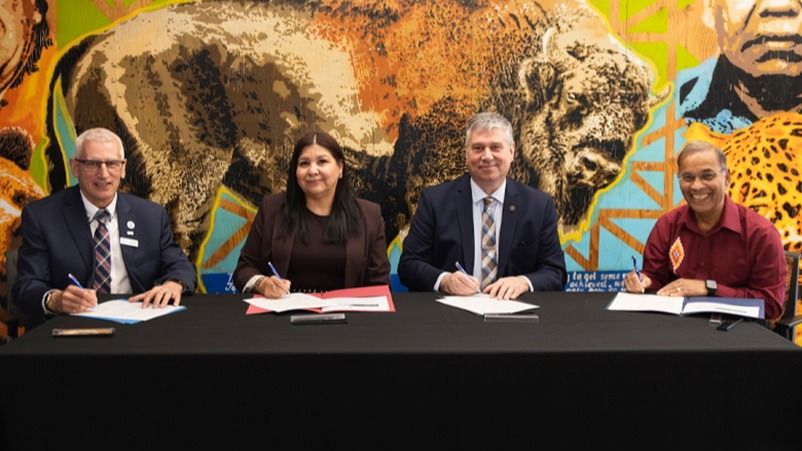
Four post-secondary institutions in southern Alberta have signed a formal agreement that could reshape how students access education across the region. The partnership brings Red Crow Community College, Lethbridge Polytechnic, Medicine Hat College, and the University of Lethbridge into a coordinated system designed to improve student pathways, boost research capacity, and strengthen regional ties.
The Southern Alberta Higher Education Relationship launched with a Blackfoot name—Innakotsiiysinni—which translates to “respect for others.” That choice signals something more than administrative efficiency. It reflects a commitment to reconciliation and Indigenous-led education, priorities that leaders say will guide decision-making as the partnership takes shape.
Dr. Paula Burns, president of the University of Lethbridge, described the agreement as a significant step forward. She noted that collaboration among institutions isn’t new, but formalizing it creates accountability and momentum. Burns said the goal is to build a system where students can move between schools without losing credits or time.
Red Crow Community College president Shawna Big Plume emphasized the importance of the Blackfoot name. She said it reflects the college’s values and the cultural foundation that should anchor education in Treaty 7 territory. Big Plume added that Indigenous students often face barriers when navigating multiple institutions, and this partnership could help remove some of those obstacles.
The agreement establishes regular meetings among institutional leaders. Officials say these sessions will focus on shared priorities rather than symbolic gestures. Transparency and inclusivity are listed as core principles, though the real test will come when decisions about resources and programs need to be made.
One of the partnership’s main goals is improving academic pathways. Students often struggle when transferring between schools. Credits don’t always align, prerequisites differ, and navigating bureaucracy can be frustrating. The four institutions plan to streamline those processes and create clearer routes from diploma programs to degrees.
Joint programming is also on the table. Officials say they want to develop programs that respond to regional needs, particularly in sectors like health care, technology, and skilled trades. Southern Alberta has experienced economic shifts over the past decade, and post-secondary schools are under pressure to train graduates who can adapt.
Research collaboration is another priority. Smaller institutions often lack the infrastructure or funding to compete for major grants. By pooling resources and expertise, the four schools hope to increase their collective research output. That could mean shared lab spaces, joint grant applications, or collaborative projects that wouldn’t be possible independently.
Medicine Hat College president Kevin Shufflebotham said the partnership allows institutions to leverage each other’s strengths. He pointed out that smaller colleges have deep community connections, while larger universities bring specialized faculty and research facilities. Combining those assets could benefit everyone involved.
Student support services are also part of the plan. Mental health resources, academic advising, and career counseling vary widely across campuses. The partnership aims to standardize some services and share best practices. Officials say students should have access to similar supports regardless of which institution they attend.
Regional stewardship is the fourth pillar of the agreement. That means the institutions will work together to understand what learners across southern Alberta need. It also involves sharing data and coordinating outreach efforts. The goal is to avoid duplication and ensure that programs reflect actual demand.
Lethbridge Polytechnic president Paula MacKinnon said the partnership isn’t about competing for students. She described it as a recognition that institutions serve the same communities and should act like it. MacKinnon added that the polytechnic model emphasizes hands-on learning, which complements the university’s academic focus.
The partnership comes at a time when post-secondary funding in Alberta remains tight. Provincial budgets have put pressure on institutions to find efficiencies. Some observers see this agreement as a strategic response to financial constraints. By working together, schools might reduce costs and make a stronger case for public investment.
Critics will likely watch how the partnership handles resource allocation. Collaboration sounds appealing, but institutions still compete for students, faculty, and funding. Balancing cooperation with self-interest won’t be easy. Leaders will need to demonstrate that the agreement produces tangible benefits, not just public relations value.
Indigenous education is woven throughout the partnership’s stated priorities. Red Crow Community College operates with a mandate rooted in Blackfoot culture and language. Including that institution as an equal partner sends a message about the direction these schools want to move. But symbolic gestures won’t satisfy anyone if systemic barriers remain in place.
The partnership also raises questions about accountability. Who decides which programs get developed? How will conflicts over resources be resolved? The agreement outlines principles, but implementation will require clear governance structures. Students and faculty will be watching to see if the collaboration delivers real change or becomes another layer of bureaucracy.
Southern Alberta’s post-secondary landscape has long been fragmented. Students in smaller communities often face limited options. Those who want specialized programs usually have to leave the region. This partnership could change that by creating a more integrated system where institutions complement each other rather than operate in isolation.
The success of this agreement will depend on follow-through. Formal partnerships can falter when priorities shift or budgets tighten. Leaders will need to maintain momentum and demonstrate measurable progress. That means tracking student outcomes, monitoring program development, and regularly reporting back to the public.
For students, the partnership offers potential benefits. Smoother transfers could save time and money. New joint programs might open doors that didn’t exist before. Improved support services could make the difference between graduating and dropping out. But those outcomes aren’t guaranteed. They’ll require sustained effort and genuine collaboration.
The four institutions serve a region with distinct economic and cultural characteristics. Southern Alberta’s identity is tied to agriculture, energy, and Indigenous communities. Post-secondary schools that reflect those realities and prepare students for regional opportunities will be more relevant than those that don’t.
This partnership represents a bet that collaboration beats competition. It assumes that institutions can achieve more together than they could separately. Time will tell if that assumption holds. The agreement creates a framework, but the real work starts now.