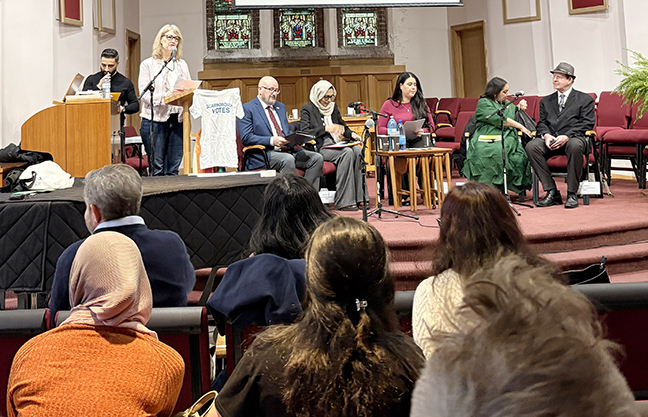
The chairs at Birchcliff Bluffs United Church were mostly full last Thursday evening. Residents came with questions about rent, grocery bills, and whether anyone running actually had answers. The federal byelection in Scarborough Southwest is less than two weeks out, and the candidates who showed up had to deliver more than talking points.
Five of the eight candidates attended. Doly Begum carried the Liberal banner. Pooja Malhotra spoke for the Greens. Fatima Shaban represented the NDP under new leader Avi Lewis. Lyall Sanders came from the Centrist Party, and David Vedova from Christian Heritage. The Conservative candidate Diana Filipova didn’t attend. Neither did Peter Koubakis of the People’s Party or Independent April Francisco.
Reza Khoshdel moderated the debate. He runs Centre 55 and laid out the format early. Parties without seats in the House of Commons would get opening and closing statements but no time during the rapid-fire portion. That left Begum, Malhotra, and Shaban to field questions from a crowd organized by the Daily Bread Food Bank, Bluffs Food Bank, Scarborough United Neighborhoods, and the South Asian Women’s Rights Organization.
The first question hit hard. How do you plan to address food insecurity when families are choosing between rent and eating?
Shaban didn’t hesitate. She said the NDP wants to break ties with corporate grocery chains and work directly with Canadian farmers. The idea is simple: cut out the middleman and get cheaper food into government-run distribution systems. She called it a necessary shift after years of watching profits climb while people skip meals.
She also tied food costs to wages and housing. Raising the minimum wage means more money left after paying rent. Building affordable housing means fewer people stretched so thin they can’t afford groceries. It’s a policy loop the NDP has been pushing in Parliament, even from the opposition benches.
Shaban pointed to wins her party claims credit for. Pharmacare. Dental care. Affordable childcare. All came after NDP pressure on the Liberals, she said. Now the push is for better transit, youth support, and stronger accountability from whoever forms government.
Malhotra took a different route. She talked about waste. The Green Party wants zero-waste legislation that forces grocery stores to donate unsold food instead of tossing it. She framed it as both an environmental and economic issue. Food that ends up in landfills could feed families instead.
She also called for higher taxes on the wealthy. Malhotra argued that corporations and high earners profit off everyday people without paying enough back. The gap between rich and poor is widening, and she said tax policy needs to correct that imbalance.
Her housing pitch centered on local definitions of affordability. The median income in Scarborough Southwest is around $37,500 per year. The average sits closer to $48,000. Malhotra said affordable housing can’t be defined nationally when costs vary so much by riding. Contracts and funding need to reflect what people in specific communities actually earn.
She also backed a guaranteed livable income. The policy has been debated in progressive circles for years, but Malhotra said the cost of living crisis makes it urgent now.
Begum defended the Liberal record and outlined what Prime Minister Mark Carney’s government is doing. She mentioned $20 million in new funding for local food infrastructure. The money is meant to help food banks and community groups get nutritious food to families faster.
On housing, she pointed to the Build Canada Homes Plan. It’s a $13 billion commitment aimed at speeding up construction. Begum said the funding is designed to cut red tape and get more units built in ridings like Scarborough Southwest where demand far outpaces supply.
She also highlighted middle-class tax cuts. The Liberal platform leans on targeted relief rather than broad structural change. Begum’s pitch was pragmatic: incremental improvements that help families now while longer-term housing projects ramp up.
Sanders spoke briefly. He’s with the Centrist Party and shared his own experience with homelessness twelve years ago. He said that time taught him what it means to have stable housing. His message was collaborative: better solutions come from working together across party lines.
He stressed transit and housing as top concerns for Scarborough Southwest residents. The riding has long dealt with unreliable transit and rising rent. Sanders said his party wants practical fixes, not ideological battles.
Vedova outlined Christian Heritage priorities. He promised to cut taxes and eliminate red tape around housing. His party also wants to ban foreign ownership of homes, farms, and critical businesses. Immigration policy came up too. Vedova said reducing demand through what he called responsible immigration would help ease housing pressure.
He also committed to mandatory balanced budgets for hospitals, schools, and transit systems. It’s a fiscal conservatism pitch aimed at voters worried about debt and government spending.
The debate format didn’t allow for deep dives. Answers were short. Follow-up questions were rare. But the issues on the table reflect what’s happening across the country. Food costs are climbing. Housing is unaffordable. Wages aren’t keeping pace.
Scarborough Southwest has been a political bellwether before. The riding flipped between parties in recent elections. It’s diverse, working-class, and feels the squeeze of inflation more than wealthier parts of the city. Whoever wins here will carry a mandate shaped by kitchen table economics.
Begum’s jump from provincial NDP to federal Liberal raised eyebrows when it was announced. She represented the riding at Queen’s Park since 2018. Now she’s asking voters to trust her in a different party under a different leader. That’s a tough sell in a riding where party loyalty runs deep.
Shaban has to convince voters that the NDP can deliver more than pressure. The party has influenced policy from opposition, but governing is different. Lewis’s leadership is still new, and voters are still sizing up whether he can turn momentum into seats.
Malhotra faces the Green Party’s perennial challenge: strong ideas, limited infrastructure. The party has never held serious sway in Scarborough. She’s pitching policy, not power, and hoping it resonates with voters frustrated by the status quo.
The candidates who skipped the debate made a choice. Maybe they calculated that the format or the crowd wouldn’t help them. Maybe other events took priority. Either way, their absence was noted.
Polls suggest a tight race. No one has a clear advantage. The byelection is April 13, and turnout will likely decide it. Scarborough Southwest voters have heard the promises before. Now they’re weighing who can actually deliver.