A special council meeting in Sarnia this week puts one councillor’s social media conduct under the spotlight after remarks about Indigenous artwork sparked outrage across the southwestern Ontario community.
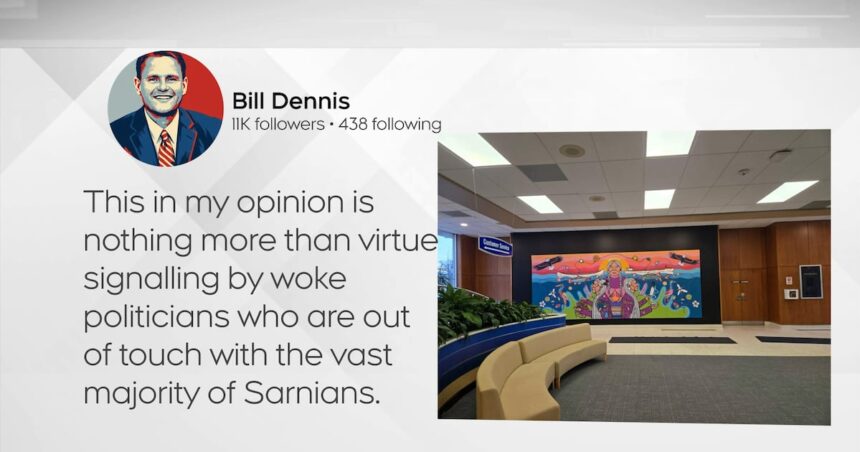
Bill Dennis, a longtime Sarnia city councillor known for stirring local debate, is now facing formal consequences after he called a new Indigenous mural at city hall “virtue signaling by woke politicians.” The $12,500 artwork was unveiled last week to mixed public reaction, but Dennis’s online commentary ignited something far beyond typical civic disagreement.
The mural itself has drawn praise from residents like Linda, who visited city hall specifically to see it. She called it beautiful. The commission and installation were funded through taxpayer dollars, a detail Dennis highlighted in his criticism. His Facebook post didn’t just question the spending. It framed the decision as disconnected from what he described as the majority of Sarnians.
That language set off a wave of responses from Indigenous leaders and community advocates. Amjiwinaang First Nation Chief Janelle Nahmabin addressed Dennis directly on social media, writing that “the race division you continuously perpetuate resolves nothing.” She declined a formal interview, citing scheduling conflicts, but her public statement reflected frustration shared by others in the region.
Dennis, reached while vacationing in Florida, doubled down. He told reporters he’s not backing away from his position. He characterized Sarnia’s current council as the most left-leaning in the city’s history and described himself as its most conservative member. That clash, he said, has left him isolated. He claimed it’s been eight against one for nearly four years.
His defense centered on free expression. Dennis argued that as an elected official, he should be able to speak his mind, critique art, and voice opinions without repercussion. He insisted he’s not a racist and framed the backlash as an attack on his right to dissent.
Mayor Mike Bradley sees it differently. He confirmed that five council members petitioned for Tuesday’s special meeting to formally address Dennis’s comments. Bradley described those remarks as “very distasteful” and said they were unacceptable regardless of format. Whether posted online or spoken in chambers, the mayor argued, there are standards elected officials must meet.
The timing matters. Sarnia has been working to strengthen relationships with neighboring First Nations communities. Those efforts involve policy coordination, shared infrastructure planning, and cultural recognition. A mural is part of that broader reconciliation work. Dennis’s comments, in Bradley’s view, undercut progress the city has made.
The consequences Dennis could face range from public reprimand to a formal integrity commissioner investigation. There’s also the possibility of a human rights complaint filed outside the council process. Bradley indicated the meeting would be difficult but necessary. He expects council to send a strong message.
Dennis announced he won’t attend. That absence may intensify the political fallout rather than diffuse it. Constituents and political observers in Sarnia are watching to see whether council takes symbolic action or pursues enforceable penalties.
This isn’t Dennis’s first brush with controversy. He’s built a reputation as a contrarian voice on council, often opposing spending initiatives and questioning progressive policy shifts. His supporters see him as a taxpayer advocate willing to challenge groupthink. His critics view him as dismissive of marginalized voices and resistant to meaningful inclusion.
The mural controversy sits at the intersection of municipal spending, free speech, and reconciliation politics. It’s a flashpoint that reveals deeper tensions in communities across Canada. What counts as legitimate political criticism? When does rhetoric cross into harm? And what accountability should elected officials face for public statements?
Linda, the resident who admired the mural, expressed disappointment that the situation escalated this far. She emphasized that public spaces should welcome everyone without prejudice. Her comment reflects a broader expectation many Canadians hold: that civic life should be inclusive, even when opinions differ.
Sarnia’s experience mirrors debates playing out in municipalities from coast to coast. Indigenous art installations, land acknowledgments, and reconciliation initiatives often spark pushback. Some of that resistance stems from genuine budget concerns or disagreement over priorities. Other opposition reflects discomfort with cultural change and power-sharing.
Dennis’s framing of the issue as “woke” politics dismisses the historical context behind reconciliation efforts. For many Indigenous communities, public recognition and cultural visibility are part of addressing decades of marginalization and erasure. A mural isn’t just decoration. It’s a statement about whose stories get told in shared civic spaces.
The financial cost Dennis cited—$12,500—is modest in municipal budget terms. Sarnia’s annual operating budget runs into tens of millions. The mural expenditure represents a fraction of one percent. But the symbolic weight carries far more significance than the dollar figure.
Tuesday’s meeting will test Sarnia council’s willingness to enforce norms around respectful dialogue. If council issues a mild statement and moves on, Dennis may interpret that as vindication. If they pursue formal sanctions, it could set a precedent for how municipalities handle elected officials who breach community standards.
The broader question remains unresolved. Elected officials do have speech protections, but those rights aren’t absolute. Codes of conduct exist in most municipalities. They outline expectations for how councillors engage with constituents and colleagues. Violations can trigger investigations and penalties, though enforcement varies widely.
Dennis’s insistence that he should be able to “say what I want” overlooks the distinction between legal rights and professional responsibilities. He can’t be jailed for his comments. But he can face political and reputational consequences within the institution he serves.
Sarnia voters will ultimately decide Dennis’s fate at the ballot box. Until then, Tuesday’s council meeting offers a preview of how local democracy handles internal conflict when words wound and leaders disagree on what respect requires.