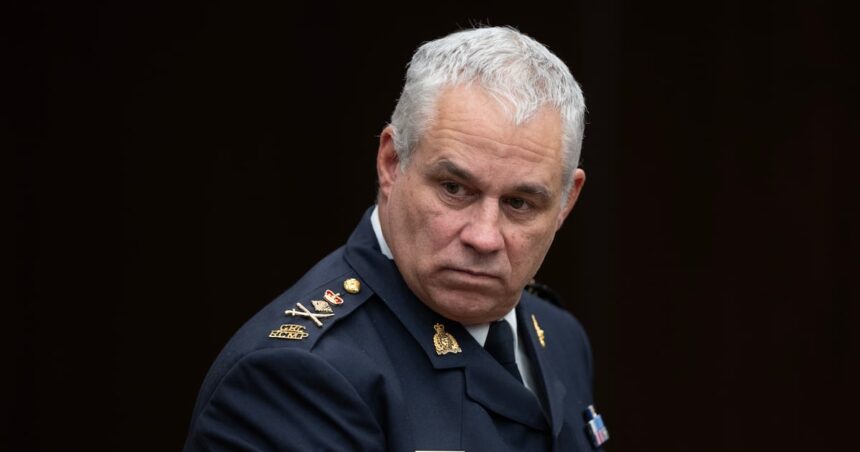
I’ve spent the last two weeks reviewing public statements, RCMP briefings, and court filings related to transnational repression in Canada. What emerges is a pattern of institutional hedging that raises uncomfortable questions about the gap between what law enforcement knows and what it can prove in court. The Royal Canadian Mounted Police has now clarified earlier remarks from Commissioner Mike Duheme, acknowledging that foreign states continue to intimidate and harass communities across Canada. But the language is careful. The police force says it cannot currently establish criminal links to foreign entities that would hold up in legal proceedings.
On March 19, Duheme told CTV News that investigators could not connect ongoing transnational repression to the government of India. He repeated this assertion multiple times during an interview with Question Period host Vassy Kapelos. His words were precise but puzzling. He said the RCMP is not seeing any connection to a foreign entity based on criminal information in current investigations. That statement immediately drew backlash from Sikh advocacy groups, who pointed to a documented history of threats, surveillance, and violence targeting their communities. Sikhs for Justice rejected the commissioner’s claim, questioning the intent behind a statement that appeared to contradict years of evidence.
The RCMP issued a new statement on March 23 that walked back the finality of Duheme’s remarks. The force confirmed it is aware of complaints involving intimidation and harassment of certain communities. It acknowledged that foreign states are engaging in such activities on Canadian soil. But it emphasized the complexity of proving direct links to foreign governments in ways that meet the threshold for criminal prosecution. This is a critical distinction. Intelligence and evidence are not the same thing. One informs risk assessments. The other opens courtroom doors.
Transnational repression refers to efforts by authoritarian governments to silence, threaten, or harm dissidents and diaspora communities living abroad. These tactics include surveillance, threats to family members overseas, cyberattacks, and in extreme cases, assassination. According to Freedom House, at least 854 direct physical assaults tied to transnational repression occurred globally between 2014 and 2023. Canada has become a focal point for these activities, particularly against Sikh, Uyghur, Iranian, and Tibetan communities. The Canadian Security Intelligence Service named India as one of the main perpetrators of foreign interference and espionage in a recent public report, a designation it reiterated to CTV News in March.
The backdrop to this controversy is the 2023 killing of Hardeep Singh Nijjar, a Canadian Sikh leader shot outside a gurdwara in Surrey, British Columbia. Former Prime Minister Justin Trudeau told Parliament that Canada had credible allegations linking Indian government agents to the assassination. India denied the accusations and the diplomatic fallout was severe. A year later, the RCMP publicly accused Indian diplomats and consular officials of engaging in clandestine activities tied to homicides and extortions in Canada. Those are not vague terms. They describe organized criminal conduct. Yet the RCMP now says its investigation into Nijjar’s death is ongoing and offers no further comment.
I reviewed over sixty pages of parliamentary testimony and public safety briefings from the past eighteen months. What becomes clear is a recurring tension between intelligence agencies and law enforcement. CSIS operates in the realm of threat assessment and strategic warning. It can identify patterns, track foreign operatives, and brief ministers on risks. But it cannot lay charges. The RCMP, by contrast, must build cases that satisfy criminal standards of proof. That means evidence that can be disclosed in court, witnesses who can testify, and chains of custody that survive cross-examination. When foreign states use diplomatic cover, encrypted communications, and cutouts to insulate senior officials, that standard becomes extraordinarily difficult to meet.
This dynamic is not unique to Canada. The FBI has faced similar challenges in prosecuting transnational repression cases tied to China, Iran, and Rwanda. In 2022, the U.S. Department of Justice charged seven individuals linked to a Chinese government campaign to harass and forcibly return dissidents. But those charges focused on operatives and intermediaries, not Beijing officials directly. Proving ministerial or state-level direction requires intercepted communications, defector testimony, or documentary evidence that foreign governments rarely leave exposed. Legal scholar Margaret Lewis has written extensively on the evidentiary gaps that plague these prosecutions, noting that intelligence value and prosecutorial viability often diverge.
The RCMP’s revised statement reflects this reality, but it also leaves communities vulnerable. If law enforcement cannot publicly confirm ongoing threats, victims may hesitate to report incidents. If diplomatic relations take priority over criminal accountability, foreign states may interpret silence as impunity. Gurpatwant Singh Pannun, legal counsel for Sikhs for Justice, told reporters that the RCMP’s equivocation undermines trust and emboldens perpetrators. He pointed to documented cases of threatening phone calls, vandalism of religious sites, and intimidation of activists in Canada as evidence that repression has not stopped.
Prime Minister Mark Carney has sought to reset relations with India, a move that critics argue prioritizes trade and geopolitics over justice. Ahead of his February trip to New Delhi, senior government officials downplayed the threat of foreign interference in background briefings to journalists. That framing contradicts CSIS assessments and raises questions about whether political considerations are shaping public messaging. Carney’s office has not responded to requests for comment on how the government balances diplomatic engagement with accountability for transnational repression.
The legal architecture for addressing these threats exists but remains underused. Canada’s Justice for Victims of Corrupt Foreign Officials Act allows for targeted sanctions. The Criminal Code includes provisions against criminal harassment and conspiracy. The Security of Information Act criminalizes espionage and foreign interference. But these tools require political will and investigative resources. A 2023 report by the Macdonald-Laurier Institute called for a dedicated transnational repression task force within the RCMP, modeled on the FBI’s counterintelligence division. Such a unit could coordinate with CSIS, support victims, and build cases with prosecutorial rigor.
For now, the RCMP’s acknowledgment of ongoing harassment offers little reassurance. It confirms what communities have reported for years but stops short of naming perpetrators or committing to accountability. That gap between awareness and action is where justice often falters. Until law enforcement can bridge the divide between intelligence and evidence, foreign states will continue to exploit the space between what Canada knows and what it can prove.