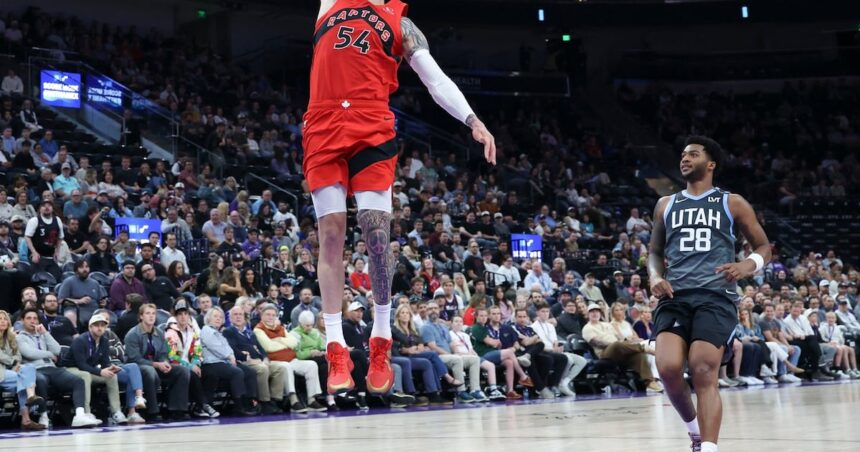
The Scotiabank Arena faithful might have been hundreds of miles away, but RJ Barrett made sure Toronto’s playoff push echoed loud and clear in Salt Lake City. His 27-point performance anchored a 143-127 Raptors victory that keeps their postseason hopes firmly intact.
Barrett wasn’t alone in dismantling a struggling Jazz squad. Sandro Mamukelashvili chipped in 23 points while Ja’Kobe Walter and Scottie Barnes each exceeded 20. The win stopped a brief two-game slide and kept Toronto clinging to that coveted fifth spot in the Eastern Conference standings.
Fifth place matters more than casual fans might realize. The top six teams bypass the play-in tournament entirely, earning a direct ticket to the playoffs. Toronto sits just half a game ahead of Atlanta for that security. Every win from here forward carries weight beyond the box score.
Utah entered the night already eliminated from playoff contention at 21-51. Their season has unraveled over recent weeks, losing six of seven games. Rookie Ace Bailey showed flashes of future promise with 37 points, but individual brilliance couldn’t patch the defensive holes that Toronto exploited relentlessly.
The third quarter told the entire story. Toronto outscored Utah 49-30 during those twelve minutes, building a cushion that reached 29 points. When a team shoots 54 percent from beyond the arc and 61 percent overall, defensive adjustments become academic exercises.
Walter’s efficiency deserves special mention. He connected on six of eight three-point attempts and finished seven of ten from the floor. Those aren’t flukes or hot streaks—that’s surgical precision when defenses collapse on primary scorers like Barrett and Barnes.
Barrett himself went ten for fifteen from the field, including four of five from deep. He distributed six assists without a single turnover in just 25 minutes of work. That kind of floor management reflects a maturing player who understands when to attack and when to facilitate.
Jamal Shead orchestrated the offense with 15 assists alongside his seven points. The ball movement Toronto displayed wasn’t accidental. It stemmed from deliberate reads and quick decisions that kept Utah’s defense perpetually off-balance.
The bench contributed meaningfully too. Jamison Battle scored 17 points while Gradey Dick added 13. Depth matters during playoff races when starters need rest and rotations tighten. Toronto’s second unit proved capable of maintaining pressure rather than surrendering leads.
One subplot carried particular intrigue. Markelle Fultz, the 2017 draft’s top overall pick, played his first NBA game this season after signing a 10-day contract earlier that day. He logged 16 minutes off the bench, finishing with two points on one of five shooting alongside five assists and three turnovers.
Fultz’s journey has been unconventional. Once considered a franchise cornerstone, injuries and performance inconsistencies derailed his trajectory. He’d been playing for Toronto’s G League affiliate before getting the call. His rust showed in the shooting percentages, but the five assists suggested his court vision remains intact.
Teams don’t sign players to 10-day contracts without reason. Toronto’s front office clearly sees potential value, whether as backcourt insurance or playoff depth. The next nine days will determine if Fultz earns an extended look.
Brice Sensabaugh provided 24 points off Utah’s bench, offering another glimpse of the Jazz’s rebuilding foundation. Bailey and Sensabaugh represent the kind of young talent that keeps franchises relevant during lean seasons. Their development continues even as wins become scarce.
Toronto’s upcoming schedule doesn’t ease up. They visit the Los Angeles Clippers on Wednesday, a team that typically defends home court with intensity. Every road game in the Western Conference carries risk, especially when playoff positioning remains unsettled.
The Eastern Conference race has tightened considerably over recent weeks. Teams separated by half-games jockey for position, knowing that play-in tournament status versus guaranteed playoff berths could swing on late-season matchups. Toronto controls its destiny but must execute consistently.
Barnes continues shouldering responsibility beyond his years. His 20 points, 10 assists, and seven rebounds reflect an all-around impact that doesn’t always register in highlight packages. He facilitates offensive flow while guarding multiple positions defensively. That versatility becomes invaluable during playoff series when matchups dictate rotations.
Utah hosts Washington on Wednesday, another lottery-bound opponent. The Jazz will finish their season evaluating young talent and stockpiling draft assets. Bailey’s 37-point outburst offers hope for next season, though moral victories don’t ease the sting of elimination.
Toronto’s path forward requires maintaining the offensive efficiency they displayed Monday night. Shooting 54 percent from three-point range isn’t sustainable over long stretches, but the ball movement and shot selection that enabled those percentages can be replicated. Barrett’s ability to attack without forcing possessions sets the tone.
The Raptors are positioned where many preseason prognosticators didn’t expect. Injuries and roster turnover could have derailed their season entirely. Instead, they’ve cobbled together enough wins to remain relevant in a competitive conference. Whether they hold that fifth spot depends on closing games like they did against Utah—with efficiency, depth, and timely shot-making.
Barrett’s growth as a primary scoring option gives Toronto a foundation to build around. His performance Monday night embodied the kind of takeover ability playoff teams require. If he maintains that consistency through season’s end, Toronto’s playoff aspirations become more than hopeful thinking.