Article – Four provincial leaders want a bigger role in choosing judges. The idea sounds reasonable on paper—local input, regional diversity, cooperative federalism. But scratch beneath the surface and you find a proposal that could reshape the independence of Canada’s courts in ways most citizens don’t yet understand. I’ve spent weeks reviewing appointment records, constitutional frameworks, and interviews with legal scholars. What emerges is a tension between political ambition and a principle older than Confederation: judges must answer to law, not governments.
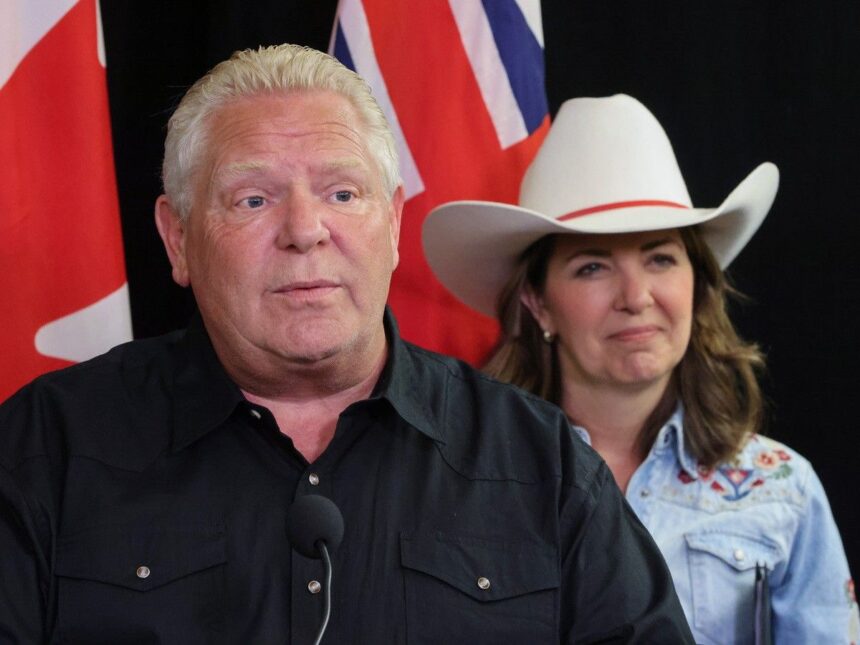
Alberta Premier Danielle Smith, Saskatchewan Premier Scott Moe, Ontario Premier Doug Ford, and Quebec Premier François Legault sent a joint letter to Prime Minister Mark Carney this week. They want federal judges appointed from lists curated by provincial governments. The letter frames this as enhancing diversity and reflecting regional needs. Justice Minister Sean Fraser rejected the proposal outright, saying the current system works and provinces already participate informally. But the premiers argue they deserve equal access to candidate information and meaningful engagement in filling judicial vacancies.
The division of judicial appointment power in Canada is not arbitrary. It reflects a constitutional design meant to insulate courts from political pressure. Provinces appoint judges to provincial courts, which handle most criminal trials and family matters. The federal government appoints judges to superior trial courts, appeal courts, and the Supreme Court. These courts interpret the Constitution, strike down laws, and resolve disputes between governments. Independent advisory committees in each province assess applicants based on legal excellence, community awareness, and personal characteristics. The system is imperfect, but it creates distance between politicians and the bench.
Giving provinces control over candidate lists would collapse that distance. A government could exclude qualified applicants whose legal opinions clash with its agenda. Smith has publicly criticized judicial rulings on energy regulation. Ford has invoked the notwithstanding clause to override court decisions. Legault has faced rulings against his language and secularism laws. Moe has clashed with courts on carbon pricing and parental rights in schools. These premiers have legitimate policy grievances, but letting them screen judges creates obvious conflicts. As Emmett Macfarlane, a political science professor at the University of Waterloo, told me last year during research on judicial independence, “The moment you give politicians gatekeeping power over who can be considered, you’ve politicized the bench, even if no individual appointment looks corrupt.”
The premiers frame their request as addressing regional underrepresentation and vacancy delays. Data from the Office of the Commissioner for Federal Judicial Affairs shows 42 vacancies as of early March, with Ontario facing 15 openings and British Columbia seven. These delays create real harm. Cases stall. Trials collapse. Victims wait years for resolution. But the premiers conflate two separate problems. Vacancy delays stem from administrative dysfunction and inadequate resources for advisory committees, not lack of provincial input. Handing provinces candidate lists does nothing to speed up appointments. It simply shifts who holds the power.
The letter invokes “open and cooperative federalism,” a phrase that sounds democratic but lacks constitutional weight. Federalism in Canada distributes powers to prevent any single government from dominating. Judicial appointments to superior courts fall under federal jurisdiction precisely because these courts adjudicate federalism itself. Provinces are parties in those cases. Giving them veto power over judges would be like letting a hockey team choose its referees. Gerard Kennedy, a former Ontario education minister and federal candidate, once described federalism to me as “organized tension.” The premiers want to collapse that tension in their favor.
Public confidence in courts is fragile, and the premiers are right to worry about it. A 2024 survey by the Angus Reid Institute found that 53 percent of Canadians believe judges are influenced by personal or political views. But that skepticism stems partly from political attacks on courts, not just flawed appointments. When premiers denounce rulings they dislike and then demand more control over who becomes a judge, they undermine the legitimacy they claim to protect. Adam Dodek, a law professor at the University of Ottawa, has written extensively on judicial appointments. He argues that transparency and merit-based criteria strengthen confidence, while political involvement erodes it. “The public needs to see that judges are chosen for their abilities, not their connections or ideologies,” he noted in a 2022 paper on appointment reform.
The current system has flaws worth addressing. The Trudeau government faced justified criticism for slow appointments and opaque criteria that allowed partisan considerations to creep in. Advisory committees sometimes lacked diversity themselves. Applicants faced long waits with no feedback. Fraser’s claim that the process works rings hollow to lawyers who’ve watched vacancies linger for years. But the solution is not provincial gatekeeping. It’s structural reform: mandatory timelines for filling vacancies, transparent criteria published online, diverse advisory committees with fixed terms, and public reporting on how candidates are assessed. These changes would preserve independence while addressing delays.
The premiers also request equal access to candidate information. This sounds procedural but carries risks. Judicial applications include sensitive details—financial records, personal references, past cases. Sharing that information with multiple governments increases leakage and political vetting. Fraser mentioned that provinces already provide input on candidates under consideration, a consultative role that respects boundaries. Expanding that to full information sharing invites misuse. A premier could privately oppose a candidate based on rulings in unrelated cases. The public would never know.
Quebec’s participation in this letter deserves scrutiny. Legault has positioned himself as a defender of provincial autonomy, particularly on language and immigration. Federal judicial appointments have occasionally frustrated his agenda, especially rulings upholding minority language rights under the Charter. His interest in shaping the candidate pool aligns with his broader push to insulate Quebec policy from judicial review. That’s a legitimate political goal, but it’s incompatible with constitutional supremacy. Courts exist to check governments, including provincial ones. A system where governments choose their own judges ceases to function as a check.
Should provinces have no role in superior court appointments? Not necessarily. Some democracies include regional input without sacrificing independence. Germany’s Constitutional Court includes judges chosen by federal and state legislatures, but strict supermajority rules prevent any single party from dominating. Canada could explore similar models—provincial advisory input with transparent criteria and safeguards against partisanship. But that requires careful design, not a power grab disguised as cooperative federalism.
The vacancy crisis is real and urgent. Forty-two empty seats mean delayed justice and strained courts. But the premiers’ proposal does not solve that problem. It exploits it. By linking legitimate concerns about delays to demands for political control, they’ve created a false choice: accept provincial gatekeeping or tolerate dysfunction. A responsible federal government would reject that framing and pursue reforms that prioritize speed and merit without compromising independence. Fraser’s refusal to consider the proposal is defensible, but only if Ottawa follows through with meaningful improvements to the current system.
Judicial independence is not a technicality. It’s the difference between law and power. Canadians deserve judges chosen for their abilities, not their acceptability to governments. The premiers’ letter, for all its cooperative language, points in the opposite direction.