The hillside above Peachland has become something of a reckoning point. What began as a modest encampment along Trepanier Creek has grown into a sprawling settlement of RVs, tents, and makeshift structures. Local residents count more than 37 people living there now. It’s raising questions nobody seems ready to answer.
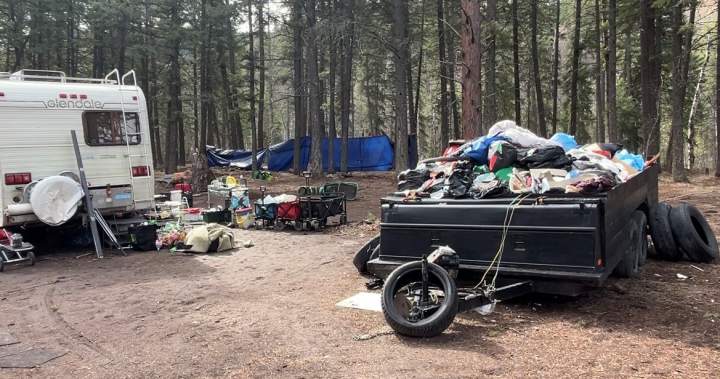
Julie Gette lives nearby and has watched the expansion unfold over the past year. “It’s just getting out of control,” she said. Her frustration mirrors that of other neighbors who see the camp multiply week by week. Around 20 RV trailers now occupy the Upper Trepanier Bench area, surrounded by tarp-covered shelters and an assortment of furniture and equipment hauled in from who knows where.
The visual clutter is one thing. The potential environmental damage is another entirely. Hoses snake down to the creek, apparently drawing water directly from a source that local signage identifies as a sensitive watershed. Piles of car tires sit next to trailers full of garbage. Vehicles and boats rest on jack stands across the site.
Kyle Gette, another area resident, doesn’t mince words about what he sees. “It’s gotten really dirty and gross,” he said. That bluntness reflects a growing unease about what’s seeping into the ground and the water. The possibility of wastewater and sewage contamination looms large, especially since several local households rely on that same creek for their water supply.
“There’s lots of our neighbours that do feed off that creek so it is concerning,” Julie Gette noted. “We have a lot of neighbours now that will be getting their well tested.” Water quality testing isn’t cheap, and it’s a cost neighbors never expected to shoulder because of an unauthorized settlement upstream.
Fire risk adds another layer of worry. The Okanagan is no stranger to wildfire. Peachland itself sits in terrain that has seen flames before and will again. Residents follow strict rules about heating appliances and outdoor burning. Yet the encampment operates under no such constraints.
“We’re not allowed to put a wood stove in our house but they all have makeshift wood stoves coming out of their trailers,” Kyle Gette said. “It’s a concern. We live in fire country. We’re in a high risk fire area.” The double standard grates, particularly when one errant spark could threaten homes and lives across the bench.
Provincial Crown land falls under specific rules. British Columbians can camp on Crown land, but the law limits stays to 14 days in one location. The encampment above Peachland has been there far longer. Enforcement, however, seems caught in a bureaucratic tangle that nobody wants to unravel.
Frustrated residents have been calling various levels of government and agencies for months. The response has been what one anonymous resident described as jurisdictional finger-pointing. “Everybody’s wiping their hands clean of it and it doesn’t matter where we turn or where we go,” the resident said. “They’re like, it’s not our responsibility, it’s somebody else’s responsibility.”
That kind of runaround is familiar to anyone who has tried to navigate overlapping government mandates. Provincial land means provincial jurisdiction, theoretically. But social services, public health, environmental protection, and bylaw enforcement all touch different ministries and agencies. When nobody wants to claim ownership of a problem, nothing gets done.
Late Thursday, the provincial government issued a statement in response to media inquiries. The Natural Resource Officer Service confirmed it is aware of the individuals on Crown land near Trepanier Creek. More significantly, the statement indicated that the Ministry of Social Development and Poverty Reduction plans to visit the site within the next month. The goal is to meet with people living there and discuss supports or services that might be available.
That sounds like a starting point, though residents have heard promises before. The statement offers no timeline for cleanup, no mention of enforcement, and no clarity on what happens if people refuse to leave. A visit from social services is not the same as action on environmental contamination or fire hazards.
One area resident who preferred to remain unnamed tried to strike a balance between frustration and empathy. “I know it’s hard times and so, like, we can’t be too hard on people,” the resident said. “But at the same time, I definitely don’t want to see this situation escalating.” That tension runs through much of the housing and homelessness debate in British Columbia. Compassion for people without stable housing meets legitimate concerns about public safety and environmental stewardship.
The Peachland situation is not unique. Encampments on Crown land have appeared across the province as housing costs soar and social supports fail to keep pace. Rural areas without municipal bylaws or regular enforcement become magnets for people priced out of cities or seeking to avoid urban shelter rules. The result is often conflict between those living rough and those living nearby.
What makes the Trepanier Creek encampment particularly troubling is the convergence of risks. Water contamination threatens a shared resource. Fire danger puts lives at stake. Waste accumulation degrades land that belongs to all British Columbians. These are not abstract policy questions. They are immediate, tangible problems that demand immediate, tangible responses.
The provincial government’s statement suggests awareness but stops short of commitment. Offering social services is important. So is enforcing land use rules. Both can happen at once, but only if someone decides to make it happen. Residents above Peachland are waiting to see whether anyone will.