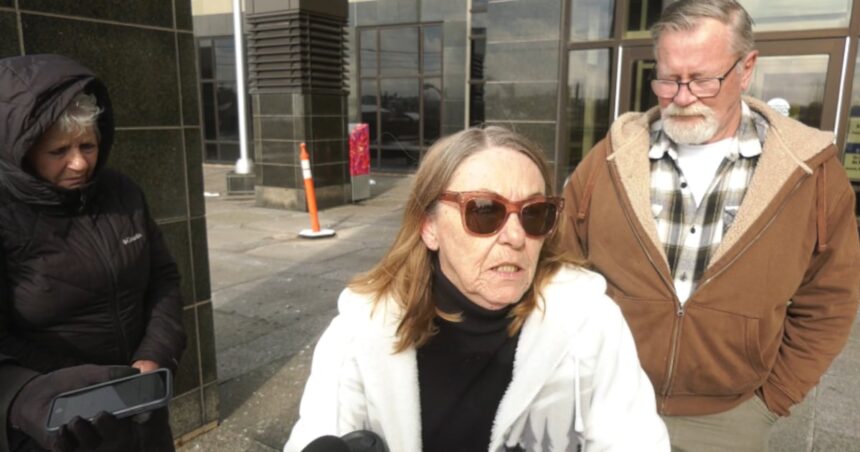
The courtroom doors opened Thursday morning in Moncton, and among those who walked through were Peter and Pat Price. They weren’t there by choice. They were there because their daughter, Melissa Dawn Price, is dead. Her body was found in a garbage bin at the bottom of High Street on February 15. She was 39 years old.
Devlin O’Blenis, one of three people now accused in connection with her death, appeared by telephone from the Southeast Regional Correctional Centre in Shediac. He is charged with first-degree murder. The hearing lasted only minutes. His lawyer was out of the country, so the judge postponed the case for two weeks. The Prices sat through it all. Then they walked outside into the crisp air and tried to put words to grief that has no grammar.
“She was my daughter,” Peter Price told reporters on the courthouse steps. “She’s home in a dining room in a box.” His voice carried the weight of a parent who has buried a child before they should. Pat stood beside him, her face tight with emotion. “Forty this Saturday,” she said. “I have to sing happy birthday to a box, an urn.”
Police arrested O’Blenis on March 11. He is 35 years old. Authorities have not disclosed how Melissa died. They have not explained what led them to charge him with first-degree murder, a charge that under Canadian law requires proof of planning and deliberation. That burden falls to the Crown. For now, the charges remain allegations. None have been tested in court.
Two others face charges in the same investigation. Leandra Beaulieu, 36, was arrested on March 25 and charged the next day with first-degree murder. Joshua Martin, also 36, was arrested on March 19 and charged with being an accessory after the fact of murder and indignity to a human body. The accessory charge suggests he allegedly helped conceal evidence or assisted someone after Melissa’s death. The indignity charge relates to how her body was treated. Both are serious criminal offenses under the Criminal Code of Canada.
Beaulieu is scheduled to return to court on April 9. Martin will appear on April 13, the same day O’Blenis is expected to attend in person. The Prices say they will be at every hearing. “Every one of them,” Pat said. “I don’t care if I have to sleep out in a tent, I’ll be here.”
Peter spoke with raw honesty about the tension between his faith and his fury. “I pray, I believe in God, and I don’t think it’s my place to have vengeance,” he said. “But I’m finding it really hard at my age not to jump over chairs and stuff. If I saw him today, I don’t know how I would react. My youth is gone, but I’ve still got a lot of fire in my veins.”
These are the words of a father who once held his daughter as an infant and now holds only an urn. The legal system moves slowly. Adjournments, procedural delays, and scheduling conflicts are routine. For families like the Prices, each postponement extends a particular kind of suffering. They are trapped between wanting answers and watching the machinery of justice grind forward at its own pace.
Pat thanked the homicide investigators publicly, calling their work a “fantastic job.” Arrests have been made. Charges have been laid. But gratitude does not erase questions. “Melissa didn’t deserve what happened to her,” Pat said. She wondered aloud why her daughter was murdered. That question may take months or years to answer, if it ever is.
First-degree murder cases in Canada are complex. They require the Crown to prove not just that the accused caused death, but that they planned it beforehand. The prosecution must establish intent, motive, and opportunity. Defense lawyers will scrutinize every piece of evidence, every witness statement, every procedural step. Trials can stretch across seasons. Appeals can add years.
The Prices are preparing for a long road. They have already been thrust into a world of legal terminology, court schedules, and victim services coordinators. They will hear arguments about admissibility, voir dires, and disclosure. They will sit through testimony that reconstructs the final hours of their daughter’s life. They will be asked to remain composed while others debate the details of her death.
Melissa Dawn Price would have turned 40 on Saturday. Her parents will mark the day without her. They will sing to an urn in their dining room. They will continue to show up at courthouses, to bear witness, to insist that her life mattered. The judicial process will unfold whether they attend or not. But their presence is a form of testimony. It says: she existed. She was loved. She was someone’s daughter.
The three accused remain in custody or under court supervision. Their cases will proceed through the provincial court system before potentially moving to trial at the Court of Queen’s Bench. Each step will be documented. Each appearance will be noted. And the Prices will be there, carrying their daughter’s memory into rooms where the law tries to make sense of loss that defies all reason.