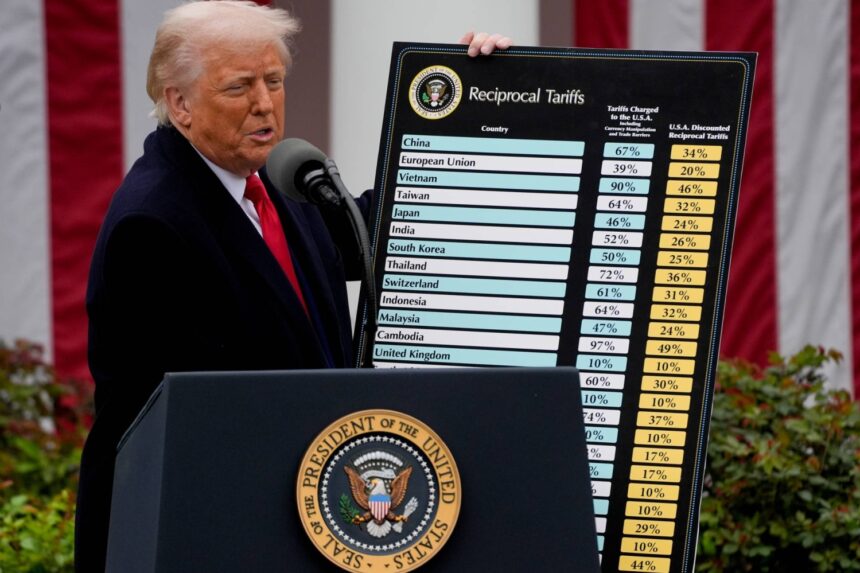
The rules that guided traders through a year of tariff chaos are suddenly obsolete. What worked after Donald Trump’s Liberation Day salvo in April 2024 means nothing now. War in Iran has rewritten the entire script, and the financial world is scrambling to adapt.
Oil prices haven’t just climbed—they’ve vaulted past every forecast made six weeks ago when the conflict ignited. Brent crude crossed $127 per barrel last week, a threshold most analysts dismissed as improbable even during the tensest moments of U.S.-China trade friction. The spike dwarfs anything seen during the initial tariff shocks, when investors could still hedge their bets and wait for diplomatic off-ramps. This time, there’s no playbook. The Strait of Hormuz, through which roughly one-fifth of global petroleum passes, has become a chokepoint defined by missile strikes and naval posturing rather than predictable supply chains.
Traders who profited handsomely from the post-tariff environment—buying tech stocks on rate-cut optimism, shorting emerging market currencies, riding the AI wave—have watched those positions implode. Global equities have shed approximately $14 trillion since hostilities erupted, according to data compiled by MSCI and Bloomberg Intelligence. That’s not a correction. It’s a wholesale rejection of the assumptions that governed markets since spring.
I spoke with Elena Vargas, a portfolio strategist at a London-based fund, who described the mood as “beyond panic—it’s disorientation.” Her firm had positioned heavily in semiconductor stocks and European industrials, expecting smooth sailing as central banks pivoted dovish. “We thought geopolitical risk was priced in after a year of tariff theater,” she said. “Turns out we were pricing in the wrong war.”
The AI rally, which had propelled the Nasdaq and fueled venture capital from Seoul to Stockholm, has cratered. Nvidia’s stock is down 41 percent from its February peak. The reason isn’t weakening fundamentals in chips or software—it’s that energy costs are eviscerating profit margins across data centers. Training large language models was already power-intensive. Now, with electricity prices spiking in sync with oil, companies like Microsoft and Google have delayed infrastructure investments. The International Energy Agency projects that if Brent stays above $120 through year-end, data center construction could contract by 18 percent globally.
This isn’t just about speculators nursing losses. Real economies are buckling. India, which imports more than 80 percent of its crude, has seen its current account deficit balloon. The Reserve Bank of India burned through $47 billion in foreign reserves over five weeks defending the rupee, according to official filings. In Nairobi, diesel shortages have idled public transport. In Jakarta, the government reinstated fuel subsidies it had eliminated only nine months ago, blowing a hole in fiscal planning.
European nations, still recovering from the energy crisis triggered by Russia’s invasion of Ukraine, face a grim replay. Germany’s DAX index has fallen 29 percent since the Iran conflict began. Chancellor Olaf Scholz convened an emergency cabinet meeting last week to discuss energy rationing for industrial users—a measure not seen since 2022. France and Italy are lobbying the European Commission to release strategic petroleum reserves, but those stockpiles are already 22 percent below pre-Ukraine war levels, according to Eurostat data.
Meanwhile, Gulf states are navigating a paradox. Higher oil prices should be a windfall for Saudi Arabia, the UAE, and Kuwait. But the war’s proximity and the risk of escalation have spooked foreign investment. Riyadh’s sovereign wealth fund reported net capital outflows of $9 billion in March alone, as multinational corporations reassess exposure to the region. A senior analyst at the Arab Petroleum Investments Corporation, speaking on condition of anonymity, told me the kingdom is “printing money on paper but watching it evaporate in capital flight and defense spending.”
China, ostensibly insulated by its strategic petroleum reserve and trade pivot away from the West, isn’t escaping unscathed. The People’s Bank of China has intervened four times in currency markets to prevent the yuan from depreciating too sharply against the dollar. Beijing’s manufacturing sector, already weakened by Trump’s tariffs, is now squeezed by energy inflation. The Caixin Manufacturing PMI fell to 47.3 in March, its lowest reading in 19 months, signaling contraction.
Diplomatic efforts to contain the crisis have so far failed to calm markets. The United Nations Security Council convened twice in ten days, producing statements but no ceasefire framework. U.S. Secretary of State Marco Rubio shuttled between Riyadh, Tel Aviv, and Abu Dhabi last week, yet oil futures climbed even as he spoke of “de-escalation pathways.” Investors have learned that words without enforcement mean little when Hormuz remains contested.
What’s striking is how swiftly the tariff-era strategies collapsed. For twelve months, the prevailing wisdom was to buy U.S. equities on any dip, to short the euro, to overweight tech. Trump’s trade war, for all its volatility, followed patterns. Threats, negotiations, tactical retreats. The Iran conflict offers no such rhythm. It’s binary and kinetic. Either shipping lanes open or they don’t. Either oil flows or it doesn’t.
Hedge funds that thrived in 2024 are hemorrhaging now. Citadel, Millennium, and Bridgewater have all reported significant drawdowns in energy-sensitive portfolios, according to investor letters reviewed by the Financial Times. The so-called “tariff hedge”—long U.S. Treasuries, short European debt—has reversed violently as investors flee to the dollar regardless of yield curves.
In Washington, the Federal Reserve faces an impossible choice. Inflation, which had moderated to 2.4 percent in February, is accelerating again. Energy and transport costs are bleeding into food prices, rent, and manufacturing inputs. But raising interest rates now, with equities in freefall and credit markets tightening, risks tipping the economy into recession. Fed Chair Jerome Powell punted the decision at the last meeting, holding rates steady while acknowledging “extraordinary uncertainty.”
On the ground in Erbil, northern Iraq, I watched fuel trucks queue for hours at a distribution terminal. Drivers said prices had doubled in three weeks. One trucker, Ahmed Hassan, explained he now loses money on routes he’s driven for a decade. “Before, I could plan,” he said. “Now, I don’t know if I’ll afford diesel tomorrow or if the border will close.” His calculus mirrors what traders in New York and London are discovering: the old models don’t work anymore.
The International Monetary Fund slashed its global growth forecast to 1.8 percent for 2025, down from 3.2 percent projected before the conflict. Energy insecurity, the IMF noted, is now the primary drag on expansion, surpassing trade tensions and monetary tightening. The World Bank separately warned that prolonged oil shocks could push an additional 78 million people into extreme poverty by year-end, concentrated in sub-Saharan Africa and South Asia.
What comes next depends on variables no algorithm can price. Military escalation, diplomatic breakthroughs, domestic unrest in oil producers, technological pivots to renewables—all are in play. But for now, the investment strategies that thrived under tariff volatility lie in ruins. The Iran war has imposed a new logic, one where energy security trumps everything else. And until that changes, markets will remain hostage to developments in a region most traders only understood through price tickers.