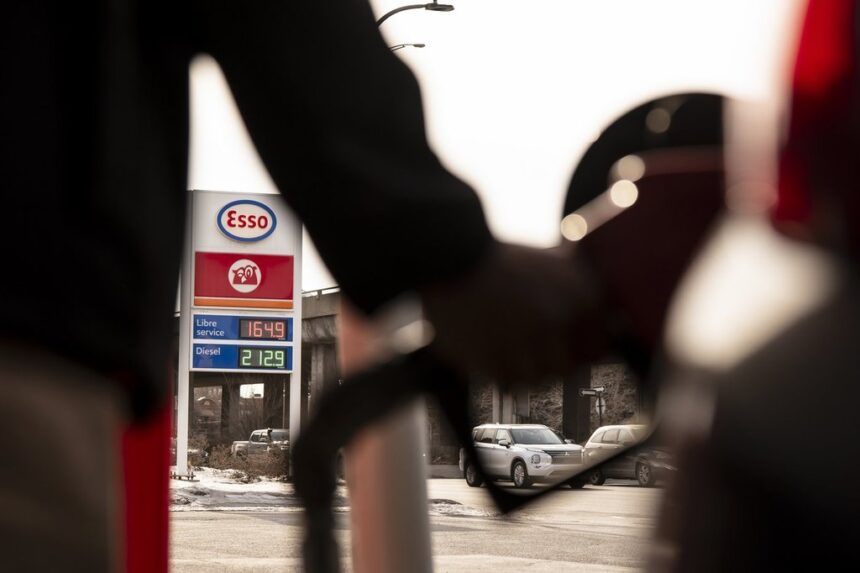
The stretch of highway between Kelowna and Vancouver was busier than usual last Thursday morning. Sandra Kwong, a graphic designer heading home after visiting her sister, pulled into a Husky station just outside Hope. The digital numbers on the pump climbed past ninety dollars before her Honda Civic’s tank was full. She shook her head, pocketed the receipt, and merged back onto the Trans-Canada. Two weeks earlier, the same fill-up cost her sixty-eight dollars.
Kwong isn’t alone. Across Canada, drivers are confronting a sharp spike in fuel costs tied to escalating tensions in the Middle East. The war in Iran, which began in late February when the U.S. and Israel launched military operations, has disrupted global oil supply chains and sent prices climbing at a pace not seen in years. For families planning Easter road trips or daily commuters already stretched thin, the timing couldn’t be worse.
Patrick De Haan, a petroleum analyst with GasBuddy, says Canadians should brace for continued increases. Oil prices jumped roughly ten percent in a single day this week, he notes, and that volatility is trickling down to every pump from St. John’s to Victoria. The national average for regular gasoline now sits around 180.8 cents per litre, up nearly nine cents in just seven days. Diesel, which powers much of Canada’s freight and agriculture, is expected to surpass 225 cents per litre within forty-eight hours. That would set a new national record.
The pain isn’t evenly distributed. Coastal communities in British Columbia, the Maritimes, Quebec, and Newfoundland are experiencing some of the steepest hikes. De Haan explains that these regions rely on oil that can easily be rerouted to international buyers willing to pay more. In contrast, inland provinces like Alberta benefit from proximity to domestic refineries and lower export risk. Edmonton and Calgary, for instance, saw February averages hovering around 118 and 122 cents per litre respectively. By comparison, Vancouver was already at 171 cents before the conflict intensified.
The root of the crisis lies thousands of kilometres away, in the narrow Strait of Hormuz. This waterway, barely thirty-three kilometres wide at its narrowest point, channels roughly one-fifth of the world’s petroleum. Since the outbreak of hostilities, Iran has effectively choked traffic through the strait, creating a bottleneck that reverberates across global markets. Tankers that once moved freely now face threats of attack. Shipping companies are rerouting or delaying, and the cost of that uncertainty lands squarely on consumers.
Federal opposition parties have seized on public frustration. Conservative leaders are calling for temporary tax relief on gasoline, arguing that Ottawa should cushion households from geopolitical shocks beyond their control. The federal government, meanwhile, has maintained that Canada will not be drawn into the conflict militarily. But economics don’t respect borders. Even if Canadian troops stay home, Canadian wallets feel every ripple from the Persian Gulf.
De Haan points out that diesel’s spike carries consequences beyond personal vehicles. Jet fuel prices have nearly doubled, raising airfare for anyone hoping to fly instead of drive. Groceries, building materials, and nearly every consumer good that moves by truck will see cost increases passed along the supply chain. Farmers preparing for spring planting are calculating whether they can afford to run tractors and transport grain. Small business owners are revising budgets. The inflationary pressure is broad and relentless.
Statistics Canada’s most recent data, covering February, shows a national landscape already under strain. Halifax averaged 136.5 cents per litre. Montreal sat at 150. Whitehorse, where transportation costs are always higher, reached nearly 149. Those figures predate the conflict. Updated numbers, expected later this month, will likely tell a grimmer story.
There are no easy answers. U.S. President Donald Trump, who set a deadline for Iran to reopen the strait, has yet to outline a concrete plan to resolve the standoff. His silence in recent national addresses has only deepened market anxiety. Oil traders, uncertain about supply stability, continue to bid prices upward. Until diplomatic or military solutions emerge, the volatility will persist.
For now, Canadians are adapting in small ways. Some are carpooling more often or consolidating errands. Transit ridership in Vancouver and Toronto has ticked upward, though public systems are still recovering from pandemic-era funding shortfalls. Employers are revisiting remote work policies, weighing the environmental and financial benefits of fewer commutes. These shifts, while modest, reflect a population caught between rising costs and limited alternatives.
There’s also a quiet reckoning happening around energy policy. Canada produces significant amounts of oil, yet remains vulnerable to global price swings. Conversations about energy sovereignty, renewable transitions, and strategic reserves are moving from policy papers into kitchen table debates. It’s a paradox that frustrates many. We export fuel, yet we’re held hostage by events halfway around the world.
Sandra Kwong made it home that Thursday afternoon. She parked her Civic in the driveway, glanced at the gas gauge, and decided her next trip could wait. The Easter long weekend, once a chance to visit the coast, now feels financially out of reach. She’s not angry, exactly. Just tired of adjusting. Tired of checking fuel apps before leaving the house. Tired of budgeting around forces she can’t control.
Across the country, millions are making similar calculations. The price at the pump is more than a number. It’s a measure of how distant conflicts shape daily life, how global systems intersect with local routines. And as long as the Strait of Hormuz remains contested, Canadians will continue paying the price for geography, geopolitics, and the stubborn reality that oil still moves the world.