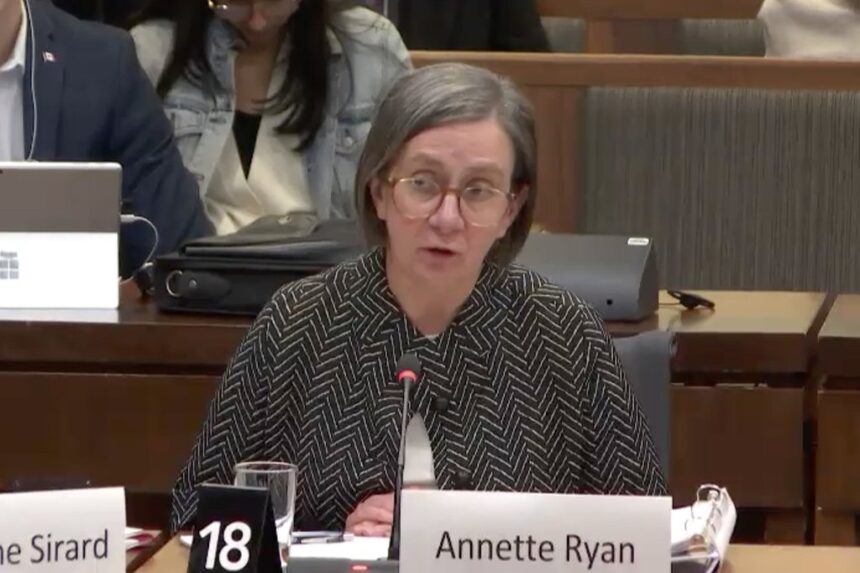
A mathematics whiz from Acadia who went on to Oxford as a Rhodes Scholar now stands at the threshold of one of Ottawa’s most scrutinized roles. Annette Ryan will face members of Parliament on Monday as the government’s pick to lead the Parliamentary Budget Office, a position that has been empty since early this month.
Ryan currently serves as deputy director at Fintrac, Canada’s financial intelligence agency. Her nomination follows a bumpy stretch for the budget office, which has been without permanent leadership and unable to publish reports or respond to MP requests. Interim officer Jason Jacques saw his six-month term expire with no successor in place, leaving the office in a holding pattern.
The Parliamentary Budget Officer is tasked with scrutinizing federal spending and costing out campaign proposals during elections. It is a watchdog role that requires both technical precision and the ability to withstand political pressure from all sides. Ryan must secure approval from both the House of Commons and the Senate before taking on the seven-year mandate.
She declined an interview ahead of her committee appearance, citing respect for the process. In a brief message, she called the nomination an honour and noted that nothing matters more to parliamentary democracy than scrutinizing taxation and spending on behalf of Canadians. She also expressed respect for Jacques and all who served before her.
Kevin Page, Canada’s first Parliamentary Budget Officer, has thrown his support behind Ryan. He worked with her in the Privy Council Office in the early 2000s, when both helped prepare briefing notes for prime ministers Paul Martin and Stephen Harper. Page described her as exceptionally sharp and said her experience gives her a strong foundation for the role.
Ryan holds degrees in mathematics and economics, and her public service career includes stints at Finance Canada, Industry Canada, and Employment and Social Development Canada. Page said that background positions her well at a critical moment for Canada’s economy, as Prime Minister Mark Carney pushes major investments in housing and infrastructure.
The Canadian Press asked whether Ryan and Carney had worked together before, given their overlapping time at Oxford in the early 1990s. A spokesperson for the prime minister described them as acquaintances but offered no further details. The Privy Council Office said Ryan’s appointment followed an open and competency-based selection process that adhered to all applicable rules, including those in the Conflict of Interest Act.
Page acknowledged that some may worry about Ryan taking on a watchdog role after previously knowing Carney. He does not share that concern and pointed out that Canada’s finance community is small enough that avoiding interaction would be nearly impossible. He faced similar questions in 2008 when he moved from working with Harper to becoming the first Parliamentary Budget Officer.
Within a year, Page said, the government tried to fire him for being too hard on them. He views that as evidence that professional integrity can override past working relationships. The role demands independence, and he believes Ryan understands that.
Conservative Leader Pierre Poilievre said his party would review Ryan’s record before voting on her nomination. In a letter to Carney sent on March 5, Poilievre expressed serious reservations and urged the prime minister to give Jacques a full seven-year term. He accused Carney of trying to muzzle the budget office by letting Jacques’ interim term expire without a successor.
Some Conservative and Bloc Québécois MPs supported that position. The standing committee on government operations and estimates passed a motion on March 10 recommending Jacques for the permanent role, despite Liberal opposition. Jacques had applied for the position but declined to comment for this story.
Early in his interim tenure, Jacques described the Liberal government’s finances as stupefying and not sustainable. He later told The Canadian Press he regretted using that language. After Ottawa tabled its fall budget in November, he said the federal spending plan was sustainable in the long run.
Page said he respects Jacques and has worked with him extensively over the years. He understands why opposition parties seized on Jacques’ earlier comments, but believes that language likely ended his chances of securing the permanent position. Page called Jacques experienced and technically sound, but said a budget officer cannot make statements like that and expect to maintain credibility across the political spectrum.
Ryan’s nomination comes weeks after the Organization for Economic Co-operation and Development released a largely positive report on Canada’s Parliamentary Budget Office. The OECD ranked the office first internationally among fiscal monitors but flagged Jacques’ comments as an example of why a formal communications strategy is needed. The office implemented such a strategy earlier this year.
The OECD also criticized persistent delays in appointing new budget officers and warned that relying on interim leaders can undermine perceptions of independence. Those concerns have been amplified by the current vacancy, which has left the office unable to fulfill its mandate.
Page said accusations of partisanship come with the territory on Parliament Hill. Whoever takes on the role next will need thick skin and the ability to handle a charged political environment. He compared it to playing competitive hockey, where getting hit is part of the game and you have to get back up.
Ryan will have to convince MPs and senators that she can navigate those hits while maintaining the independence the office requires. Her technical background and public service experience provide a foundation, but the real test will be how she handles the scrutiny that comes with holding the government to account.
The finance committee hearing on Monday will offer the first public glimpse of how Ryan approaches that challenge. MPs will probe her understanding of the role, her plans for the office, and her ability to remain independent despite any past connections. The outcome will determine whether the Parliamentary Budget Office can resume its work after weeks of being sidelined.
For now, the office remains in limbo, unable to publish the reports and analysis that MPs rely on to hold the government accountable. That vacancy has drawn criticism from opposition parties and fiscal policy observers who view the budget office as essential to parliamentary oversight.
Ryan’s confirmation would end that uncertainty and restore the office’s ability to function. Whether she can earn the trust of all parties remains to be seen, but Monday’s hearing will be the first step in that process.