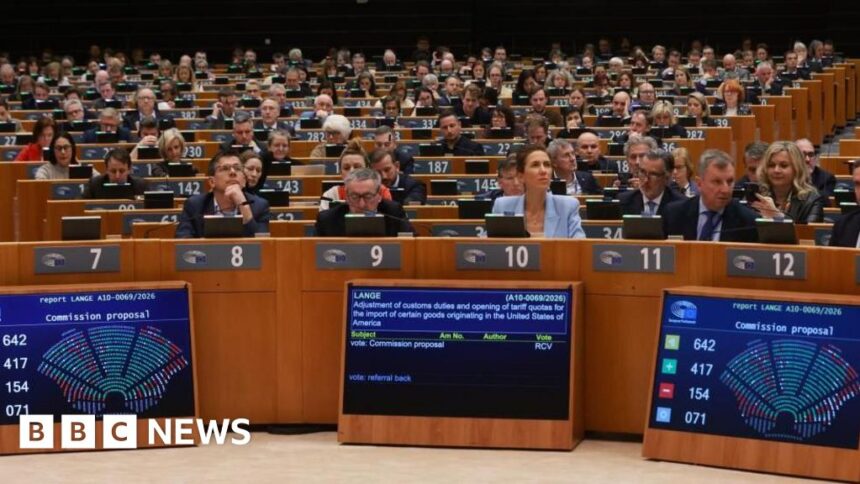
The European Parliament voted Thursday to approve a controversial trade agreement with the United States, but only after inserting multiple escape hatches that could unravel the whole arrangement. The 417-to-154 vote reflects Brussels’ deep mistrust of Washington’s promises under President Donald Trump, even as both sides publicly celebrate what they’re calling a breakthrough.
I’ve watched trade negotiations from Geneva to Nairobi, and rarely have I seen a deal wrapped in so many conditional clauses. This isn’t normal diplomacy. It’s a prenuptial agreement between partners who already suspect each other of cheating.
The core bargain appears straightforward enough on paper. European goods would face 15% tariffs entering the U.S. market instead of the 30% Trump initially threatened. In exchange, Europe would eliminate import duties on American industrial products and commit to massive investments in the United States. The framework was hammered out last July at Trump’s Turnberry golf course in Scotland, where European Commission President Ursula von der Leyen flew for what she later called a “huge deal.”
But the devil’s in the safeguards that lawmakers added Thursday. The European Parliament inserted what they’re calling a “sunrise clause” that prevents EU tariff reductions from taking effect unless Washington actually delivers on its promises first. There’s also a suspension provision that would halt the entire agreement if the U.S. slaps additional tariffs on European goods or threatens EU territorial sovereignty—a direct reference to Trump’s bizarre comments about annexing Greenland, a Danish autonomous territory.
According to the European Parliament, the most contentious element involves steel and aluminum. Trump insisted last summer that his 50% tariff on these metals would still apply to Europe. But on Thursday, lawmakers voted to accept zero tariffs on American goods only if hundreds of European products containing steel and aluminum get excluded from that punishing 50% levy. It’s a game of chicken with billions of dollars riding on who blinks first.
European Economy Commissioner Valdis Dombrovskis tried to sound reassuring after the vote. “At this stage, we have received reassurances from the U.S. that they intend to honour the deal,” he said. Then came the qualifier that tells you everything: “While we will continue our efforts to maintain constructive relationships and avoid volatility, we will not turn a blind eye to any risks to our interests.”
That’s diplomatic speak for “we don’t actually trust you.”
The numbers involved are staggering. Trump committed Europe to boosting U.S. investment by $600 billion, including purchases of American military equipment. Another $750 billion would go toward energy purchases—liquified natural gas, oil, and nuclear fuels meant to wean Europe off Russian energy dependency. These aren’t trivial sums. They represent a fundamental restructuring of transatlantic economic flows.
The European Commission reports that more than €1.6 trillion in goods and services flowed between the U.S. and EU in 2024, accounting for nearly a third of all global trade. Trade in goods alone hit $976 billion last year, with the U.S. importing roughly $606 billion from Europe while exporting around $370 billion. That’s a significant trade imbalance that Trump has obsessed over throughout his political career.
I spoke with a senior European trade official in Brussels last month who described the negotiating atmosphere as “surreal.” Trump’s tariff threats have become so unpredictable that European governments are now planning contingency scenarios for everything from a full trade war to sudden policy reversals announced via social media. “We’re negotiating with a moving target,” the official told me on condition of anonymity. “One day we have a deal. The next day he’s threatening to annex our territory.”
The agreement still needs approval from all 27 EU member states before implementation. That vote is expected in April or May, though several countries have expressed reservations. France has historically been protective of its agricultural sector and manufacturing base. Germany worries about automotive exports. Smaller nations fear getting crushed between competing superpowers.
Brussels has been scrambling to diversify its trade relationships as insurance against American unpredictability. The EU signed a comprehensive trade deal with Australia this week, according to World Trade Organization filings. In January, after nearly two decades of intermittent talks, Europe announced a landmark agreement with India that could reshape trade flows across Asia and the Indian Ocean.
These aren’t random developments. They’re part of a deliberate European strategy to reduce dependence on the U.S. market. When your largest trading partner starts weaponizing tariffs and talking about territorial annexation, you start looking for other options.
The “sunset clause” inserted Thursday means the entire agreement expires by March 31, 2028, regardless of how well it’s working. That’s unusually short for a major trade deal. Most agreements run indefinitely with periodic reviews. This termination date reflects European recognition that Trump’s successor might want to renegotiate or abandon the whole thing.
What’s really happening here goes beyond tariff schedules and trade volumes. The transatlantic relationship that anchored global commerce since World War II is fragmenting under the pressure of competing economic nationalisms. Trump views trade as zero-sum competition where America’s gain requires Europe’s loss. Brussels sees trade as mutual benefit requiring rules-based cooperation.
From the European perspective, this deal represents damage control rather than opportunity. It’s about minimizing pain rather than maximizing gain. The multiple safeguards and escape clauses reveal how far trust has eroded between Washington and Brussels.
The International Monetary Fund warned in recent analysis that escalating trade tensions between the U.S. and EU could reduce global GDP growth by 0.5% over the next two years. That might sound small, but it translates to hundreds of billions in lost economic output and millions of jobs that won’t be created.
Whether this conditional approval leads to actual implementation remains uncertain. Trump’s track record on international agreements isn’t encouraging. He’s withdrawn from climate accords, renegotiated NAFTA, threatened to leave NATO, and imposed tariffs on allies without warning. European lawmakers crafted their safeguards precisely because they’ve watched this pattern repeat.
The coming months will reveal whether pragmatic compromise can survive populist unpredictability, or whether the Atlantic is becoming too wide for traditional partnership.