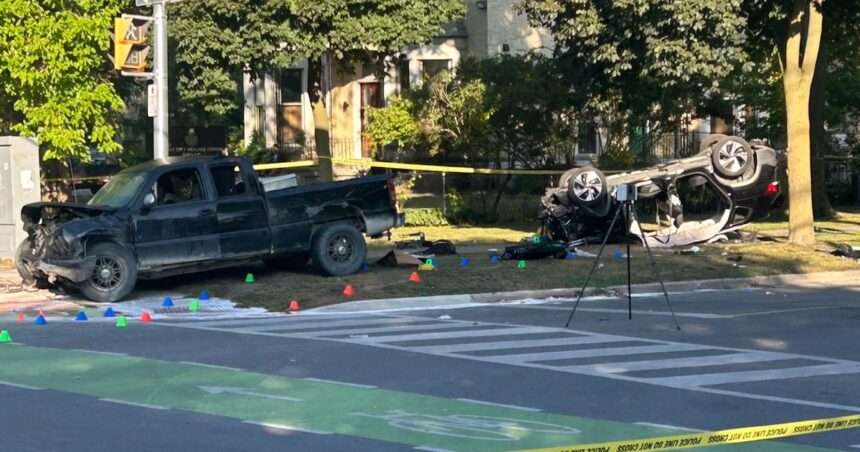
Randy Jones wiped tears from his face as he stood in a London courtroom, confronting the weight of a decision that ended one life and shattered others. The 44-year-old from Manitoulin Island pleaded guilty to dangerous driving causing death and dangerous driving causing bodily harm. His victims: a retired school principal who spent decades shaping young minds, and her husband of many years.
The crash happened on Sept. 10, 2025, at the busy intersection of William Street and Queens Avenue in downtown London. Catherine Sallows, 67, died at the scene. Her husband Stephen, 70, survived with serious injuries. Both were simply driving through their city when Jones’ black Chevy Silverado slammed into their Volkswagen SUV at nearly 100 kilometers per hour.
Jones should not have been driving at all. Court records confirm his license was suspended at the time of the collision. Despite that legal prohibition, he got behind the wheel with several friends as passengers. What followed was a dangerous chase through city streets that ended in tragedy.
London police officers first noticed the pickup truck and began following it. The vehicle ran multiple red lights before officers initiated pursuit. Video evidence captured most of the incident, showing the Silverado racing through intersections at speeds approaching highway limits on city roads designed for 50 km/h traffic.
The agreed statement of facts presented to the court detailed what happened after impact. Jones fled the crash scene immediately, leaving behind the couple he had just struck, along with his own injured passengers still trapped in the wreckage. He did not call for help. He did not stay to face what he had done.
Police reviewed surveillance footage that tracked his movements away from the intersection. A week later, authorities arrested Jones in Thunder Bay, over 1,400 kilometers northwest of London. The distance suggests he was not planning to turn himself in.
Prosecutors initially filed 11 criminal charges against Jones. These likely included counts related to fleeing the scene, driving while suspended, and multiple dangerous driving offenses. By pleading guilty to two serious charges, Jones accepted responsibility for the most consequential outcomes of his actions that day.
Catherine Sallows dedicated her career to education as a school principal. Retired principals often remain active in their communities, mentoring new educators and volunteering with youth programs. Her death removes decades of accumulated wisdom and care from the community she served. Stephen Sallows now faces recovery from significant injuries while grieving the loss of his wife.
The passengers in Jones’ vehicle also sustained injuries, according to court testimony. These individuals trusted Jones enough to ride with him, unaware he was driving illegally and would soon make choices that endangered everyone around him. Their trust left them injured and traumatized.
The legal framework for dangerous driving causing death in Canada carries a maximum sentence of life imprisonment under the Criminal Code. Dangerous driving causing bodily harm allows up to 14 years. Judges consider aggravating factors like prior driving suspensions, fleeing the scene, and high speeds when determining sentences.
Jones remains in custody until his sentencing hearing scheduled for June 17. The court will hear victim impact statements from Stephen Sallows and likely from the Sallows family, friends, and former colleagues. These statements give victims a voice in the justice process and help judges understand the full human cost of criminal actions.
Suspended drivers who get behind the wheel create documented public safety risks. Studies from Transport Canada and the Insurance Institute for Highway Safety show that drivers with suspended licenses are statistically more likely to be involved in fatal collisions than licensed drivers. Suspensions result from serious violations like impaired driving, accumulating too many demerit points, or failing to pay fines.
The decision to drive while suspended, run red lights, and flee after a fatal crash reveals a pattern of disregard for law and human safety. Each choice Jones made that day compounded the harm. Each decision point offered him a chance to stop.
Video evidence proved crucial in this case. Surveillance cameras throughout urban areas now capture traffic incidents with clarity that helps investigators reconstruct events second by second. This footage contradicts false statements and provides courts with objective records of what occurred.
The guilty plea spares the Sallows family a lengthy trial but cannot restore what was taken. Catherine Sallows will not see another sunset or hold future grandchildren. Stephen Sallows faces years ahead without his partner. The ripple effects touch everyone who knew them.
Jones’ tears in the prisoner’s box may reflect genuine remorse. They may also reflect recognition of the consequences he now faces. Only he knows whether he would have turned himself in if police had not found him in Thunder Bay. Only he knows if he thought about Catherine and Stephen Sallows during that week he remained free.
The sentencing hearing in June will determine how many years Jones spends incarcerated. It will not answer the harder questions about why he made the choices he did or how communities can prevent similar tragedies. Those questions remain for policy makers, police services, and anyone who has ever considered getting behind the wheel when they should not.