The timing wasn’t subtle. Just weeks before President Donald Trump touched down in Beijing for what diplomats were calling a critical May summit, China’s Ministry of Commerce fired a warning shot across the Pacific. On a Friday afternoon, officials announced a full-scale investigation into American trade barriers targeting Chinese clean technology. The probe wasn’t just legal housekeeping. It was a calculated prelude to what could become the next round of economic warfare between the world’s two largest economies.
Beijing framed the inquiry as a response to years of US restrictions on Chinese electric vehicles, solar panels, and battery imports. But experts saw something more tactical at play. China was building a legal foundation for retaliation—preparing its countermeasures in case Trump’s administration followed through on threats to impose even harsher tariffs. “They’re trying to send a signal to the US: don’t impose tariffs on us as a result of these investigations because our gun is loaded and we’re ready to retaliate,” said Wendy Cutler, senior vice president at the Asia Society Policy Institute. The Ministry’s announcement came alongside a separate trade investigation, underscoring Beijing’s readiness to escalate if provoked.
The backdrop to this standoff is more than a decade of American efforts to wall off Chinese green technology. Under the Biden administration, tariffs on Chinese EV batteries jumped to 25 percent. Electric vehicles themselves faced a staggering 100 percent duty. Solar panels and other clean energy products were similarly targeted through a patchwork of restrictions that Washington justified on national security and industrial policy grounds. Trump added his own layers of tariffs during his first term and has signaled no intention of softening that stance. In January, a World Trade Organization panel sided with Beijing in a complaint that US clean energy subsidies unfairly discriminated against Chinese technology, handing China a legal victory it now seems eager to leverage.
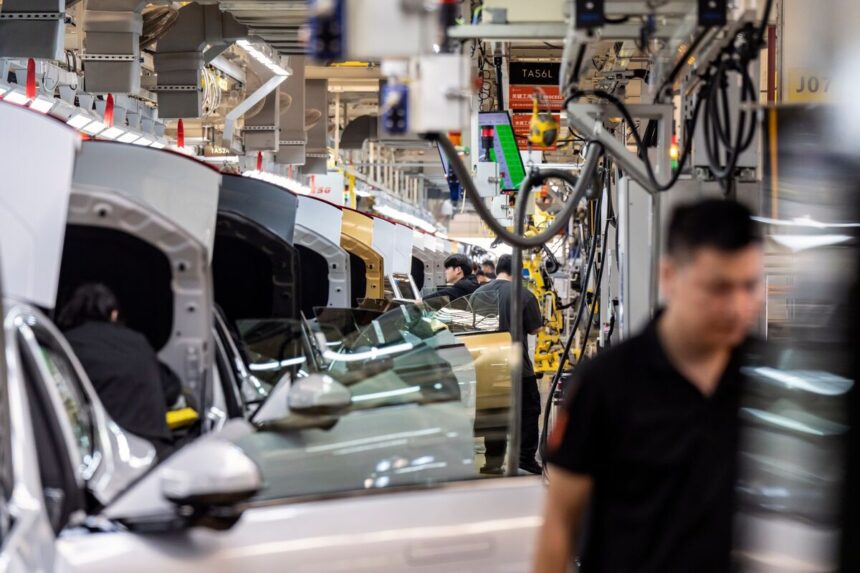
For China, the stakes are existential. Green technology exports have become a lifeline for an economy struggling with sluggish domestic consumption and a real estate crisis that shows no signs of ending. Solar panels, electric vehicles, and other clean energy technologies accounted for more than a third of China’s economic growth last year, according to a February analysis by the Centre for Research on Energy and Clean Air, a nonprofit think tank based in Helsinki. Without those green industries propping up GDP figures, China would have missed its official growth target. Last year also set a record for Chinese exports of green products, cementing their role as a pillar of national economic strategy.
Chinese companies have aggressively targeted the US market, viewing it as lucrative despite the tariffs. The push reflects a broader industrial strategy: dominate global supply chains for the technologies that will define the energy transition. Beijing has poured state subsidies into battery production, solar manufacturing, and EV assembly lines, creating economies of scale that make Chinese products cheaper than Western competitors. That advantage has sparked anxiety in Washington and Brussels, where policymakers worry about dependence on a geopolitical rival for critical infrastructure.
But China’s investigation into US practices isn’t just about trade retaliation. The Ministry of Commerce defined American barriers in sweeping terms—covering not only tariffs but also limits on technology cooperation and what it called efforts to stymie clean energy deployment. That framing suggests Beijing is aiming its message beyond Washington. “China is essentially arguing that US industrial policy is actively slowing global decarbonization, a message likely aimed less at Washington than at Europe and emerging markets,” said Jonas Nahm, an associate professor at Johns Hopkins University School of Advanced International Studies. The narrative plays well in developing countries that see Chinese solar panels and batteries as affordable tools for their own energy transitions.
At recent international climate talks, Chinese officials have pushed this argument hard. They portray their clean technology exports as a global public good—cheap, scalable solutions that accelerate emissions reductions worldwide. By contrast, they cast US policy as fragmented and protectionist, driven more by security paranoia than climate urgency. “Beijing is positioning itself as enabling fast, cheap clean energy rollout while casting the US approach as fragmented and protectionist under security pretenses,” Nahm added. It’s a savvy diplomatic move that complicates Washington’s efforts to rally allies around a unified stance on Chinese industrial policy.
The investigation also lands at a moment of internal debate within the Trump administration about how far to push economic decoupling from China. Hardliners want to expand tariffs and technology restrictions, arguing that Beijing’s dominance in green supply chains poses long-term strategic risks. Others worry that aggressive trade barriers will raise costs for American consumers and slow the domestic energy transition by making solar panels and EV components more expensive. Trump’s visit to Beijing in May was supposed to address these tensions, with both sides exploring whether any compromise on trade could prevent a return to the tit-for-tat escalations that marked his first term.
Now China has laid down a marker before those talks even begin. The investigation gives Beijing leverage—a tangible threat it can escalate or dial back depending on how negotiations unfold. If Trump announces new tariffs or export controls during or after his visit, China can quickly move from investigation to sanctions, targeting American industries with precision. Agricultural exports, aerospace products, and even financial services could face retaliation. Chinese officials have proven adept at choosing targets that inflict maximum political pain, hitting industries concentrated in swing states or sectors with outsized lobbying power.
What makes this moment particularly volatile is that both sides are operating under domestic political pressures that leave little room for compromise. Trump faces a Republican base skeptical of engagement with Beijing and eager for tough talk on trade. Chinese President Xi Jinping confronts his own economic headwinds and needs to project strength amid questions about his handling of the post-pandemic recovery. Neither leader can afford to look weak in front of domestic audiences, which narrows the space for the kind of backroom deal-making that once defused US-China tensions.
For industries caught in the crossfire, the uncertainty is paralyzing. American solar installers dependent on Chinese panels are watching costs and supply chains. Chinese EV manufacturers eyeing North American expansion are recalculating their strategies. European policymakers, already worried about being squeezed between Washington and Beijing, are drafting contingency plans in case the tariff war reignites and pulls them in. The global clean energy transition, which requires massive coordination and investment, is becoming hostage to great power competition.