Prime Minister Mark Carney stood in Brampton on a Tuesday afternoon and made a pitch that sounded less like budgetary housekeeping and more like a generational bet. His message was simple but sweeping: Canada is about to spend big on infrastructure, and the country needs workers ready to build it.
Carney broke down the details of a $51 billion fund designed to patch gaps in roads, bridges, water systems, and community centres from coast to coast. The Build Communities Strong Fund, first outlined in the 2025 budget and now law, represents what the prime minister called a near doubling of infrastructure investment over the next eight years compared to the previous eight.
That figure alone demands attention. But the political dimension is equally sharp. This is not just about fixing potholes or replacing aging pipes. It is about positioning the Liberals as the party of nation-building at a time when housing affordability and municipal strain dominate voter concerns. Carney knows that infrastructure spending connects to those anxieties in ways that abstract fiscal policy does not.
The announcement included $27.8 billion over ten years for core municipal needs like roads and sewers. Another $6 billion will support local projects such as building retrofits and recreation facilities. Brampton, where Carney spoke, received the first allocation under this stream: $64 million for a new recreation centre and park. By day’s end, Ottawa had committed $300 million to 13 projects nationwide, with over a third earmarked for water and wastewater systems tied to housing developments in Iqaluit.
Municipalities can now apply for funding through a federal web page launched the same day. The structure is deliberate. Ottawa wants to be seen as the partner stepping in where provincial coordination falls short. For mayors navigating housing pressures and crumbling infrastructure, this could provide real leverage. But it also raises questions about execution speed and bureaucratic friction.
The remaining $17.2 billion requires provincial and territorial matching. That pool includes $5 billion over three years to expand health care facilities, including emergency departments. Ontario leads with $6 billion. Quebec follows with $3.6 billion. British Columbia gets $2.2 billion, and Alberta receives $1.9 billion. Smaller provinces and territories will split hundreds of millions more.
There are conditions attached. Provinces must direct 20 percent of their funds toward rural, Northern, and Indigenous communities. Ten percent of the $6 billion direct delivery stream must go to Indigenous-led projects. These requirements reflect political calculation as much as policy design. The Liberals are trying to address criticism that federal infrastructure dollars flow disproportionately to urban centres and leave remote regions behind.
Carney also previewed upcoming announcements on skills training and apprenticeships. His appeal to young Canadians was direct. He urged them to consider trades like welding, plumbing, carpentry, and electrical work. “The next 25, 30 years is going to be a great time to be in the trades,” Carney said. “We are literally going to build this country.”
That language is intentional. The Liberals are aware that construction timelines depend on labour supply. Without enough electricians and pipe fitters, billions in funding stalls. Carney is framing the infrastructure push as an economic opportunity for workers, not just a government project. Whether youth buy into that narrative remains uncertain, especially as trade schools face enrolment challenges in some regions.
Ontario and Ottawa finalized an agreement last week worth $8.8 billion in matching funds. The goal is to encourage municipalities to cut development charges that inflate homebuilding costs. Both levels of government will also waive sales taxes on eligible new homes for one year. That adds another $1.7 billion to the pot, split among provinces and territories to lower construction expenses however they choose.
The tax waiver is politically significant. It allows Carney to claim action on housing affordability without directly controlling municipal zoning or provincial land use rules. But it also depends on provinces playing along. If premiers decide to allocate funds elsewhere or slow-walk agreements, the housing benefits could evaporate.
British Columbia Conservative MP Dan Albas dismissed the rollout as “another reannouncement.” As the Conservative critic for transport, Albas accused the Liberals of recycling old promises. “Conservatives want our infrastructure, homes and health to grow and improve,” he said in a statement, “but the Carney Liberals need to get out of the way and scrape their anti-development laws and unaffordable taxes.”
That critique reflects the broader Conservative strategy: portray the Liberals as obstacles to growth despite big spending pledges. Albas is betting voters see regulatory delays and tax burdens as bigger barriers than funding shortfalls. Whether that resonates depends partly on how quickly shovels hit the ground.
Infrastructure spending always carries political risk. Projects take years to complete. Voters often remember delays more than ribbon cuttings. Carney is gambling that visible progress on housing-related infrastructure and community facilities will pay electoral dividends before the next campaign cycle. But if the fund becomes mired in provincial turf wars or municipal red tape, it could reinforce frustration rather than confidence.
The emphasis on Northern and Indigenous communities is noteworthy. These regions often face the steepest infrastructure deficits, yet federal commitments have historically lagged. Requiring specific allocations signals awareness of that gap. Still, execution matters more than targets. Indigenous leaders have grown wary of federal promises that arrive late or with strings attached. Carney’s challenge is proving this time is different.
The sheer scale of the fund invites scrutiny. Fifty-one billion dollars over a decade sounds transformative. But spread across thousands of municipalities and competing needs, the per-project impact becomes harder to predict. Some communities will see meaningful upgrades. Others may receive modest top-ups that barely dent backlogs.
Carney is also navigating a tight fiscal environment. Deficits remain elevated, and borrowing costs have not returned to pandemic lows. Infrastructure investment can stimulate growth, but only if projects deliver productivity gains. Roads that ease bottlenecks or water systems that unlock housing supply justify the expense. Vanity projects or poorly planned builds do not.
The skills training component remains vague. Carney promised details soon, but the timeline is uncertain. Training programs take time to scale, and apprenticeships require employer buy-in. If construction ramps up faster than workforce capacity, labour shortages could delay projects and drive up costs. The Liberals need to coordinate education policy with infrastructure rollout. That requires working with provinces, which control most training systems.
This announcement reflects a broader Liberal strategy: use federal spending power to shape outcomes in areas where constitutional authority is shared or contested. Infrastructure sits at that intersection. Municipalities depend on provincial transfers and federal top-ups. By dangling billions, Ottawa gains influence over local priorities. But it also assumes political risk if results disappoint.
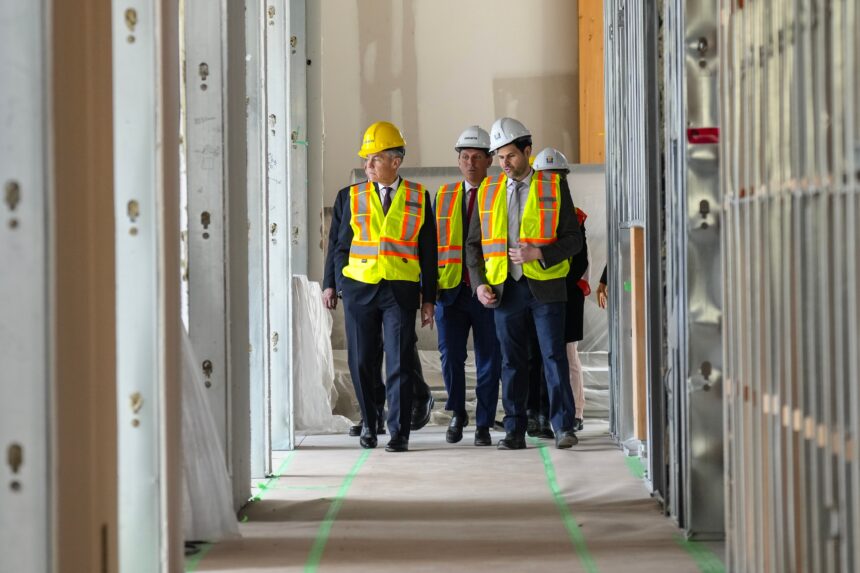
Carney’s Brampton appearance was carefully staged. The suburb has grown rapidly, straining services and infrastructure. Promising a new recreation centre there sends a message to similar communities across the country. The Liberals are positioning themselves as responsive to suburban growth pressures that swing ridings. Whether voters credit Ottawa or their local mayor for the improvements will shape the political payoff.