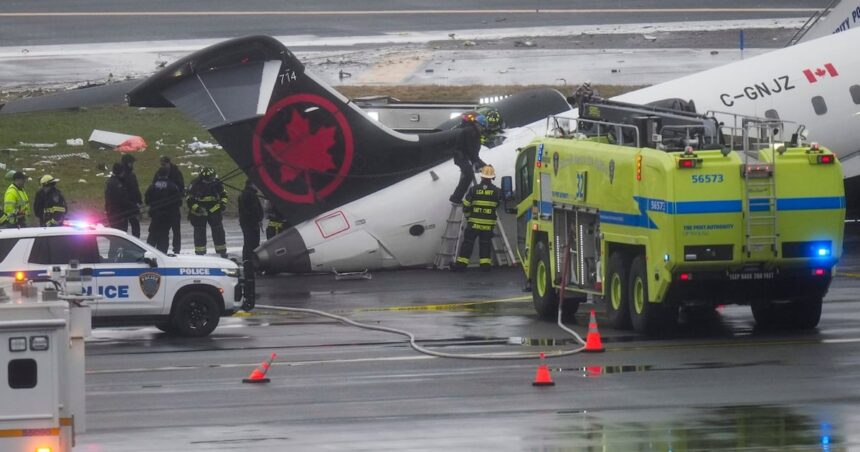
The wreckage at LaGuardia Airport is still being cleared, but the emotional debris has already spread far beyond New York. Two pilots are dead. Dozens injured. And across Canada, the shock is settling in like fog over the Rideau Canal in January.
Dennis Wyche knows what those final moments in the tower must have felt like. He spent 35 years in air traffic control, watching blips on screens turn into safe landings. When he heard the recorded conversation from LaGuardia, something inside him went cold.
“I feel it in my bones,” Wyche said. “I think every air traffic controller who hears a recording feels it in their bones.”
That phrase—in my bones—isn’t dramatic flourish. It’s occupational memory. The kind that lives in your chest when you’ve spent decades preventing disasters that are always one mistake away from happening.
The Air Canada Express flight, operated by Jazz Aviation, left Montreal’s Trudeau International Airport on what should have been a routine Sunday night trip. It touched down at LaGuardia shortly after 11:30 p.m. Then something went catastrophically wrong.
Wyche, who worked 20 years as a controller, about eight as an instructor, and roughly seven as a systems specialist, knows the script. Plane crashes don’t happen because of one failure. They happen when a chain of small errors aligns in the worst possible way.
“The system is not just the air traffic controller,” he explained. “It’s not just the pilot. It’s everyone working together.”
He ticked off the list: mechanics, gate agents, people ensuring passengers board safely. Every link matters. Every small thing that goes wrong could be an error waiting to meet another.
The Federal Aviation Administration is now picking through every second of that flight. Flight logs, cockpit recordings, maintenance records, weather data. Wyche says they’ll reconstruct the entire event frame by frame.
“They will find whatever piece of the puzzle contributed to the accident,” he said. The report could take a year, maybe two. Then the industry will adjust. That’s how aviation safety works—tragedy becomes data, data becomes protocol.
But protocols don’t stop the emotional fallout. At Pearson Airport in Toronto and Trudeau in Montreal, the ripple effects were immediate. LaGuardia stayed closed for nearly 15 hours. Dozens of flights were cancelled or delayed.
Ottawa’s international airport wasn’t hit as hard operationally, but the crash was still weighing on travellers. Debra Christmas was among them. Her sister has been a flight attendant with Air Canada for 38 years.
“She was the first message I sent,” Christmas said. “It’s heartbreaking.”
She travels frequently. She knows the statistics. Flying is safer than driving to the grocery store. But statistics don’t comfort you when you’re buckling into a seat at 30,000 feet and imagining yourself in someone else’s disaster.
“You don’t want to think about that, but you do,” she said. “Because it could have been you on that plane.”
That’s the bargain air travel demands. We surrender control in exchange for speed and convenience. Most of the time, it’s a deal that works. But when it doesn’t, the vulnerability is absolute.
Mark Sabry was at the Ottawa airport Monday watching his wife board a flight to Egypt. He wasn’t rattled enough to stop her from going, but he wasn’t ignoring what happened either.
“My condolences to everyone who has been affected,” Sabry said. “I hope the investigation will yield some tangible results.”
He wants policy changes if they’re needed. He wants lessons learned. But he also accepts the reality: air travel isn’t optional anymore. It’s infrastructure. It’s how families stay connected across continents and how economies move goods and people.
“Air travel is here to stay,” he said. “It’s something that we depend on.”
That dependency makes crashes like this even harder to process. We’ve built a world that requires us to trust systems we can’t fully see or control. Most Canadians will never meet an air traffic controller or understand the mechanics of a landing gear system. We just trust that someone else does.
Wyche understands that trust intimately. He also understands how fragile it can feel when something goes wrong.
“I can’t imagine how all the people affected by this accident are dealing with it,” he said. Not just passengers and crew, but everyone in the supporting systems. The gate agent who checked them in. The controller who guided them down. The mechanic who signed off on the plane.
“It’s really sad,” Wyche said. His voice carried the weight of someone who’s lived on the other side of that responsibility.
The Transportation Safety Board of Canada is sending investigators to New York. They’ll work alongside American counterparts to piece together what happened. The findings will matter to regulators, airlines, and pilots. But for now, they won’t ease the grief.
Two families are planning funerals. Dozens of passengers are recovering from injuries. And across Canada, people who fly regularly are confronting an uncomfortable truth: safety is a system, not a guarantee.
Wyche still believes in that system. He spent most of his adult life inside it. He knows it’s designed with redundancy and oversight and constant improvement. He also knows it’s not perfect.
“I believe the system is still a very, very safe system,” he said. But belief and certainty aren’t the same thing. And in the bones of every air traffic controller, there’s a quiet acknowledgment that on any given day, despite everything, something could go wrong.
For now, LaGuardia is reopening. Flights are resuming. The system is moving forward because it has to. But the people touched by this crash—whether they were on the plane, in the tower, or just watching from an airport terminal in Ottawa—will carry it differently.
Some things you feel in your bones. And some things stay there.