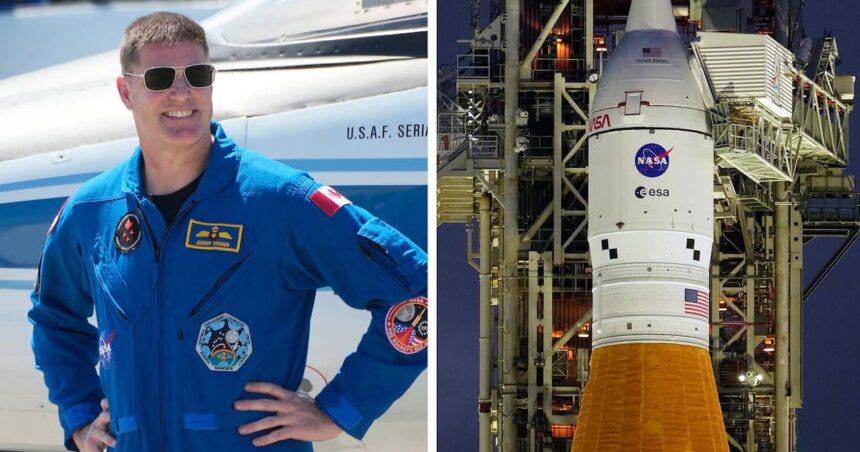
The roar echoed across the Florida coast just after noon on Wednesday. For Jeremy Hansen, a 38-year career built on precision, service, and an unwavering childhood dream reached its defining moment. The Canadian astronaut lifted off from Kennedy Space Center aboard Artemis II, becoming the first non-American ever to journey beyond low Earth orbit.
Hansen’s final words before liftoff carried weight. “We’re going for all humanity,” he said. Those seven words captured what this mission means—not just for Canada, but for a global effort to return humans to the moon after more than half a century away.
The 50-year-old from London, Ontario, is serving as mission specialist alongside veteran NASA astronauts Reid Wiseman, Victor Glover, and Christina Koch. Their 10-day lunar fly-around will take them farther from Earth than any human has traveled since the Apollo era. They’ll see the far side of the moon with their own eyes, a view no living person has witnessed.
Watch parties erupted across Canada as the rocket climbed. From Vancouver to Halifax, people gathered to watch one of their own make history. The moment felt personal for many Canadians who’ve followed Hansen’s journey since the Canadian Space Agency selected him in 2009.
Getting to this point wasn’t smooth. The launch, originally scheduled for February, faced delays tied to issues with the flight termination system. Engineers worked through technical problems in the hours before liftoff. But when the window opened Wednesday afternoon, the spacecraft was ready.
Hansen said goodbye to his family in those final hours. Cameras captured the moment he stood behind a barricade in his bright orange spacesuit, looked at his wife Catherine and their children, and said, “I love you.” He flashed a thumbs-up. Catherine wrapped her arms around their kids. Then Hansen and his crewmates boarded the vehicle that took them to the capsule.
Catherine Hansen spoke to reporters the day before launch. She described the emotional weight of watching her husband pursue something this enormous. “There will be excitement, there will be exhilaration, there will be terror and fear,” she said. She wanted the family to be present for every moment, whatever it brought.
The Hansens have been married 23 years. They met in Moose Jaw, Saskatchewan, when Catherine went to watch her brother receive his Air Force pilot wings. Jeremy told her on that first day he planned to become an astronaut. She thought it sounded crazy at first. But she quickly realized he meant every word.
“And we were going to do everything we could to make it happen,” she said with a smile.
Catherine is an accomplished obstetrician-gynecologist. The couple looked at their lives together and figured out how both could reach their professional goals. “I cannot really explain to people how important it is to just lift each other up, and that’s exactly what we’ve done,” she said.
Jeremy Hansen was a fighter pilot when the space agency recruited him. He’s spent 30 years in military service. Lt.-Gen. Jamie Speiser-Blanchet, commander of the Royal Canadian Air Force, said Tuesday she couldn’t be more proud. “It’s just a real pleasure to see his hard work pay off in this way.”
For the Hansen family, this mission represents 16 years of preparation. Catherine said they couldn’t have done it without extended family, friends, the military, the space agency, and government supports. The achievement belongs to more than one person.
King Charles sent “heartfelt good wishes” to Hansen and the crew on their “momentous endeavour.” His statement referenced the Astra Carta, a framework for sustainable space exploration. “May the stars align in your favour, and may your safe return inspire countless others,” the message read.
Hansen is carrying something personal on this journey. He commissioned a mission patch from Anishinaabe artist Henry Guimond. The patch’s shape and animal imagery reference the Seven Sacred Laws from First Nations teachings, which were shared with Hansen before his flight.
A Canadian flag sits at the top of the patch. Hansen wanted to recognize everyone across the country who made this possible. It’s a way of bringing Canada along symbolically. Other symbols on the patch acknowledge his Air Force service, humanity as a whole, and his family.
Catherine said the days before launch were spent soaking up time together. She’s excited to watch her husband represent Canada, but she’s also looking forward to what comes after. Jeremy wants to share the experience with people when he returns. “He really has the heart for wanting people to go on this ride with him,” she said.
This mission matters for Canada’s role in space exploration. The country has been a partner in international space efforts for decades, but this is different. Hansen’s presence on Artemis II reflects Canada’s contributions to the Artemis program, including the Canadarm3 robotic system planned for the lunar Gateway station.
The flight is also a stepping stone. Artemis II is a test mission, proving systems and procedures before Artemis III attempts a lunar landing. If all goes well, humans will walk on the moon again within the next few years. Canada will be part of that story.
Catherine Hansen described watching her husband live out his childhood dream as “no less than a miracle.” But miracles, in this case, required decades of work, sacrifice, and support from countless people. The rocket’s roar on Wednesday was the sound of all that effort paying off.
For Jeremy Hansen, the journey is just beginning. Ten days circling the moon. A view of Earth from a quarter-million miles away. The far side of the moon passing beneath the spacecraft. Then the return home, where millions of Canadians will be waiting to hear what he saw.