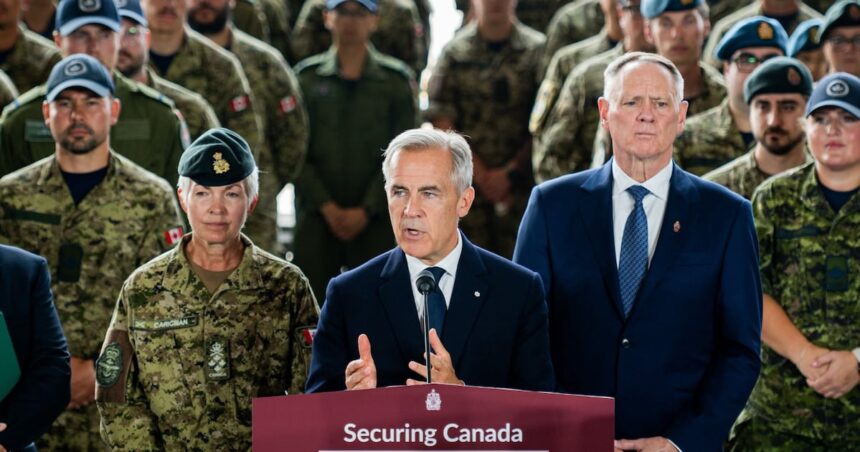
Article – Canada’s pledge to dramatically boost military spending may soon come with a price tag ordinary families feel every time they shop.
A report released Thursday by the C.D. Howe Institute lays out the financial reality behind Ottawa’s promise to raise defence spending to five per cent of GDP by 2035. The numbers are staggering. Annual military budgets would nearly triple, jumping from just over $50 billion in 2025–26 to almost $150 billion within a decade.
That’s roughly equal to what the federal government transfers to provinces each year for health care, social programs, and infrastructure combined.
Authors Colin Busby and Nicholas Dahir warn that without significant policy shifts, meeting this commitment will require hard fiscal choices. Among the options? A one- to two-point increase in the GST, slower growth in non-defence programs, or taking on more debt.
“Some combination of tax increases, spending cuts, or taking on more debt is required,” they wrote.
A two-point GST hike alone would generate about $25 billion in new revenue for 2025–26. But that also means a bigger bite out of household budgets, especially for those already stretched thin by the cost of living.
The report arrives just days after NATO confirmed Canada finally hit the alliance’s two per cent of GDP defence spending target. It’s a milestone the country missed for years. Under former prime minister Justin Trudeau, Canada was spending 1.5 per cent of GDP on defence in 2024, placing it among 11 NATO members failing to meet the benchmark.
Now the bar has been raised. And the fiscal pressure is mounting.
Canada is not in an ideal position to absorb this kind of spending surge. Productivity growth has stalled. The population is aging. Federal debt remains high. Economic growth has been sluggish. All of this leaves little room for manoeuvre.
The authors argue that without changes, ramping up military spending will push federal deficits even higher. That means more borrowing, more interest payments, and a heavier debt load passed on to future generations.
They suggest a mixed approach might be the most realistic path forward. A modest GST increase combined with tighter control over non-defence spending growth could help Ottawa meet its NATO commitments without spiralling into unsustainable debt.
“A mixed approach that combines a modest GST increase with slower growth in non-defence spending offers a practical path to meeting NATO commitments while maintaining fiscal sustainability,” the authors wrote.
But what does slower growth in non-defence spending actually mean? It could affect everything from public services to infrastructure projects to social programs. Departments already stretched thin may face even tighter budgets. Programs Canadians rely on could see funding growth capped or reduced.
There is broad political consensus that Canada needs to strengthen its military. The world has become more unstable. Threats are evolving. Allies are watching. But agreeing on the need is easier than agreeing on how to pay for it.
For decades, successive governments have deferred difficult fiscal decisions. The bill, it seems, is now coming due.
Raising the GST is politically toxic. It’s a regressive tax that hits lower-income households harder. Cutting or freezing spending in other areas risks backlash from communities and sectors that depend on federal support. Borrowing more adds to the debt burden and raises questions about fiscal responsibility.
Yet the report makes clear that doing nothing is not an option. Meeting the five per cent target without policy changes would blow a hole in the federal budget. Deficits would widen. Debt-to-GDP ratios would climb. And future governments would inherit an even tougher fiscal situation.
The C.D. Howe Institute is a non-partisan economic think tank. Its research is widely respected across the policy spectrum. When it flags fiscal risks, politicians and economists tend to pay attention.
This report is a wake-up call. It forces a conversation that many in Ottawa have been reluctant to have. How much is Canada willing to pay to meet its defence commitments? And who will bear the cost?
Taxpayers will be watching closely. So will provinces, which rely on federal transfers to fund health care and other services. So will advocacy groups concerned about cuts to social programs. And so will Canada’s NATO allies, who have long criticized this country for underspending on defence.
The debate over how to fund this military buildup is just beginning. But one thing is clear. The choices ahead will shape Canada’s fiscal landscape for years to come. And they won’t be easy.