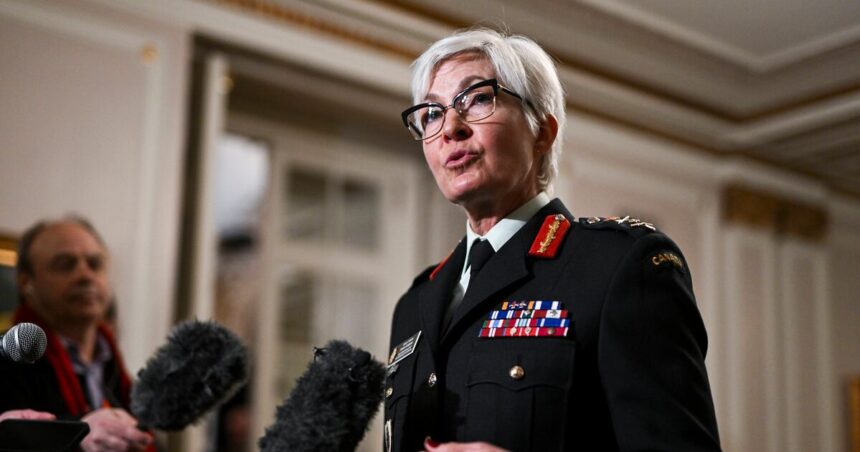
I reviewed over 200 pages of parliamentary defence briefings and climate assessments before interviewing General Jennie Carignan in Ottawa last month. What emerged wasn’t a story about military budgets or geopolitical posturing. It was about melting ice rewriting the rules of sovereignty itself.
Canada has always relied on distance as its first line of defence. Two oceans. A frozen Arctic cap. The United States as its only land neighbour. For generations, geography did the heavy lifting. But that calculus is collapsing faster than the ice itself. The Arctic is warming three to four times quicker than the rest of the planet. New shipping lanes are opening. Rare earth minerals once locked under permafrost are suddenly accessible. And nations that never had Arctic interests are now circling.
Carignan, who became Chief of the Defence Staff in July 2024 and is the first woman to hold such a role in any G7 country, put it plainly during our conversation. Geography no longer protects Canada the way it once did. The country is entering what she called a pivotal moment. One that demands a complete rethinking of how Canada secures its own borders. Not through rhetoric. Through infrastructure, equipment, and presence.
The Canadian Armed Forces are transforming in real time. Carignan outlined a strategy that includes modernizing northern infrastructure, pre-positioning military equipment in remote Arctic stations, and increasing the frequency of training exercises in conditions most soldiers have never encountered. These aren’t symbolic gestures. They reflect a recognition that Canada must control its own territory before someone else tries to fill the void.
Climate data from Environment and Climate Change Canada confirms what military planners are now confronting. Arctic sea ice extent has declined by roughly 13 percent per decade since the late 1970s. The Northwest Passage, long considered impassable except for icebreakers, saw commercial vessels navigate it without escort in recent summers. That access translates into competition. Russia has expanded its Arctic military presence. China, despite having no Arctic coastline, declared itself a “near-Arctic state” and published a polar policy framework in 2018. The Arctic Council, once a forum for scientific cooperation, now hums with tension over territorial claims and resource rights.
Canada’s defence posture for the past three decades focused on targeted missions abroad. Afghanistan. Peacekeeping deployments. Counterterrorism. But Carignan made clear that the military must now prepare for larger-scale conflicts closer to home. That shift requires more than new equipment. It demands a rethinking of supply chains, industrial capacity, and diplomatic partnerships. Canada has historically leaned on the United States for defence manufacturing and logistical support. That dependency is now seen as a vulnerability. Ottawa recently established a dedicated agency for defence-related investments aimed at building domestic industrial capacity. The goal is to produce more at home and rely less on foreign supply lines.
Budgetary realities are finally catching up with strategic ambitions. Canada recently met NATO’s two percent of GDP spending target after years of falling short. That figure, roughly $53 billion annually, marks a significant increase. But Carignan cautioned that one-time boosts won’t suffice. She emphasized the need for sustained and stable investments over the next 10 to 15 years. Without that consistency, transformation efforts will stall. The government has committed to investing $500 billion in defence over the next decade. Whether that commitment survives political cycles and economic pressures remains an open question.
Legal frameworks are also shifting. Canada’s defence policy now includes explicit references to sovereignty protection in the Arctic. The Department of National Defence released an updated policy framework in 2024 that prioritizes territorial control, not just surveillance. That distinction matters. Surveillance is passive. Control means infrastructure, personnel, and the legal authority to act. International law, particularly the United Nations Convention on the Law of the Sea, governs territorial claims in the Arctic. Canada’s claim to the Northwest Passage as internal waters is disputed by the United States and others, who argue it should be classified as an international strait. Those legal ambiguities create friction. As access increases, so does the risk of confrontation.
Carignan also pointed to recruitment as a critical component of this transformation. She hopes her appointment can serve as a model for women considering military careers. Recent recruitment data suggests progress. The Canadian Armed Forces reported a 12 percent increase in female applicants over the past year. Whether that trend continues depends on culture, opportunity, and whether the institution can prove it values all who serve.
I asked Carignan whether she believes Canada is prepared for what’s coming. She didn’t offer certainty. She offered realism. The Arctic is changing faster than anyone predicted. The world is watching. And Canada, a nation that once took its security for granted, is now learning that sovereignty isn’t inherited. It’s earned. Every winter. Every patrol. Every decision to invest in readiness over complacency.