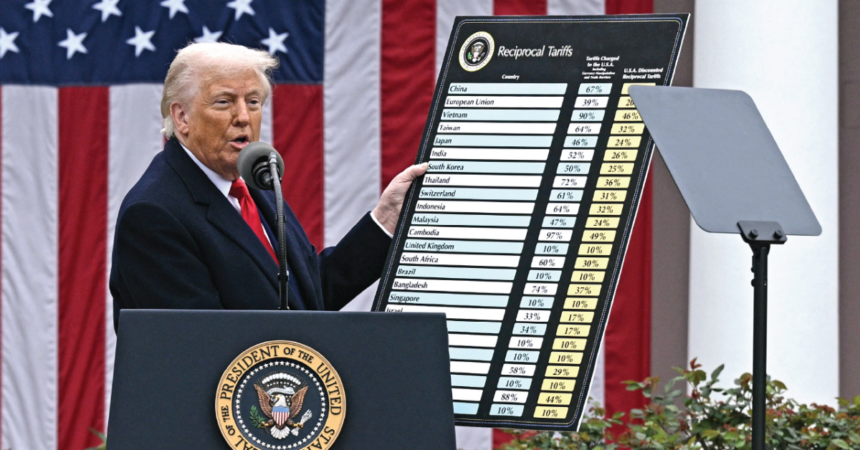
The ballroom at Mar-a-Lago was still decorated with champagne flutes when Donald Trump declared it “Liberation Day”—his term for the sweeping tariffs he slapped on America’s closest trading partners exactly one year ago. The promise was simple: reclaim economic sovereignty, punish unfair competitors, and restore manufacturing jobs to the heartland. Today, most Americans aren’t buying it. According to new data from the Pew Research Center, nearly six in ten U.S. adults lack confidence in Trump’s ability to make sound trade decisions, while 63 percent express doubt about his tariff strategy specifically.
That skepticism isn’t abstract. It’s rooted in grocery bills, supply chain disruptions, and retaliatory measures from Beijing to Ottawa. The poll, conducted in late March 2026 among 3,507 adults, reveals a public increasingly wary of economic nationalism when it collides with the complexities of global commerce. What seemed bold a year ago now feels reckless to a majority, even as Trump’s core supporters remain unmoved. The divide isn’t just political—it’s generational, geographic, and reflective of whose livelihoods depend on stable cross-border exchange.
Trade policy rarely makes headlines unless it breaks something. In this case, it broke trust. The confidence gap between Republicans and Democrats has widened into a chasm: 74 percent of GOP-leaning voters still believe Trump knows what he’s doing on trade, compared to just 12 percent of Democrats. But dig deeper and the fractures multiply. Older Republicans, those over 50, show near-unanimous faith in the president’s tariff judgment—84 percent express confidence, with nearly half calling themselves “very confident.” Meanwhile, 92 percent of older Democrats feel the opposite, with more than two-thirds saying they have no confidence at all.
This isn’t typical partisan bickering. It reflects fundamentally different experiences of the same economy. Rural manufacturing towns that voted for Trump see tariffs as leverage against decades of offshoring. Urban professionals and younger voters, who benefit from cheaper imported goods and integrated supply chains, view the same policies as inflationary and counterproductive. The U.S. Census Bureau reports that trade volumes with Canada and Mexico have declined modestly since the tariffs took effect, while Chinese imports have rerouted through third countries to avoid penalties—a workaround that undermines the stated goal without reducing dependency.
The divergence is sharpest when Americans assess relationships with specific trading partners. China remains the villain in the public imagination, though attitudes have softened slightly. Forty-two percent still believe Beijing benefits more from U.S.-China trade than America does—down from 46 percent a year earlier. That shift matters. It suggests the narrative of China as exploiter is losing urgency, possibly because the tariffs haven’t delivered the promised correction. Instead, American companies absorbed costs, passed them to consumers, or simply restructured supply chains in ways that kept Chinese components in the mix under different labels.
Canada and Mexico present a messier picture. These aren’t adversaries—they’re neighbors and treaty partners under the USMCA, the trade agreement Trump himself renegotiated. Yet his administration imposed tariffs on Canadian steel and Mexican agricultural products, citing national security and immigration enforcement. The move baffled even some Republican lawmakers. Senator John Thune of South Dakota told Politico last fall that “punishing allies to prove a point doesn’t strengthen your hand—it weakens the table.” Predictably, both countries retaliated. Canada targeted U.S. dairy and bourbon. Mexico slapped levies on Midwestern corn exports. The result was a trade spat that hurt farmers in red states while doing little to address the underlying imbalances Trump claimed to be fixing.
On the ground in Windsor, Ontario, just across the Detroit River, auto parts manufacturers are adjusting to a new reality. Maria Castellanos, who manages logistics for a supplier feeding Ford and GM plants on both sides of the border, described the tariff regime as “death by a thousand forms.” Every shipment now requires additional paperwork to verify origin and compliance. Delays have become routine. “We used to move parts in hours,” she said in a March interview. “Now it’s days, and the costs pile up.” That inefficiency doesn’t stay in the factory—it trickles into car prices, which have risen faster than inflation over the past year according to Bureau of Labor Statistics data.
The human cost of tariff policy rarely shows up in GDP figures, but it shapes voter sentiment. In Pennsylvania, a swing state Trump won twice, steelworkers initially cheered the tariffs on Chinese imports. A year later, enthusiasm has dimmed. The United Steelworkers union released a statement in February acknowledging that while some mills saw temporary boosts, the broader manufacturing ecosystem—automakers, appliance producers, construction firms—suffered from higher input costs. Jobs gained in Pittsburgh were offset by layoffs in Erie, where a refrigerator plant cited steel prices as a factor in its closure. Economic policy is rarely zero-sum in theory, but it feels that way when your factory shuts down.
Younger Americans, those under 35, show the least confidence in Trump’s trade acumen across all demographics. Only 28 percent of this cohort believes he can make sound decisions on tariffs, compared to 48 percent of those over 65. Part of this reflects partisan sorting—young voters skew Democratic—but it also signals a generational divide over globalization itself. Millennials and Gen Z came of age in an interconnected economy where iPhones are assembled in China, avocados come from Mexico, and streaming services operate borderless. The notion of “economic sovereignty” feels antiquated, even naïve, to a generation that views interdependence as inevitable and often beneficial.
The Pew survey also captured a striking ambivalence about trade itself. When asked separately whether trade creates jobs or destroys them, respondents split nearly evenly. This ideological stalemate explains why tariff policy has become such a blunt instrument—politicians exploit uncertainty rather than build consensus. Trump’s approach banks on the idea that fear of foreign competition outweighs the tangible costs of protectionism. For now, that gamble is losing. The majority of Americans may not have a PhD in economics, but they know when prices rise and promises fall short.
International reactions have been measured but pointed. The International Monetary Fund warned in its latest World Economic Outlook that tit-for-tat tariffs risk fragmenting global supply chains and slowing growth in already fragile markets. Meanwhile, the European Union, watching from the sidelines, has quietly strengthened trade ties with both Canada and Mexico—a hedge against American unpredictability. “We don’t punish partners to make points,” European Commission President Ursula von der Leyen said at a Brussels press conference in January. “We build coalitions to shape rules.” That diplomatic rebuke, aimed squarely at Washington, underscores how Trump’s tariff strategy has isolated the U.S. even among traditional allies.
A year after Liberation Day, the promise of economic independence looks more like economic loneliness. The confidence gap revealed in the Pew data isn’t just about Trump—it’s about whether Americans believe unilateral trade wars can deliver prosperity in a globalized world. Right now, most don’t.