The cockpit voice recorder will tell part of the story. So will the controller’s work schedule. But what happened on Runway Four at LaGuardia on Sunday night demands answers that go beyond any single piece of evidence.
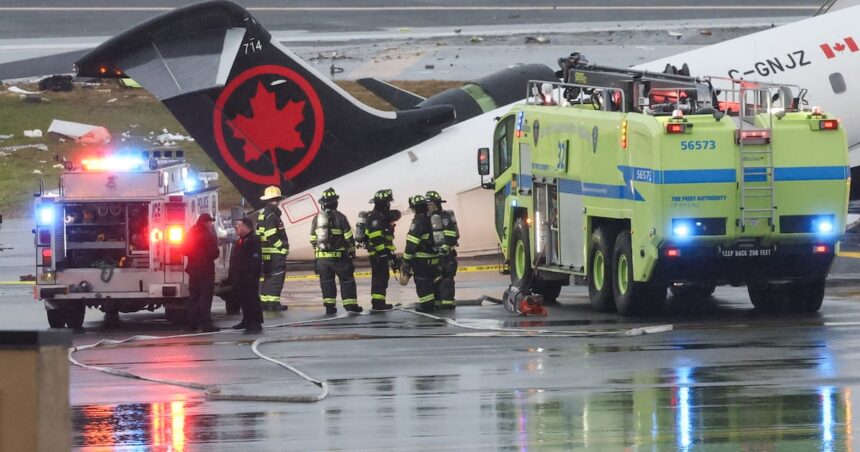
An Air Canada Express flight carrying 72 passengers from Montreal collided with a fire truck moments after landing. Both pilots died. Dozens of passengers were injured, though most walked out of hospital by Monday. Two Port Authority workers in the truck survived with injuries that weren’t life-threatening.
The plane, operated by Jazz Aviation under the Air Canada Express banner, was a Bombardier CRJ900. These regional jets are built for shorter routes and seat up to 100 people. They’re narrow-body aircraft with engines mounted at the rear and a distinctive T-shaped tail.
What we’re learning from the audio is chilling. An air traffic controller cleared the fire truck to cross the runway. Seconds later, his voice changed. “Stop, stop, stop, truck one, stop!” he shouted. Then an alarm went off. The collision had already happened.
In the minutes that followed, another voice tried to offer comfort. “Man, that wasn’t good to watch,” the second controller said. The first replied, “Yeah, I know. I was here. I tried to reach out to my staff. And we were dealing with an emergency earlier. I messed up.” His colleague pushed back gently. “No man, you did the best you could.”
Prime Minister Mark Carney called the crash “deeply saddening.” U.S. President Donald Trump was blunter. Speaking on a tarmac in Florida, he said, “Terrible. They made a mistake. It’s a dangerous business.”
Conservative Leader Pierre Poilievre expressed condolences on social media. Quebec Premier François Legault and Montreal Mayor Soraya Martinez Ferrada did the same. Foreign Affairs Minister Anita Anand said consular officials were on the ground in New York, with more en route.
Air Canada issued a statement expressing sorrow over the loss of two Jazz employees. The airline set up a helpline for families at 1-800-961-7099. Flights between Montreal and LaGuardia were cancelled until 2 p.m. Monday. The airport itself remained closed for the same period to allow investigators to work.
The fire truck had been responding to a separate issue. A United Airlines flight reported an odour on takeoff that made some flight attendants feel ill. Controllers were arranging a stair truck in case passengers needed to deplane. That’s when the emergency vehicle was given clearance to cross Runway Four.
What isn’t clear yet is whether one controller was handling both tower and ground frequencies. That matters. Aircraft talk to tower control. Ground vehicles talk to ground control. If those two channels weren’t coordinating in real time, a gap opens up. And gaps like that can turn fatal.
John Cox is a retired airline pilot and aviation safety analyst. He told CTV News Channel that National Transportation Safety Board investigators will spend days piecing together what happened. They’ll interview the air traffic controllers. They’ll listen to the cockpit voice recorder. They’ll talk to the fire truck crew when they’re able.
“All of this will help them assemble the timeline that led to this tragedy,” Cox said. He added that investigators will look at whether the controller was working two frequencies at once. They’ll examine fatigue, work schedules, and staffing levels at the tower.
Cox was careful not to speculate. “This is an exceedingly rare event,” he said. “So we need to understand what all led up to it.” He reminded viewers that air travel remains the safest form of transportation ever designed.
Phyl Durdey, another aviation analyst, wasn’t surprised by the severity of the collision. The aircraft was likely travelling around 100 miles per hour when it hit the truck. It hadn’t reached the halfway point on the runway yet. “That’s why the significant impact with the truck shredded the nose,” Durdey said.
He was surprised more passengers weren’t hurt. The plane would have stopped suddenly. Internal injuries, bumps, bruises—all of that was expected. But the death toll could have been much worse.
One passenger, Christopher Pal, helped others evacuate by sliding down the wing. His wife, Sarah Dorner, told CTV News Channel that Pal was one of the first off the plane. He smelled gas. That pushed him to act quickly. “He was encouraging people to just slide down, go down the wing,” Dorner said. “He was there to catch them, help people get off the wing.”
Pal is a computer science professor at Polytechnique Montreal. He doesn’t have medical training or an emergency response background. He just reacted. His glasses broke in the crash, but he didn’t need hospital care.
Another passenger, Jack Cabot, told CNN that the plane hit something immediately after landing. “And it was just chaos in there,” he said. “About five seconds later, we had come to a stop, but in that short period, I mean, everyone was hunkered down and everyone was screaming.”
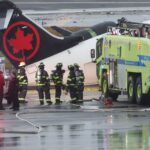
There were no directions from the cockpit. The front of the aircraft had been destroyed. Someone shouted to head for the emergency exit. That’s what they did. Photos from the scene show the plane’s nose pointed skyward, the cockpit peeled back to the first passenger window. Wires and flight controls hung in a shredded tangle.
The New York Post reported that a female flight attendant was ejected through the front of the aircraft while still in her seat. She survived. Port Authority police helped rescue her, and she was taken to hospital.
Harvey Scolnick is a retired U.S. Federal Aviation Administration controller. He told CTV News Channel that staff shortages in air traffic control have persisted for decades. Controllers work long hours and overtime. Agencies stretch existing staff instead of hiring more people.
“Very often positions get combined later in the evening especially right before the midnight shift or the overnight shift comes in,” Scolnick said. The audio from Sunday night suggests that positions may have been combined.
John Gradek, an aviation management expert, said controllers in the U.S. are under severe stress. There’s a shortage of around 3,000 controllers across the American aviation system. Investigators will look at how long the controllers on duty had been working, when their shifts started, when they were supposed to end, and whether they had taken breaks.
Controllers are highly trained. They’re required to have a “second-by-second attention span” when overseeing the complex movements of planes and vehicles. “That’s something they’re going to be looking at very closely,” Gradek said.
U.S. Transportation Secretary Sean Duffy expressed condolences on social media. He said the FAA was sending a team to the crash site as the NTSB investigates. “We will continue to work closely with the NTSB and share additional updates as soon as possible,” Duffy wrote.
The Transportation Safety Board of Canada announced it was sending investigators to New York to support the NTSB. The TSB is an independent agency that investigates air, marine, pipeline, and rail incidents. Its sole aim is advancing transportation safety. It doesn’t assign fault or determine civil or criminal liability.
Canadian Ambassador to the United States Mark Wiseman said the embassy’s consular team was working to support those affected. “My thoughts are with the families of those who lost their lives and with those injured,” he wrote.
New York City Mayor Zohran Mamdani said the city was in close contact with federal, state, and local partners. “I am grateful to our first responders, whose swift actions saved lives,” he wrote. He advised travellers to check with their airline for the latest flight information before coming to the airport.
Capt. Jason Ambrosi, president of the Air Line Pilots Association, called the loss of the two pilots a “profound tragedy.” He said the pilots had dedicated their careers to the safe transport of passengers. “We are all thinking of their families, loved ones, and colleagues at Jazz Aviation during this devastating time,” Ambrosi said. The association’s investigation team was travelling to LaGuardia to assist the NTSB.
At Toronto’s Pearson International Airport, 26 flights had been cancelled by Monday morning due to the closure at LaGuardia. Jake Keating, a spokesperson for Pearson, said there are about 45 flights between the two airports each day. “Even though it did not involve an aircraft that left Toronto or involve the Toronto airport at all, it does still have an impact here,” he said.
Transport Minister Steven MacKinnon wrote on social media that Canada was working closely with U.S. authorities. “Aviation safety remains our highest priority,” he said. LaGuardia was the 19th busiest airport in the U.S. in 2024, with more than 16.7 million passengers boarding there.
U.S. air traffic controllers are not affected by the partial government shutdown that has caused long delays at airport security checkpoints in recent days. But they have been affected by past shutdowns. In the fall, a previous shutdown led to flight reductions across 40 high-volume airports in November. The FAA said air traffic controllers were showing signs of strain after weeks without pay.
This investigation will take time. It will be methodical. Cox said investigators will look at air traffic control tapes, the flight data recorder, and the cockpit voice recorder. They’ll interview the fire truck driver and any other crew members in the truck as soon as they’re able. “It is a very methodical process to understand how this collision occurred,” he said.
What remains is the human cost. Two pilots are dead. Dozens of passengers were injured. Two Port Authority workers were hurt. And a question hangs over the entire event: how did a fire truck and a passenger jet end up in the same place at the same time?