The morning light cuts low across the Vermilion campus when the welding torches first spark to life. Students bend over metal joints, their hands learning the rhythm of precision work that will one day keep pipelines running, refineries humming, power systems steady. It’s the kind of labor that holds up economies quietly, without fanfare, until something breaks.
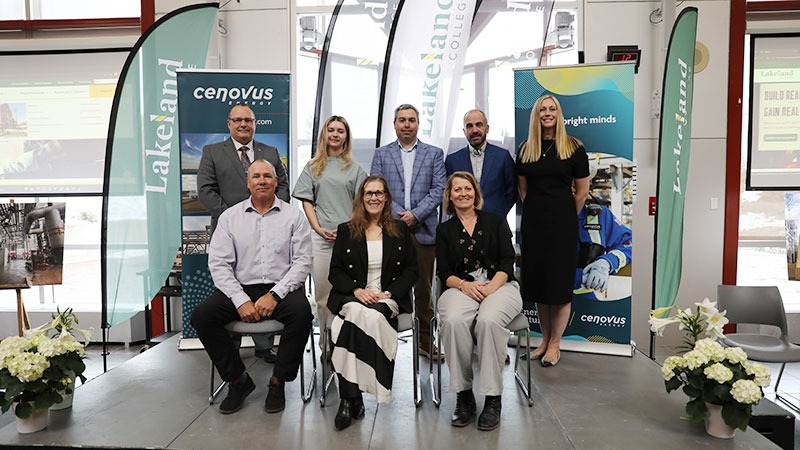
Now, those students will train in spaces that look more like the future they’re walking into. Cenovus Energy announced this week it’s putting $2 million into Lakeland College, a rural institution straddling the Alberta-Saskatchewan border that has long served as a gateway into trades and energy careers for young people who might not otherwise find their way into the sector.
The investment will modernize two labs at the Lloydminster campus—the Cenovus Energy Production Lab and the Cenovus Energy Power Engineering Lab—and upgrade learner spaces in the School of Trades and Technology at Vermilion. The college will also rename its Applied Engineering Building the Cenovus Energy Industrial Trades Building, a gesture that speaks to the depth of the partnership.
But beyond the nameplates and upgraded equipment, the funding will launch something potentially more consequential: dual-credit programming that allows high school students to earn college credits while still finishing their secondary education. One course will focus on energy through Lakeland’s School of Energy. Another will center on electrical work in the School of Trades and Technology.
Dr. Alice Wainwright-Stewart, president and CEO of Lakeland College, called the investment a model for what happens when industry and education align their intentions. She described Cenovus as a longstanding partner that understands how money spent on students reverberates through communities and sectors for years.
There’s a pragmatism to this kind of collaboration that doesn’t always get acknowledged. Rural colleges like Lakeland serve populations that are often overlooked in broader conversations about workforce development. Students here are frequently the first in their families to pursue post-secondary education. Many come from farming backgrounds or small towns where opportunity can feel like a distant concept.
Jeff Lawson, Cenovus executive vice-president of corporate development and chief sustainability officer, framed the investment as essential to ensuring a steady flow of skilled workers into the energy sector. He pointed to the interdependence of industry, government, and educational institutions in building what he called a pipeline of future-ready people.
The metaphor is deliberate. Energy companies have long faced criticism for recruiting labor without investing in the infrastructure that creates it. This funding suggests a different calculus, one that acknowledges the sector’s survival depends on more than extraction—it depends on cultivation.
Lakeland has made industry alignment central to its teaching philosophy. The college emphasizes that students should train with the same technology, equipment, and environments they’ll encounter once they leave campus. It’s not enough to teach theory if the tools in the classroom are outdated or disconnected from real-world practice.
That approach matters in trades where safety and precision are non-negotiable. A welder who hasn’t worked with modern equipment isn’t just less competitive—they’re more likely to make costly or dangerous mistakes. A power engineer unfamiliar with current systems can’t troubleshoot effectively when something fails at three in the morning in the middle of winter.
The dual-credit programming also addresses a subtler problem: the delay between high school graduation and career clarity. Many young people drift after finishing secondary school, uncertain about their next steps. By introducing them to trades and energy careers earlier, Lakeland hopes to shorten that gap and give students a head start on both education and employment.
This matters especially in rural areas, where economic options can be limited and young people often leave for cities in search of work. If students can see a viable career path while still living at home, they’re more likely to stay. That stabilizes communities and supports regional economies that depend on skilled labor.
Cenovus and Lakeland have partnered before on initiatives like Feast on the Farm, student awards, the Energy Centre and Residence Village, along with practicum placements and job opportunities for graduates. The relationship isn’t new, but this investment deepens it in ways that could reshape how students experience vocational training.
There’s also a broader context here. Canada’s energy sector is undergoing significant transformation as the country tries to balance economic needs with climate commitments. That shift requires workers who understand both traditional energy systems and emerging technologies. Training programs that prepare students for that dual reality are becoming essential.
Lakeland’s location in the heart of oil and gas country gives it a unique role in that transition. The college serves students who often have family ties to the industry, who grew up in towns where the energy sector is the economic backbone. Teaching them how to adapt without abandoning their roots is a delicate task.
The $2 million from Cenovus won’t solve every challenge facing rural education or the energy workforce. But it does something important: it signals that investment in people can be as strategic as investment in infrastructure. It recognizes that the future of any industry depends on who’s coming up through the ranks, and whether they’re prepared for what’s ahead.
When those welding torches spark to life next fall, the students bending over them will be working in spaces that reflect a commitment to their success. Whether that translates into long-term stability for the sector and the region depends on much more than money. It depends on whether the industry continues to see education as partnership, not transaction.