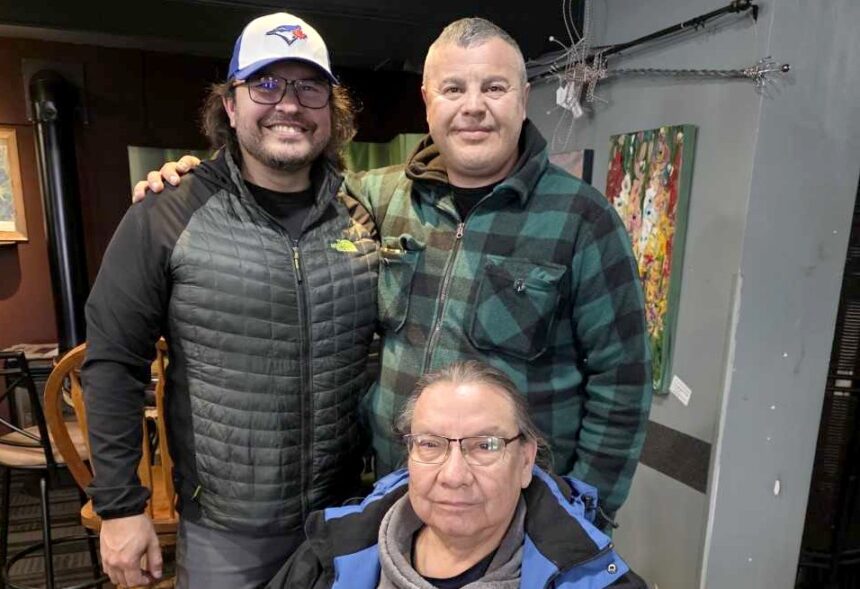
Three men in Prince Albert decided they had seen enough. Enough isolation. Enough of watching their neighbors struggle silently. Enough young men turning to substances because no one showed them another path.
Conrad Burns, Robby Clarke, and Elder Harold Burns aren’t professional counselors. They’re community members who noticed a gap that formal services weren’t filling. For over a year now, they’ve been building something quiet but purposeful: a weekly gathering where men can reconnect with who they were meant to be.
Their approach doesn’t rely on clinical language or treatment models imported from elsewhere. Instead, they’re drawing on something older and more rooted in place. They call it the “Dog Warrior” framework, a concept tied to traditional roles that Indigenous men once held in their communities.
“We wanted to create a foundation where we looked at who Aboriginal men were traditionally and how that applies to us today,” Conrad Burns explained to local reporters. “Being what we call the ‘Dog Warrior’ would be how to be true to our ancestral selves and being honest too, so that we can move forward in a good way.”
The meetings happen weekly at Plaza 88. Any man can walk in. Indigenous or not. Teenager or elder. No referral needed. No intake forms. Just show up.
Prince Albert has one of the highest Indigenous populations in Saskatchewan, hovering around 40 percent according to recent census figures. But population numbers don’t tell you much about access. Many residents grew up disconnected from ceremony, from language, from the cultural practices that once anchored identity and purpose.
That disconnection has consequences. Clarke pointed to what he sees unfolding across the city every day. Gang recruitment. Addiction cycles. Violence that stems from young men searching for belonging in all the wrong places.
“We’re basically trying to build something that would be on the other side of the spectrum where people would then embrace identity and worldview in a positive, good way and have access to ceremonies,” Clarke said.
The group has partnered with the Prince Albert Indian and Métis Friendship Centre, which is developing cultural grounds at Little Red River Park. Burns and Clarke plan to use that space for sweat lodges and other ceremonies as the need arises. It’s about creating physical places where men can gather without judgment or expectation beyond showing up honestly.
Warren Roberts from the Friendship Centre has offered cost-sharing for land-based activities. One idea involves organizing men’s outings to harvest traditional medicines like sweetgrass and rat root. For many participants, it would be their first time doing something their grandfathers once did as routine.
Clarke knows that experience matters. “Warren Roberts from the Friendship Centre wants to cost-share so we can go out and pick medicines as a men’s group, go pick sweetgrass or rat root and make a day of it,” he said. It’s not therapy in the conventional sense. It’s connection to land and practice and each other.
The initiative targets no specific age range. Teens are welcome alongside middle-aged men and elders. The organizers understand that the void men feel doesn’t discriminate by generation. It shows up differently depending on your stage of life, but the emptiness is similar.
What fills that void becomes the critical question. Some men turn to alcohol or opioids. Others drift toward gangs that offer structure and identity, even if it comes wrapped in violence. The Dog Warrior gatherings offer a different option, one grounded in accountability and cultural continuity rather than escape.
“At the end of the day, our mission is to fill that void because people are out there struggling with their own identities and worldview and when people have a void, they will fill those things with addictions,” Clarke said.
There’s no formal curriculum here. No twelve-step program or evidence-based protocol approved by a provincial health authority. That’s partly the point. The three organizers believe that for many Indigenous men, healing doesn’t start in a clinic. It starts in a circle, with an elder present, where stories can be told without clinical diagnosis attached.
Prince Albert faces well-documented challenges around mental health and addiction. Provincial data shows higher-than-average rates of substance use disorders in the region. Emergency room visits related to overdose have climbed steadily. Gang activity remains a persistent concern for both city police and community organizations.
Formal support services exist, but capacity is limited. Wait times for addictions counseling stretch weeks or months. Youth programs are often underfunded. And many existing services weren’t designed with Indigenous cultural frameworks in mind, which can make them feel foreign or unwelcoming to the people who need them most.
The Dog Warrior group isn’t trying to replace those services. They’re filling a different niche entirely. It’s peer support rooted in shared culture and lived experience. It’s preventative rather than reactive. And it’s designed to be accessible without navigating intake procedures or waitlists.
Elder Harold Burns brings traditional knowledge and ceremonial guidance to the gatherings. That presence matters. Elders hold authority in Indigenous communities that doesn’t translate easily into mainstream social service models. Having one involved signals that this effort is legitimate, grounded in proper protocol and respect for tradition.
The group already has relationships with elders in surrounding communities, which allows them to facilitate teachings and ceremonies in a good way. That network becomes crucial when you’re trying to offer cultural reconnection at scale. You can’t just improvise ceremony or claim teaching authority without proper lineage and community backing.
For now, the work continues quietly. Week after week, men gather. Some come once and never return. Others become regulars. A few bring friends or family members who are struggling. The organizers don’t track attendance metrics or measure outcomes in ways that would satisfy a grant application. They measure success in smaller terms. A man who stops using. A teenager who finds purpose. A father who learns how to be present.
Prince Albert won’t solve its mental health and addiction crisis through one grassroots initiative. But the Dog Warrior gatherings represent something important: community members stepping up when systems fall short. It’s mutual aid with a cultural foundation. It’s men helping men find their way back.
The meetings remain open to anyone who wants to show up. No one gets turned away. That openness reflects a traditional value that the organizers want to model. Community was never meant to be conditional or exclusive. Everyone had a role. Everyone belonged.