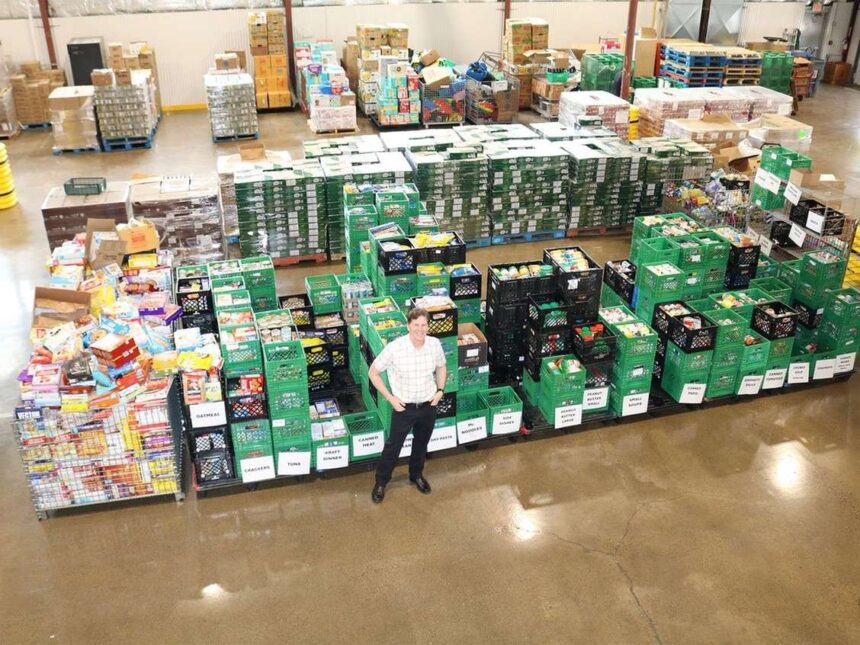
The lines outside Partners in Mission Food Bank tell a story that budget spreadsheets and inflation reports can’t quite capture. Dan Irwin has watched those lines grow longer each year since he took the helm as Executive Director. Now, heading into what he calls the “quiet donation months,” the food bank is mobilizing volunteers across Kingston for what might be its most critical collection drive yet.
On Saturday, April 11, teams will fan out to eight grocery stores across the city. Their goal sits at 25,000 pounds of food and $30,000 in cash donations. It’s ambitious, but the need has never been sharper.
Irwin doesn’t mince words when describing the trajectory. Last year marked the fifth consecutive record for demand at the food bank. The first quarter of 2026 has pushed that trend even further, with a 22.8 percent spike compared to the same period last year. One in 17 people in Kingston and Loyalist Township now relies on Partners in Mission for food assistance.
Those aren’t abstract statistics. They represent families making impossible choices at kitchen tables, seniors stretching pension cheques until they snap, and working adults discovering that employment no longer guarantees food security.
The Food Blitz runs from 9 a.m. to 4 p.m. Saturday. Volunteers will hand out collection bags to shoppers and gather donations at locations including Tanya’s No Frills on Division Street, Loblaws on Princess Street and Midland Avenue, FreshCo on Princess Street, and Food Basics stores on Highway 15, Princess Street, and Gardiners Road. Andrew & Emily’s No Frills on Coverdale Drive rounds out the list.
The most-needed items haven’t changed much over the years, but the urgency around them has. Canned meat and fish, boxed breakfast cereal, pasta and pasta sauce, and peanut or alternative spreads top the priority list. Baby food, diapers, and wipes remain in constant short supply, a reminder that inflation hits families with young children particularly hard.
Irwin emphasized that the Food Blitz serves dual purposes. It bolsters inventory heading into slower donation months, typically late spring and summer when donor attention drifts elsewhere. But it also raises awareness. Many Kingston residents still don’t realize how widespread food insecurity has become in their own community.
Partners in Mission operates without government or agency funding. That makes it both nimble and vulnerable. Every can donated, every dollar contributed, comes from individuals, businesses, and community groups who recognize that the safety net has holes.
This year’s effort draws support from an impressive coalition. Kingston Rotary groups, the Kingston and Area Real Estate Association, RBC, BMO, Empire Life, Kawartha Credit Union, and Celanese have all stepped up. Irwin made a point of thanking the countless individual volunteers who make the operation possible.
“Their incredible assistance brings our mission ‘to provide nourishment, hope, and support in our community with an opportunity for all to share’ to life,” he said in a recent release.
The food bank has been a Kingston fixture since 1984. Four decades of service means institutional memory that tracks economic shifts and policy changes. The current surge in demand reflects broader national trends, but it also carries distinct local characteristics shaped by Kingston’s particular mix of students, retirees, service workers, and families.
Federal cost-of-living measures and provincial social assistance programs have not kept pace with housing and grocery inflation. The gap between policy intention and lived reality widens each month. Food banks become pressure valves for that gap, absorbing need that other systems fail to address.
Irwin’s comment about five consecutive record years deserves unpacking. That’s half a decade of escalating need, predating pandemic disruptions and extending well beyond them. It suggests structural issues rather than temporary shocks. Rising rents, stagnant wages, and grocery prices that climb faster than incomes have created a new normal where food insecurity touches demographics once considered secure.
The 22.8 percent increase in the first three months of 2026 is particularly striking. It represents acceleration, not stabilization. Whatever relief some households gained from recent policy adjustments hasn’t reached the people Partners in Mission serves.
Community food banks occupy an awkward position in Canadian civic life. They fill gaps that shouldn’t exist in a wealthy country. Yet their presence has become permanent infrastructure rather than emergency response. Partners in Mission exemplifies that tension, celebrating 42 years of service while confronting demand that keeps breaking records.
The Food Blitz also highlights something often overlooked in political debates about poverty and food security. Solutions require more than policy announcements. They need logistics, volunteers, warehouse space, refrigeration, and the unglamorous work of sorting donated goods. Saturday’s collection drive represents that ground-level reality.
Monetary donations can be made online at the food bank’s website. Cash contributions allow the organization to purchase specific items and respond flexibly to shifting needs. A dollar donated often stretches further through bulk purchasing arrangements than the same dollar spent by individual shoppers.
For Kingston residents wondering whether their contribution matters, the math is straightforward. One in 17 neighbors needed food bank assistance last year. That ratio will likely worsen this year unless donation volumes match rising demand.
Irwin’s focus on awareness makes strategic sense. Food insecurity often hides in plain sight. Families experiencing it rarely advertise the fact. Co-workers, classmates, and fellow congregants manage hunger quietly, making the scope of need invisible until food banks publish their data.
Saturday’s Food Blitz offers a tangible response. Shoppers can grab an extra box of cereal, some canned tuna, or a jar of peanut butter. Volunteers will collect it, sort it, and distribute it to people who need it. The simplicity of that exchange carries profound civic weight.
Partners in Mission has served Kingston for more than four decades without government funding. That independence comes with vulnerability, but also authenticity. The community either steps up or neighbors go hungry. Saturday will test that relationship once again.