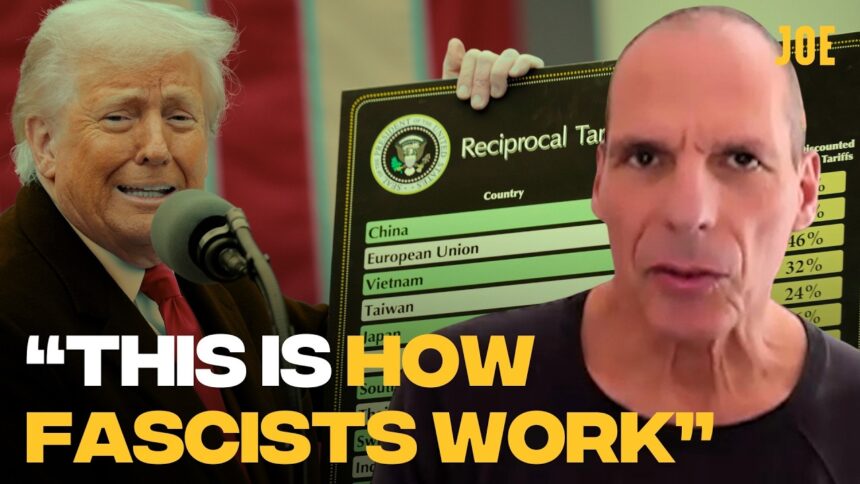
I stood in a Brussels café last week watching European trade ministers file past, their expressions somewhere between bewilderment and panic. Trump’s tariff announcements had just dropped, and the careful architecture of post-war trade seemed to be collapsing in real time. One German attaché I know muttered something about “economic vandalism.” But Yanis Varoufakis, the former Greek finance minister turned global economics provocateur, sees something far more calculated at work.
Varoufakis isn’t buying the chaos narrative. In his view, Trump’s tariff offensive represents a deliberate demolition of multilateral trade structures, designed to drag individual nations into bilateral negotiations where American leverage becomes overwhelming. It’s not recklessness. It’s strategy. And it’s working exactly as intended, forcing countries to choose between access to American markets and their own economic sovereignty.
The comparison Varoufakis draws to Nixon’s 1971 decision to abandon the gold standard isn’t accidental. That move unilaterally ended the Bretton Woods system, reshaping global finance to America’s advantage for decades. Trump’s tariffs, in this reading, mark a similar rupture—the end of the globalization framework that Washington itself built but no longer finds useful. The International Monetary Fund warned in March that fragmented trade blocs could reduce global GDP by up to seven percent over the medium term. That’s not a bug in Trump’s plan. It’s a feature.
What makes this moment particularly brutal is how it exposes the hollow foundations of certain economies. The United Kingdom, for instance, has spent forty years building wealth through financial services while letting manufacturing wither. Varoufakis argues that financialization creates the illusion of prosperity without the structural resilience to weather genuine economic conflict. When tariffs target goods, services-based economies suddenly realize they’ve been playing a different game entirely. UK manufacturing now represents just nine percent of GDP, down from twenty-five percent in the 1970s, according to the Office for National Statistics.
I’ve reported from factory towns across the American Rust Belt and England’s Midlands. The pattern is identical: shuttered plants, debt-heavy households, and a political class that promised service-sector jobs would replace industrial work. They didn’t, not with the same stability or wages. Now those communities watch as tariff wars unfold, knowing they lack the productive capacity to benefit even if their governments secure better terms. The economist Mariana Mazzucato has spent years documenting how financialization extracts value rather than creating it, leaving economies vulnerable precisely when they need resilience.
The deeper game, as Varoufakis sees it, benefits American financial elites regardless of tariff outcomes. Tariffs drive up costs for consumers and create market volatility, but they also funnel negotiations through channels where corporate interests hold disproportionate influence. Trade deals get hammered out behind closed doors, often prioritizing intellectual property protections and investor rights over labor standards or environmental safeguards. The United States Trade Representative’s office has made clear that bilateral agreements will include “robust” IP enforcement—code for pharmaceutical patents and tech monopolies.
China and the United States share one critical advantage in this scenario: enormous internal markets. China’s middle class now exceeds four hundred million people, according to Brookings Institution estimates. America’s consumer economy remains the world’s largest. Both can theoretically absorb the inefficiencies of fragmented trade because their domestic demand provides a cushion. Companies might grumble about supply chain disruptions, but neither economy faces existential collapse from reduced cross-border commerce.
Europe confronts an entirely different reality. The European Union comprises twenty-seven economies with divergent industrial bases, fiscal policies, and political priorities. Germany runs massive manufacturing surpluses while southern European nations struggle with debt and unemployment. The EU’s collective GDP rivals America’s, but its inability to coordinate industrial strategy leaves it perpetually reactive. When Trump imposed steel tariffs in 2018, European retaliation targeted bourbon and motorcycles—symbolic gestures that changed nothing structurally.
I spoke with a Polish manufacturing analyst in Warsaw last fall who laid out Europe’s dilemma starkly. The continent lacks a unified approach to emerging technologies, green energy infrastructure, or semiconductor production. Individual nations compete rather than collaborate, while China pours state resources into strategic sectors and America leverages its tech giants. The European Commission has proposed a Green Deal Industrial Plan, but it remains chronically underfunded compared to America’s Inflation Reduction Act or China’s Made in 2025 initiative.
Varoufakis contends this fragmentation guarantees European stagnation. Without massive coordinated investment in productive capacity—not financial instruments or consulting services—Europe becomes a bystander in the new economic order. Germany’s recent industrial output figures support this worry. Manufacturing dropped 1.5 percent in the fourth quarter of 2024, with energy-intensive sectors particularly hammered. The European Central Bank keeps warning about “competitiveness gaps,” but warnings don’t build battery factories or train engineers.
The humanitarian cost of these shifts rarely makes trade policy headlines. I’ve watched Syrian refugees in German integration programs training for manufacturing jobs that may not exist in five years. Turkish workers in Dutch logistics hubs face automation driven partly by tariff-induced cost pressures. When economists talk about “structural adjustment,” they mean communities upended, skills rendered obsolete, and safety nets strained past capacity. The International Labour Organization estimates that trade fragmentation could eliminate fourteen million jobs globally by 2030, concentrated in export-dependent regions.
What unsettles me most after two decades covering geopolitics is how little public debate these transformations generate. Tariff policy sounds technical, boring even. But it determines which communities thrive and which communities die. It shapes everything from climate transition timelines to military supply chains. Trump’s approach treats international commerce as zero-sum competition, abandoning any pretense of mutual benefit. That’s a fundamental philosophical shift, and its consequences will outlast any single administration.
Varoufakis has plenty of critics who dismiss his analysis as too conspiratorial or ideologically rigid. Fair enough. But his core point deserves reckoning: the globalization era is ending, and what replaces it will be shaped by those willing to wield economic power most ruthlessly. Europe’s bet on rules-based multilateralism looks increasingly like a relic. America and China are already playing a different game, one where leverage matters more than norms.
The question isn’t whether Trump’s tariffs will cause short-term economic pain. They will. The question is whether democracies can build economies resilient enough to withstand this new era without abandoning the social contracts that make them worth defending. Right now, I’m not sure anyone has a convincing answer.