I’ve watched trade wars unfold from Port-au-Prince to Prague, and the pattern is always the same: what begins as domestic posturing ends as a collective headache for everyone involved. The Trump administration’s latest attempt to simplify its sprawling steel and aluminum tariff system is no exception. After months of compliance nightmares for American importers and strained relationships with major trading partners, Washington is finally preparing to announce a tiered approach that could reshape how these duties function. But the question hanging over Brussels and Beijing alike is whether this recalibration will ease tensions or deepen them.
When Trump imposed a 50 percent levy on foreign steel and aluminum last year, the stated target was Chinese overcapacity. Fair enough—China’s industrial output has long distorted global markets, flooding sectors with subsidized goods that undercut competitors. But the tariffs quickly expanded to cover products containing these metals, hitting allies as hard as adversaries. Canada, the European Union, Mexico, and South Korea—all critical trade partners—found themselves caught in the crossfire. I spoke with a mid-sized Canadian auto parts manufacturer in January who described the process as “trying to navigate a minefield blindfolded.” His company spent tens of thousands on compliance consultants just to keep shipments moving.
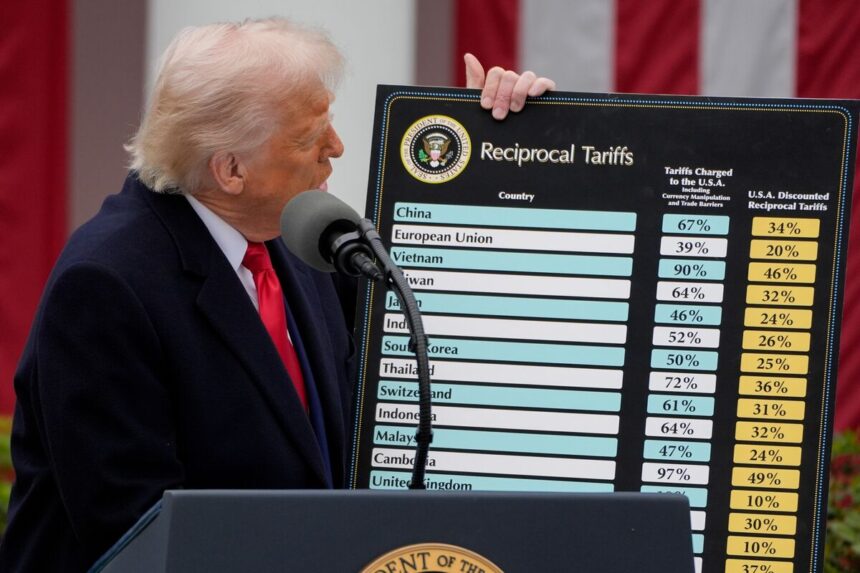
The new approach reportedly shifts tariffs from content-based calculations to the full value of imported products. On paper, this sounds simpler. In practice, it could mean higher costs across entire supply chains. A European steel executive I interviewed in March warned that such a change would “punish downstream industries more than it protects upstream ones.” The announcement is expected as early as Thursday, coinciding with the one-year anniversary of Trump’s “Liberation Day”—that April 2, 2025 declaration of global tariffs that the Supreme Court ultimately struck down in February. The timing feels deliberate, almost theatrical, as if the administration is trying to reclaim a narrative that slipped through its fingers.
Adding another layer to this already complex picture, the US is reportedly planning 100 percent tariffs on certain pharmaceutical imports. According to the Financial Times, companies that haven’t struck deals with Trump would face these punitive duties. Countries with negotiated agreements would see rates capped under those terms. This creates a two-tiered global pharmaceutical market where access to American consumers becomes a bargaining chip. A Geneva-based trade lawyer told me last week that this approach “weaponizes public health in a way we haven’t seen before.” She’s right. When essential medicines become subject to the same mercurial tariff logic as steel beams, the human cost shifts from abstract to immediate.
The most critical date on the calendar isn’t this Thursday’s announcement but July 24. That’s when Trump’s 10 percent universal duties—imposed after his Supreme Court loss—expire. He’s also launched two Section 301 investigations targeting industrial overcapacity and forced-labor practices, either of which could trigger additional tariffs. But unlike a year ago, the political environment has shifted. Inflation concerns are mounting, and trade is slowing partly because of the ongoing US-Israeli war against Iran. When I was in Washington two weeks ago, even Republican congressional staffers privately admitted that another round of broad tariffs would be “politically toxic.”
The United Nations Conference on Trade and Development warned Wednesday that international commerce is losing momentum after a strong start to 2026. Global merchandise trade is now expected to grow between 1.5 and 2.5 percent this year, a sharp drop from last year’s 4.7 percent. These aren’t just numbers on a UNCTAD report. They represent real jobs, real factories, and real communities that depend on predictable trade flows. A Polish logistics coordinator I know described the current climate as “planning in quicksand.” Every shipment requires contingency upon contingency, driving up costs that ultimately land on consumers.
Meanwhile, US manufacturing activity expanded in March by the most since 2022, according to the Institute for Supply Management. But this growth comes with a painful asterisk: input prices surged amid the war with Iran. The ISM’s gauge of prices paid for manufacturing inputs climbed 7.8 points to 78.3, the highest since mid-2022. Over two months, the index jumped 19.3 points—the steepest increase in nearly a decade. Manufacturers are caught between rising demand and skyrocketing costs, a squeeze that tariffs only worsen.
The Iran conflict adds another dimension entirely. Tehran’s Islamic Revolutionary Guard Corps now exerts control over shipping through the Strait of Hormuz, extracting tolls from vessels and giving preferential treatment to ships from countries it considers friendly. The United Arab Emirates has called on the UN to intervene, but diplomatic solutions seem distant. This chokepoint carries roughly one-fifth of global oil supply, and any prolonged disruption reverberates through energy markets, manufacturing costs, and ultimately consumer prices. I watched similar dynamics play out during the Suez Canal blockage in 2021, and the ripple effects lasted months.
American manufacturers of plastic goods—soda bottles, peanut butter jars, sandwich bags—are feeling the pinch as the Iran war chokes off supplies. A Texas packaging executive told me his company is operating at 70 percent capacity because resin shipments have become unpredictable. “We’re not even talking about tariffs anymore,” he said. “We’re just trying to get raw materials.” This is the reality behind policy debates: real people scrambling to keep businesses afloat while Washington and Tehran calculate their next moves.
Canada has emerged as another friction point. The US Trade Representative again cited Canadian laws about online platforms as trade barriers, adding the country’s sovereign-computing initiative to the list. These digital services issues will likely dominate upcoming trade talks, but they also reveal a broader truth: trade policy has become inseparable from technology policy, national security policy, and industrial policy. The old frameworks don’t fit anymore, and nobody has figured out what replaces them.
Europe offers a contrasting case study. Late to the AI boom and trailing China on electric vehicles, the continent remains competitive in humanoid robotics. This matters because it shows how targeted industrial strategy can carve out advantage even when broader trends seem unfavorable. But Europe also faces its own vulnerabilities. Emirates Global Aluminium, the Middle East’s top producer, halted operations at its Al Taweelah smelter after Iranian missile and drone strikes over the weekend. Global supply chains are so interconnected that a strike in Abu Dhabi affects production in Stuttgart.
The fundamental challenge is that tariffs, sanctions, and trade restrictions are blunt instruments in a world that demands precision. They generate revenue and signal resolve, but they also impose costs that cascade through economies in unpredictable ways. I’ve interviewed enough factory managers, logistics coordinators, and trade officials to know that the people implementing these policies often understand their limitations better than the politicians announcing them. Yet the political logic of appearing tough on China or protecting domestic industry overwhelms the economic logic of maintaining efficient global supply chains.
As Trump approaches July 24 and considers his next moves, he faces a more constrained environment than a year ago. The Supreme Court has limited his unilateral authority. Inflation is politically toxic. Allies are exhausted by tariff whiplash. And the Iran conflict has introduced variables nobody can fully control. Whether Thursday’s announcement on steel, aluminum, and pharmaceuticals represents genuine simplification or just another layer of complexity will depend on details we haven’t yet seen. But if the past year teaches anything, it’s that trade policy has become inseparable from geopolitics, and geopolitics right now is dangerously unstable. The ripple effects will be felt far beyond Washington, in factories and ports and living rooms across the globe.