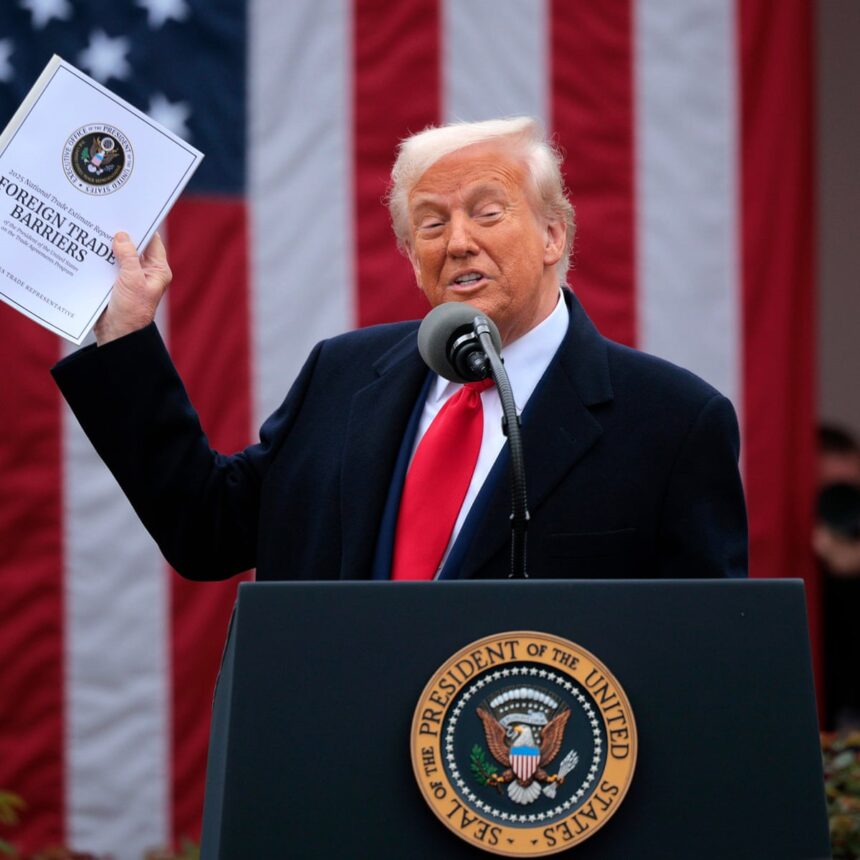
I watched from a cramped briefing room in Brussels last April as Donald Trump’s “liberation day” tariffs crashed into global markets like a rogue freight train. Colleagues in Washington were scrambling. Diplomats I’d been tracking for years looked genuinely stunned. The president had just slapped import duties on nearly every trading partner the United States had cultivated since World War II. Within hours, currency traders were dumping dollars. Within days, the economic data started telling a story the White House didn’t want to hear.
One year later, the verdict from economists, investors, and even some former Trump allies is harsh. The tariff gambit hasn’t just failed to meet its stated goals. It’s actively undermined the American economy in ways that will take years to unwind. And the irony cuts deep: a policy sold as economic nationalism has instead accelerated the very decline it claimed to reverse.
Dario Perkins, who heads global research at TS Lombard, put it bluntly when I reached him by phone last week. “If it was possible for Trump to have spent the last 14 months on the golf course, we’d be in a better place,” he said. That’s not partisan rhetoric. That’s a senior analyst at a major consultancy watching capital flight in real time and concluding that presidential inaction would have been preferable to what actually happened.
The numbers back him up. According to the Bureau of Labor Statistics, U.S. companies essentially stopped hiring the moment liberation day was announced. Revisions published in February show that payroll employment in 2025 was pushed down by 403,000 jobs. The net gain for the entire year was just 181,000 positions added across an economy with 163 million workers. That’s statistical noise, not growth.
Manufacturing, which Trump explicitly promised to revitalize, took the hardest hit. Between January 2025 and March 2026, the sector shed 100,000 jobs. Even more telling: the ratio of manufacturing workers to total nonfarm employment fell to its lowest point since 1939, when the Bureau of Labor Statistics began tracking this metric. For a president who campaigned on bringing factory jobs back, that’s not just a failure. It’s a complete inversion of the stated mission.
Bryan Riley directs the free trade initiative at the National Taxpayers Union Foundation. He’s spent the past year analyzing the tariff fallout with a mix of frustration and grim vindication. “One year after liberation day, the evidence is in,” Riley told me. “Tariffs failed even by the Trump administration’s own terms. They didn’t shrink the trade deficit, didn’t revitalize manufacturing, didn’t help farmers. Replacing one set of failed tariffs with another would be a mistake.”
That trade deficit Trump vowed to eliminate? The Bureau of Economic Analysis reported it expanded to an all-time high in 2025. Imports didn’t collapse. Exports didn’t surge. Instead, American consumers paid more for goods while foreign competitors found new markets. China’s industrial profits jumped 15.2% in the year through February 2026. Beijing isn’t complaining about liberation day. They’re benefiting from it.
Consumer confidence data from the Conference Board and the University of Michigan shows Americans soured on the economy almost immediately after Trump took office. There was a brief recovery in May, coinciding with a partial walk-back of the China tariff escalation. That tells you something important: even temporary relief from the tariff chaos boosted sentiment. But by autumn, as budget fights shut down parts of the federal government, confidence cratered again. A six-month moving average showed every generation, from baby boomers to Gen Xers, losing faith in economic prospects.
Russ Mould, investment director at British stockbroker AJ Bell, has watched international capital reassess American exceptionalism in real time. “America is still home to the world’s largest economy and reserve currency,” Mould said. “But investors continue to reassess their exposure one year on from liberation day.” That reassessment isn’t theoretical. Investors sold dollar-denominated assets and bought into Europe, Asia, and South America instead. The dollar weakened steadily after inauguration day. For an economy built on attracting global investment, that’s a slow-motion disaster.
Some observers draw uncomfortable parallels between Trump’s economic approach and Vladimir Putin’s long-term hollowing out of the Russian economy to fund populist pet projects. Both leaders prioritize political theater over sustainable growth. Both undermine institutions meant to provide stability. Mould pointed to Trump’s challenges against Federal Reserve independence, military posturing over Greenland, and incursions in Latin America and the Middle East as evidence that investors no longer see the U.S. as a reliable steward of capital. “Tariffs and strong-arm trade tactics are combining with lofty stock valuations and a soaring federal deficit to prompt investors to reassess the narrative of American exceptionalism,” he explained.
The International Monetary Fund, in its typically cautious diplomatic language, expressed concern about “heightened domestic and global uncertainties posed by significant ongoing policy shifts.” IMF directors called for “determined actions” to reduce deficits, protect Fed independence, control inflation, and stabilize financial markets. Translation: the world’s economic watchdog thinks Washington is driving off a cliff and urging it to hit the brakes.
I spoke with a mid-level diplomat from a European Union member state who requested anonymity to discuss U.S. policy frankly. “We expected chaos,” she said. “What surprised us was the self-inflicted damage. Trump didn’t just antagonize allies. He convinced our business community that American markets aren’t worth the risk anymore.” Her country has seen a 22% increase in American corporate investment applications over the past year. Companies are hedging against further U.S. instability by planting roots elsewhere.
That’s the quiet story beneath the tariff headlines. Major corporations are redirecting investment flows away from the United States. Some of that capital lands in Europe. Much of it ends up in China, despite Trump’s stated goal of decoupling from Beijing. Chinese officials I’ve corresponded with over the past year express genuine bewilderment at American economic policy. One senior analyst at a state-affiliated research institute told me, “We were preparing for a serious economic confrontation. Instead, your president gave us a competitive advantage we couldn’t have engineered ourselves.”
The chaos Perkins mentioned wasn’t accidental. Trump’s wholesale slashing of government jobs under the so-called Department of Government Efficiency and the defunding of U.S. aid agencies signaled that institutional disruption was a feature, not a bug. But investors don’t reward chaos. They flee from it. And when the world’s reserve currency starts looking unstable, capital finds safer harbors fast.
There’s a human cost buried in these statistics. Factory workers who expected a manufacturing renaissance got pink slips instead. Farmers who anticipated tariff protection watched export markets evaporate as retaliatory duties kicked in. Families planning major purchases delayed them as prices climbed and economic uncertainty mounted. Consumer confidence isn’t just an abstract indicator. It reflects millions of individual decisions shaped by fear about what comes next.
Liberation day was supposed to mark America’s economic rebirth. One year on, it looks more like a strategic blunder with compounding consequences. The trade deficit widened. Manufacturing employment hit historic lows. Consumer confidence collapsed. Investment capital fled. And China posted double-digit profit growth while American companies struggled.
Perkins’ golf course quip stings because it contains an uncomfortable truth. Presidential passivity might genuinely have produced better outcomes than what actually occurred. That’s not a standard any leader should aspire to clear. Yet here we are, assessing a year of economic policy and concluding that deliberate action produced worse results than inaction would have.
The International Monetary Fund’s call for “determined actions” implies that course correction is still possible. But political will seems absent. Trump hasn’t acknowledged the policy failures, much less reversed course. Congressional Republicans remain divided between free market conservatives horrified by protectionism and populist nationalists who view tariffs as ideological victories regardless of economic outcomes.
Meanwhile, the global economy adapts around American dysfunction. European manufacturers find new suppliers. Asian markets deepen regional trade ties. China consolidates industrial gains. The U.S. risks becoming a cautionary tale rather than the economic hegemon it’s been for eight decades.
As I write this from a hotel in Warsaw, where I’m covering NATO’s economic security summit, the conversation among allied officials centers on post-American economic architecture. Not post-American alliance structures. Not post-American military cooperation. Economic decoupling from a partner now seen as unreliable. That shift represents a fundamental reordering of global commerce, set in motion by a policy Trump promised would make America great again.
One year after liberation day, we’re liberated mainly from illusions about tariff efficacy. The policy failed. The data proves it. And the world has moved on.