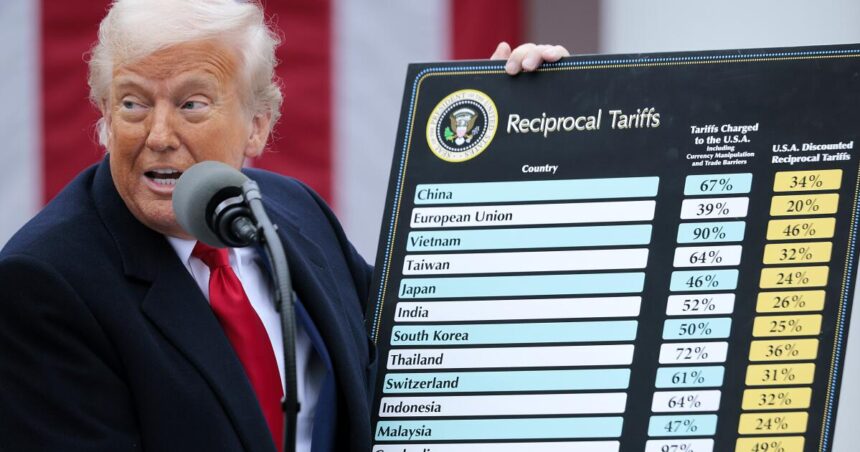
The champagne bottles stayed corked in Beijing, and American factory floors felt emptier, not fuller. Twelve months after Donald Trump declared “Liberation Day” and launched the most aggressive trade war in decades, the promised renaissance of American manufacturing looks more like a cautionary tale in economic hubris.
I’ve spent the past year tracking the ripple effects of those tariffs—from textile factories in North Carolina to shipping terminals in Long Beach, from diplomatic back channels in Brussels to boardrooms scrambling to redesign supply chains they’d spent decades perfecting. What emerges isn’t the triumphant reclamation of American industrial might that Trump envisioned. It’s something messier, more expensive, and potentially more damaging to U.S. economic credibility than anyone in the administration seems willing to admit.
The numbers tell part of the story. According to a European Central Bank study released this month, American importers and consumers absorbed roughly 92% of the tariff costs in the first year—not the foreign exporters Trump insisted would foot the bill. Federal customs duties did surge, bringing in approximately $27 billion in January and February alone. But that revenue barely made a dent in deficit reduction. Tax cuts and increased defense spending swallowed those gains whole, while the national debt continued its relentless climb.
Manufacturing job losses exceeded 100,000 over the past twelve months, according to data from the Bureau of Labor Statistics—a trend that contradicts every promise made in that Rose Garden speech. The American Enterprise Institute’s Michael Strain pointed to increased input costs for U.S.-based manufacturers as the primary culprit. When you raise the price of steel, aluminum, and electronic components, domestic factories don’t suddenly become more competitive. They become more expensive to operate.
The volatility proved almost as damaging as the tariffs themselves. Trade policy shifted with the predictability of a roulette wheel. Countries faced escalating duties one week, temporary exemptions the next, then retroactive increases a month later. I spoke with a logistics director at a mid-sized furniture manufacturer in Michigan who described the year as “planning in quicksand.” His company couldn’t commit to long-term contracts, couldn’t guarantee prices to retail partners, couldn’t even decide whether to source plywood from Vietnam or risk Canadian timber that might face sudden import restrictions.
That uncertainty cascaded through financial markets. The S&P 500 experienced one of its most volatile years on record, with gains concentrated almost exclusively in tech giants largely insulated from import duties. Portfolio managers I interviewed described a persistent fog hanging over quarterly projections. When trade policy becomes unpredictable, so does corporate planning, and investors hate nothing more than uncertainty.
The Supreme Court’s February ruling that Trump exceeded his constitutional authority by bypassing Congress should have clarified matters. Instead, it triggered creative workarounds. The administration pivoted to invoking national security statutes and anti-dumping provisions—legal justifications that trade attorneys immediately began challenging. Kimberly Clausing, a tax policy professor at UCLA School of Law, described the approach as “whack-a-mole governance” that substitutes judicial authority for legislative process.
Aaron Klein at the Brookings Institution made a point that resonated with diplomatic sources I’ve cultivated over years covering trade negotiations. It’s not just about whether tariffs work economically. It’s about what erratic policy does to America’s reputation as a reliable partner. When you weaponize trade policy on a weekly basis, when you announce major economic decisions via social media at 6 a.m., when you ignore both Congress and the Supreme Court, you signal to the world that contracts and commitments mean little.
That erosion of trust carries tangible consequences. Kenneth Rogoff, the Harvard economist, suggested that future historians might mark Liberation Day as the beginning of dollar dominance decline. I’ve heard similar concerns from central bankers in Europe and finance ministers in Asia. When the U.S. becomes unpredictable, other currencies look more attractive. The euro gained ground as a reserve currency this year. China accelerated efforts to settle trade in yuan. Even cryptocurrency advocates pointed to tariff chaos as validation for decentralized alternatives.
The geopolitical reshuffling extended beyond currency markets. Mary Lovely at the Peterson Institute for International Economics documented how Chinese manufacturers responded by ramping up offshore investments—particularly in Vietnam, Mexico, and Eastern Europe. Rather than bringing production back to Ohio or Pennsylvania, Trump’s tariffs incentivized Chinese firms to establish intermediate processing facilities in third countries. Components still originated in Shenzhen, but they got assembled in Hanoi before entering the U.S. market. Same supply chain, extra steps, higher costs.
I visited a footwear factory outside Hanoi in November that exemplified this trend. The Taiwanese owner had operated in southern China for twenty years before relocating 70% of his production to Vietnam in response to tariff threats. He employed 800 Vietnamese workers but sourced most materials from Chinese suppliers. The shoes reached American retailers at prices 18% higher than pre-tariff levels. American consumers paid the difference.
That price pressure showed up in polling. Roughly 70% of Americans now believe tariffs increased their cost of living, according to recent surveys—including nearly two-thirds of Republicans and independents. Trump’s approval ratings on inflation dropped below those of Jimmy Carter and Joe Biden, both of whom faced significant price pressures during their terms. A CNN poll this week showed 72% disapproving of the president’s handling of rising prices.
The political damage makes sense when you consider grocery bills and rent checks rather than abstract trade theory. A family in Phoenix doesn’t care whether tariffs represent sound long-term industrial policy. They care that their washing machine costs $200 more than it did two years ago. They care that the local furniture store raised prices twice in six months. They care that promised manufacturing jobs never materialized while everything got more expensive.
Sung Won Sohn, former commissioner at the Port of Los Angeles, emphasized a subtler cost that GDP figures don’t capture. The tariffs injected friction into every business decision. Companies delayed expansions, postponed hiring, and adopted wait-and-see stances that compound over time. Productivity suffers when managers spend hours gaming out tariff scenarios instead of improving operations. Innovation stalls when capital that could fund research gets diverted to navigating customs regulations.
The Federal Reserve faced its own complications. Fighting inflation requires different tools when price increases stem from import tariffs rather than excess demand. Raising interest rates can’t make steel cheaper if the government imposed a 25% duty. The policy conflict created what one Fed official described to me as “flying blind through turbulence”—trying to manage inflation while the administration actively implements inflationary policies.
Looking forward, the question isn’t whether Trump’s tariffs achieved their stated goals. The evidence overwhelmingly suggests they didn’t. Manufacturing declined, consumers paid more, allies grew wary, and competitors adapted. The real question is whether this represents a temporary policy mistake or a fundamental shift in how America engages with the global economy.
Trade economists I’ve consulted largely agree that the genie doesn’t go back in the bottle easily. Even if a future administration reversed every tariff tomorrow, the damage to U.S. credibility persists. Companies that relocated supply chains won’t immediately reverse course. Trading partners that pursued alternative arrangements won’t rush back to exclusive reliance on American markets. The dollar’s reserve currency status, built over decades, erodes faster than it rebuilds.
There’s also a domestic political dimension. Trump’s trade war failed economically but succeeded in normalizing protectionist rhetoric across both parties. Progressive Democrats and populist Republicans now routinely advocate for industrial policy that would have seemed radical a decade ago. The bipartisan consensus favoring open trade that dominated from the 1990s through the 2010s feels like ancient history.
That shift might prove Liberation Day’s most enduring legacy—not the tariffs themselves, but the political space they created for questioning whether integration into global markets serves American workers. That’s a legitimate debate worth having. But it should be grounded in honest assessment of what protectionism actually delivers, not wishful thinking about manufacturing resurgences that never materialize.
One year later, the receipts are in. They show higher prices, fewer jobs, damaged alliances, and an economic fog that won’t lift quickly. Whether voters demand accountability or double down on protectionist promises will shape American trade policy for years to come. The world, meanwhile, is learning to function without assuming American reliability—a lesson that may prove impossible to unlearn.