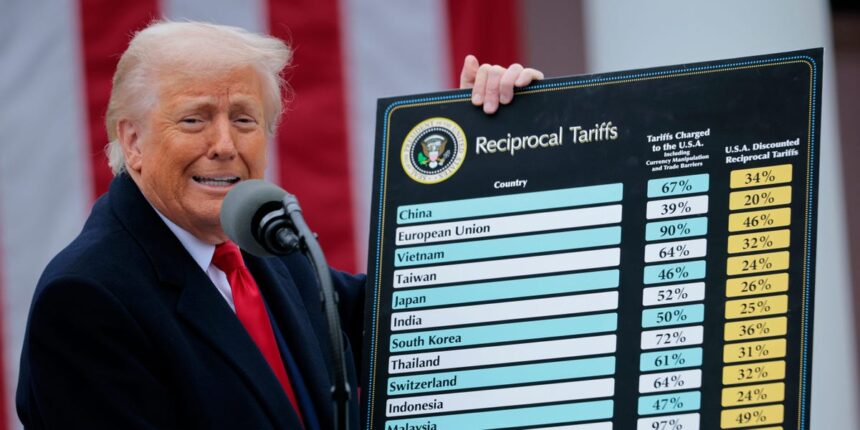
I watched the fallout unfold from a cramped office in Brussels last April, where trade officials spoke in hushed tones about what they called “the great unraveling.” One year after Donald Trump’s Liberation Day tariffs reshaped global commerce, the economic scorecard tells a story far more complicated than the triumphant rhetoric suggested it would be.
The Tax Foundation, a non-partisan research organization that analyzes fiscal policy, recently published a comprehensive assessment of Trump’s tariff regime. Their analysis measured the actual outcomes against four bold promises the president made when he launched what his administration framed as an economic liberation. The results paint a portrait of policy ambition colliding with economic reality, and American consumers caught somewhere in between.
Manufacturing employment was supposed to surge. Trump declared that jobs and factories would “come roaring back” to American soil, protected by tariff walls high enough to make foreign competition prohibitively expensive. Bureau of Labor Statistics data reveals a different trajectory. Manufacturing jobs have declined since April 2025, continuing a downward trend that predates Liberation Day itself. The Tax Foundation notes that while this isn’t necessarily a tariff-caused collapse, the policy volatility likely discouraged the very investment and hiring decisions that were supposed to flourish.
I spoke with a factory manager in Ohio three months ago who put it bluntly: “Uncertainty is worse than bad policy. We can adapt to rules. We can’t plan around chaos.” His plant makes automotive components, and the constantly shifting tariff landscape made long-term contracting nearly impossible. Foreign suppliers didn’t know what prices to quote. Domestic buyers didn’t know what budgets to set. The result was paralysis dressed up as economic nationalism.
The revenue picture tells a more nuanced story. Trump promised tariffs would generate “trillions and trillions of dollars” and restore American wealth. The Tax Foundation confirms that tariff rates did increase government revenue substantially. Customs duties brought in approximately two hundred sixty-four billion dollars in 2025, representing nearly five percent of total federal revenue. Before the Supreme Court struck down portions of the tariff structure, collections had reached one hundred sixty-six billion dollars. By that narrow metric, the promise held some water.
But revenue generation operates within a broader fiscal ecosystem. The Tax Foundation identified a mechanical problem: tariffs reduce the tax base for income and payroll taxes. When imports become more expensive and economic activity slows, workers earn less and companies generate smaller profits. The net revenue gain becomes considerably smaller than the gross customs collections suggest. A European Central Bank economist I interviewed in Frankfurt described it as “robbing Peter’s future to pay Paul today.”
The national debt reduction promise collapsed entirely under scrutiny. Trump claimed on Liberation Day that tariff revenue would pay down America’s thirty-nine trillion dollar debt “very quickly.” One year later, the national deficit has increased during his second term. The arithmetic was never realistic—even the highest tariff collections represented a fraction of annual deficit spending. Paying down accumulated debt would require either massive spending cuts or revenue increases an order of magnitude larger than tariffs could generate.
This wasn’t a surprise to anyone who ran the numbers beforehand. Multiple budget analysts warned that the math didn’t work. The Committee for a Responsible Federal Budget, a non-partisan watchdog organization, published projections showing the debt would continue growing regardless of tariff policy. Those warnings were dismissed as pessimism from establishment voices resistant to disruption. The warnings proved accurate anyway.
The consumer impact has been the most politically volatile outcome. Trump promised that “more production at home will mean stronger competition and lower prices for consumers.” The Tax Foundation found the opposite occurred. Tariffs raised prices and weighed on economic activity, contradicting claims that foreign countries would absorb the costs. Several Federal Reserve economists published research demonstrating that consumers bore the burden, work that drew sharp criticism from administration officials who disputed the methodology.
The economic mechanics are straightforward. Tariffs are taxes on imports, legally paid by the importing company. Those companies rarely absorb the cost—they pass it to downstream businesses or final consumers. Domestic producers often raise their own prices in response, knowing that foreign competition now costs more. The result is inflation that touches everything from groceries to construction materials.
Federal Reserve Chair Jerome Powell publicly attributed recent inflationary pressure to tariff policy during congressional testimony last fall. His comments sparked a predictable political firestorm, but the data supported his assessment. The Tax Foundation calculated that tariffs functioned as an average one thousand dollar tax increase per household in 2025, with an additional six hundred dollars projected for 2026. Those aren’t abstract figures—they represent real purchasing power lost from family budgets already strained by years of inflation.
I visited a food distribution warehouse outside Baltimore in November where the manager showed me inventory sheets filled with price increases. Coffee, cooking oil, canned vegetables—all affected by either direct tariffs or indirect cost increases from suppliers facing their own tariff burdens. “People think tariffs only hit big-ticket items,” she told me. “They don’t realize it’s in everything they buy, just hidden in the price tag.”
The Tax Foundation analysis doesn’t engage in partisan point-scoring. Their evaluation simply measures promises against outcomes using available economic data. What emerges is a picture of policy that delivered revenue but failed to achieve its broader economic transformation goals. Manufacturing didn’t boom. The debt didn’t shrink. Consumers paid higher prices.
None of this resolves the underlying policy debate about America’s trade posture. Reasonable people disagree about whether short-term economic pain justifies long-term strategic repositioning. Some argue that reshoring critical industries requires temporary disruption. Others contend that tariffs are blunt instruments that cause more damage than benefit. The Tax Foundation’s work doesn’t settle that philosophical argument—it simply establishes the factual baseline for having it.
What the one-year anniversary makes clear is that economic transformation doesn’t happen through proclamation. Liberation Day promised a swift reordering of American industrial fortunes. The reality has been messier, costlier, and far less triumphant than the rhetoric suggested. Whether that represents policy failure or merely the difficult middle chapter of a longer story remains an open question, one that American households are answering every time they check prices at the grocery store.