Picture an auto parts worker in Windsor clocking out early because orders have dried up. On the drive home, they skip their usual coffee stop. Multiply that across thousands of workers, and suddenly the Tim Hortons down the street doesn’t need three baristas on the morning shift anymore. This is how tariffs move through an economy—not like a thunderclap, but like a slow leak that eventually floods the basement.
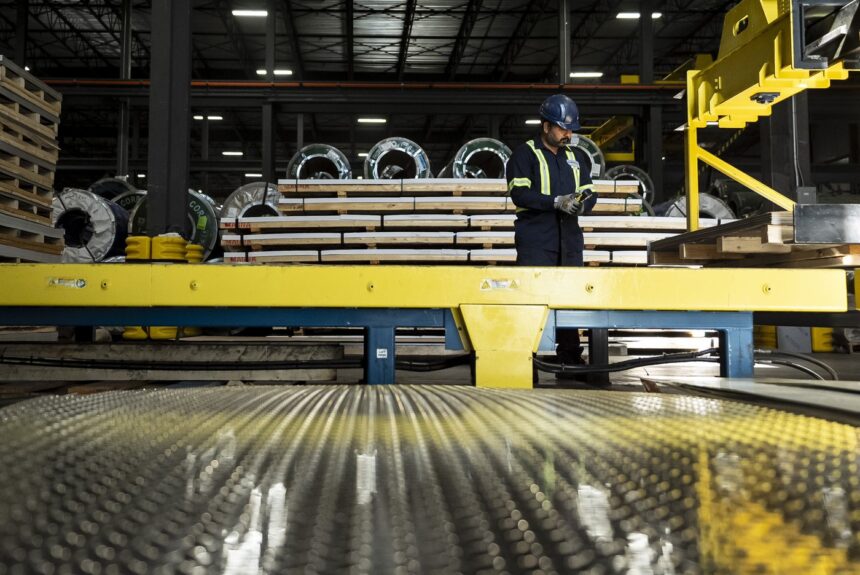
Thursday marks one year since Donald Trump launched what he called “Liberation Day,” unleashing a wave of tariffs that reshaped North American trade. For Canada, the damage didn’t arrive all at once. It started with threats in February of last year, hardened into sector-specific duties by March, and has been quietly hollowing out parts of the labour market ever since. Manufacturing has bled more than 51,000 jobs in the past twelve months, making it the hardest-hit sector in the country. Most of those losses landed in Ontario, where steel, aluminum, and automotive plants anchor entire communities.
Brendon Bernard, senior economist at Indeed, summed up the past year in two words: pretty static. Job growth hasn’t collapsed, but it hasn’t bounced back either. The labour market is treading water, and economists are starting to wonder if the shallow end is about to get deeper.
Manufacturing was always going to take the first punch. U.S. tariffs targeted steel, aluminum, and autos with surgical precision, and Canada’s industrial heartland felt it immediately. Andrew DiCapua, principal economist at the Canadian Chamber of Commerce, is worried the pain isn’t finished. Many automotive contracts run six to twelve months, which means layoffs could arrive in waves as those agreements expire and companies reassess how much production capacity they actually need.
Statistics Canada reported in March that industrial capacity utilization—a measure of how much factories are producing relative to their potential—sat at 78.5 percent in the fourth quarter of last year. That’s a modest drop, but it signals that plants are running cooler than they could. When orders slow, companies don’t need as many workers on the floor. DiCapua fears the momentum is still tilting downward.
Desjardins senior economist Kari Norman acknowledges the damage has been severe for individual workers and specific industries, but she notes that the national labour market hasn’t cratered the way some early forecasts predicted. The big unknown is what happens during the upcoming review of the Canada-U.S.-Mexico trade agreement later this year. If tariff levels stay roughly where they are now and Canada gets a firm commitment from Washington, Norman expects manufacturing employment to flatten rather than freefall.
Services have been the country’s safety net. Health care alone added 92,000 jobs over the past year, driven by provincial investments to care for an aging population. Across all services sectors, Canada gained 85,900 positions, more than offsetting the 34,200 jobs lost in goods-producing industries. That’s one reason the unemployment rate hasn’t spiked.
But February’s labour force survey revealed a crack in that resilience. Canada shed 84,000 jobs in a single month, and most of those losses came from services. It’s a reminder that no part of the economy exists in a vacuum. When manufacturing stumbles, the ripple effects eventually reach industries that seem insulated from trade policy.
DiCapua’s coffee shop analogy illustrates the contagion risk. A worker losing shifts means less spending on morning routines, lunches, and errands. Businesses that serve those workers see demand soften and start trimming staff. Marketing budgets shrink. Supply chains adjust. The provinces hit hardest by U.S. tariffs—Ontario, Quebec, and British Columbia—are also seeing slower growth in services, which suggests sentiment is spreading beyond the factory floor.
Bernard from Indeed said it’s hardly surprising that tariffs and a cooling housing market are combining to weaken Ontario’s broader labour picture. The province has been squeezed from multiple directions, and the pressures are starting to show in sectors that don’t export a single widget.
Some economists caution against reading too much into one bad month. The labour force survey is notoriously volatile, and February’s steep decline could simply be statistical noise. The Survey of Employment, Payrolls and Hours, which is less timely but often more stable, paints a flatter picture. Bernard noted that when the labour force survey was showing robust job growth in the fourth quarter of last year, the SEPH was essentially flat. That suggests the truth is somewhere between the headlines—neither as rosy as the best months nor as grim as the worst.
Still, both datasets agree on one thing: job growth has slowed. And the biggest driver of that slowdown isn’t just tariffs. It’s demographics.
Statistics Canada reported in March that the Canadian population shrank in 2025, the first annual decline on record. More baby boomers are retiring than young workers are entering the labour force, and immigration has tapered. The result is a labour pool that’s stagnant or even contracting. That means Canada doesn’t need to add as many jobs each month to keep the unemployment rate stable. It also means that monthly employment declines—which used to signal trouble—might become routine.
Bernard explained that when the trend line is flat, the data will bounce around that flat number. Even if the economy isn’t getting worse, the volatility will make it look like it’s swinging wildly. Monthly job losses will appear more often, not because the fundamentals have deteriorated, but because the baseline has shifted.
Desjardins forecasts the unemployment rate will hover around 6.7 percent through 2026, roughly where it stood in February, before improving the following year. Norman sees a few bright spots on the horizon. Government spending on defence and construction could spur hiring in those fields. Youth unemployment, which has been stubbornly high, might ease during the summer job season—especially if more Canadians vacation domestically. An energy price spike tied to the Iran conflict has pushed jet fuel and airfare costs higher, which could nudge families toward road trips and staycations. That would be a small win for Canada’s tourism sector and the seasonal workers it employs.
But those are modest tailwinds in a market that’s mostly becalmed. The outlook for manufacturing hinges on politics and diplomacy, not productivity or innovation. Services are holding up, but they’re not immune to the slowdown in goods production. And the demographic headwinds aren’t going away.
A year ago, when Trump announced his tariffs, the immediate question was how bad the damage would be. Now, with twelve months of data in hand, the answer is becoming clearer. The damage hasn’t been catastrophic, but it’s been persistent. Jobs haven’t disappeared en masse, but they’ve stopped appearing at the rate Canada needs to keep pace with a changing population.
Static might be the right word. It’s not a recession, but it’s not growth either. It’s a labour market stuck in place, waiting to see if the next policy shift will unstick it—or push it deeper into the mud.