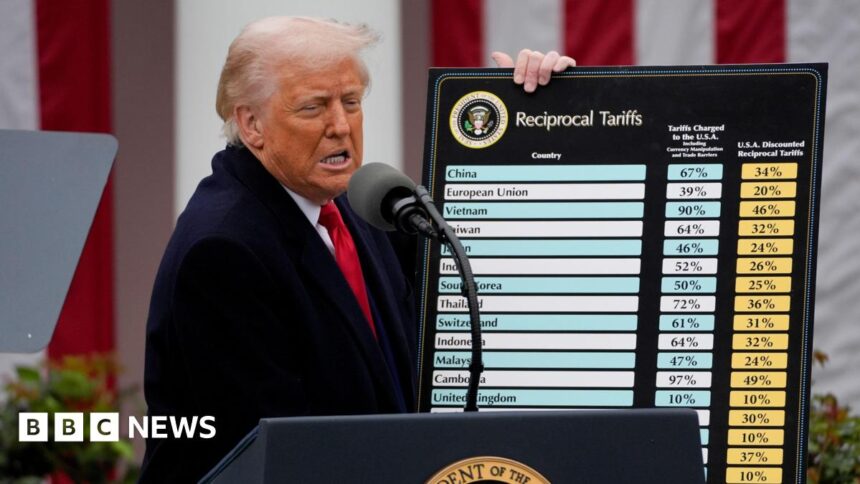
I spent the better part of last spring in Shenzhen, watching container ships sit idle in the harbor. It was early May, just weeks after what the White House had branded Liberation Day—the moment Donald Trump revived his promise to reshape global commerce through sheer fiscal force. What I saw wasn’t rebirth. It was paralysis.
A year into Trump’s second-term tariff experiment, the numbers tell a story that goes far beyond campaign rhetoric or economic theory. The average effective tariff rate in the United States has quadrupled, jumping from 2.5% to roughly 10%. That’s the highest level in generations. But the real impact isn’t captured in percentages. It’s in the rewiring of supply chains, the souring of diplomatic relationships, and the quiet erosion of American influence in rooms where trade and security have always been inseparable.
The US-China trade relationship, once the backbone of global manufacturing, has effectively collapsed. American imports from China dropped by 30% last year. Chinese purchases of US goods fell by a similar margin. By December, Chinese products accounted for less than 10% of total US imports—a figure not seen since 2000, before China joined the World Trade Organization. Davin Chor, who holds the globalization chair at Dartmouth’s Tuck School of Business, told me the decoupling that economists had long anticipated finally materialized. “When it comes to direct shipments, it has been very dramatic and very decisive,” he said during our conversation in February.
But the trade hasn’t disappeared. It’s moved. Vietnam and Mexico have absorbed much of the flow, with Chinese firms quietly expanding their operations in both countries. I visited a factory outside Hanoi in November where the owner, a businessman from Guangdong, admitted that 70% of his components still come from China. The final assembly happens in Vietnam. The label says “Made in Vietnam.” The economics say otherwise.
What’s striking is how little this has benefited American workers. Manufacturing contracted for most of last year, according to data from the Institute for Supply Management. Foreign direct investment into the United States also declined, despite public pledges from pharmaceutical companies and automakers about boosting domestic production. The Tax Foundation, a nonpartisan research group, analyzed government data and found that the investment promises made on Liberation Day largely failed to materialize. The jobs didn’t follow the tariffs.
Instead, American consumers paid the bill. Goldman Sachs estimated in October that about 55% of the new tariff costs were passed directly to buyers. Inflation, which had been cooling throughout 2024, ticked up by roughly half a percentage point because of the tariffs, according to Michael Pearce at Oxford Economics. That might sound modest, but for families already stretched by housing and food costs, it registered. I spoke with a small business owner in Ohio who imports electronics components. Her costs rose 18% last year. She raised prices twice. Her customers noticed.
Trump’s tariff strategy extended well beyond China. He imposed new levies on steel, lumber, and automobiles. He ended the de minimis rule, which had allowed shipments under $800 to enter the country duty-free—a move that hit e-commerce platforms and small importers hard. He threatened allies with punitive rates, then negotiated exemptions in exchange for concessions. The result was a patchwork system that rewarded access and punished distance, both geographic and political.
Even countries that received relatively favorable treatment began looking elsewhere. The United Kingdom, which faced a 10% tariff on most goods, saw its export share to the United States shrink while trade with Germany, France, and Poland expanded. Jun Du, an economics professor at Aston University in Birmingham, described it as a “re-wiring” of global commerce. The US remained Britain’s top export destination, but the gap narrowed. That trend appeared across Europe and Asia.
Canada’s response was particularly telling. Despite being largely exempt from tariffs under the renegotiated North American free trade agreement, Ottawa grew wary of Washington’s unpredictability. In a move that stunned auto industry analysts, Canada slashed its tariffs on Chinese-made electric vehicles from 100% to just over 6%. It was a sharp pivot toward Beijing and a direct challenge to American carmakers, which have dominated the Canadian market for decades. The decision underscored a broader reality: Trump’s unilateralism has frayed alliances in ways that extend far beyond trade.
Petros Mavroidis, who teaches international economic law at Columbia, framed it bluntly during our call in March. “How can you ask for cooperative behavior when you screw them on trade?” he said. “You lose your soft power, which was the biggest advantage the US had. All of this is gone now and how do you build it back?”
That erosion showed up in unexpected places. Canadian tourism to the United States dropped 20% last year, costing the American economy more than $4 billion, according to the US Travel Association. Diplomatic efforts to extend a 28-year ban on tariffs for electronic transactions—streaming services, cloud computing, digital downloads—stalled amid broader trade tensions. Efforts to build coalitions around the war in Iran faced quiet resistance from countries frustrated by Washington’s economic aggression.
The tariffs collected over $260 billion in revenue last year, a windfall the administration initially celebrated. Then in February, the Supreme Court struck down the Liberation Day duties, ruling that the president had overstepped his authority. The government is now obligated to return more than half of what it collected. The legal battle continues, but the financial and political damage is done.
Manufacturing didn’t return. Investment didn’t surge. What arrived instead was uncertainty. I’ve covered enough conflict zones to recognize the fog of war. This feels similar—a fog of policy, where businesses can’t plan, allies can’t trust, and citizens absorb the costs without seeing the benefits.
The White House insists the strategy needs time to work. Erica York, vice president of federal tax policy at the Tax Foundation, told me she doubts the administration will return to Liberation Day-level tariffs, especially with midterm elections approaching in November. Inflation and affordability remain top concerns for voters. Republicans in competitive districts have quietly distanced themselves from the tariff push.
Despite the disruption, the broader US economy grew 2.1% last year. Unemployment stood at 4.4% in December. Pearce, the Oxford economist, acknowledged that while tariffs created “a lot of noise,” the macroeconomic damage remained limited. That resilience might explain why Trump hasn’t faced more domestic political backlash. But resilience isn’t the same as progress.
What concerns trade experts and diplomats I’ve spoken with isn’t just the immediate economic impact. It’s the precedent. Other countries are now exploring their own protectionist measures, emboldened by Washington’s example. The international order that emerged after World War II, built on multilateral cooperation and rules-based trade, is fraying. Trump didn’t create that erosion, but he’s accelerated it.
I returned to Shenzhen in February. The harbor was busy again. The ships were moving. But they weren’t heading to Los Angeles or Long Beach. They were bound for Rotterdam, for Hamburg, for Santos in Brazil. The goods still flow. The world still trades. America just isn’t the center anymore.