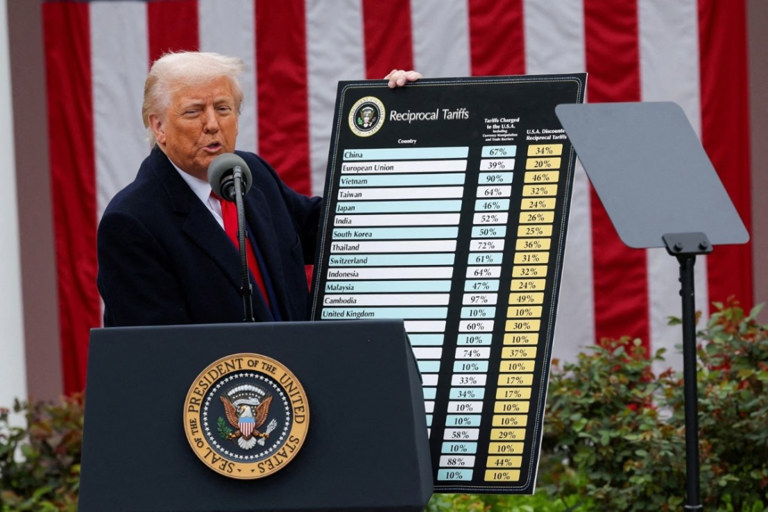
I was standing in a steel mill outside Pittsburgh last month when a foreman told me something I hadn’t expected. “We thought the tariffs would save us,” he said, wiping grease from his hands. “But half our customers can’t afford what we’re making anymore.” One year after the Trump administration’s sweeping tariff regime took full effect, the economic landscape looks nothing like what was promised—and the geopolitical consequences are reshaping alliances in ways Washington didn’t anticipate.
The tariffs, marketed as a shield for American manufacturing, have become something closer to a blunt instrument. Steel and aluminum imports now face duties as high as 25 percent, while goods from China carry an additional 10 to 25 percent depending on the category. The Peterson Institute for International Economics estimates these measures have raised costs for U.S. importers by roughly $80 billion since implementation. That’s not an abstract figure. It translates to higher prices for cars, appliances, and construction materials—costs that get passed to consumers who were told this policy would protect their jobs.
What’s become clear after twelve months is that tariffs don’t operate in a vacuum. China retaliated almost immediately, targeting American soybeans, pork, and aircraft. The European Union responded with duties on bourbon, motorcycles, and blue jeans—products chosen for maximum political impact in swing states. According to the U.S. Department of Agriculture, farm bankruptcies rose 13 percent in the Midwest during the first nine months after tariffs took hold. I spoke with a soybean farmer in Iowa who lost a third of his export market overnight. “Beijing was our biggest buyer,” he told me over coffee in a diner that’s been in his family for generations. “Now they’re buying from Brazil, and those relationships don’t just come back because Washington changes its mind.”
The manufacturing jobs that were supposed to return haven’t materialized in the numbers promised. The Bureau of Labor Statistics shows modest gains in steel production employment—roughly 1,900 jobs added—but losses in steel-consuming industries like auto parts and machinery manufacturing have been significantly larger, with an estimated 75,000 positions affected by higher input costs. Harley-Davidson announced it would move some production overseas to avoid EU tariffs. General Motors cited tariffs as a factor in closing plants and cutting 14,000 workers. The economic nationalism that fueled the tariff push has collided with the reality of global supply chains that took decades to build and can’t be unwound with policy declarations.
Beyond the immediate economic pain, the tariffs have accelerated a geopolitical shift that may outlast any single administration. China has deepened trade relationships across Southeast Asia, Africa, and Latin America—regions where U.S. influence was already contested. The Regional Comprehensive Economic Partnership, a trade bloc that includes China but excludes the United States, became the world’s largest free trade agreement partly in response to American protectionism. I watched negotiations unfold in Jakarta last year, where diplomats from Vietnam and Indonesia made clear they saw Chinese market access as more reliable than American promises.
European allies have grown frustrated with what they view as arbitrary trade policy that ignores decades of partnership. A senior German official I interviewed in Brussels described the situation with barely concealed anger. “We stood with America on Russia sanctions, on Iran, on counterterrorism,” she said. “And our reward is tariffs on cars we’ve been building in South Carolina and Alabama for twenty years.” The transatlantic relationship, already strained by disagreements over NATO funding and climate policy, has found another fault line. Trade disputes that might have been resolved through the World Trade Organization are instead devolving into tit-for-tat measures that weaken the rules-based system America once championed.
The humanitarian dimension of this trade conflict is often overlooked. In developing countries that depend on exports to the United States, job losses have been severe. The International Labour Organization estimates that tariff-related disruptions contributed to employment declines affecting roughly 2.3 million workers in Southeast Asian garment and electronics industries. I visited a textile factory outside Dhaka that laid off 400 workers when orders from U.S. retailers dried up. The women I spoke with—many of them sole breadwinners—didn’t understand the policy rationale. They only knew the paychecks stopped coming.
What’s emerged is a picture of economic policy detached from economic reality. The tariffs were sold as a tool to reduce the trade deficit, but the deficit with China has actually grown as companies shifted sourcing to Vietnam, Mexico, and other countries rather than bringing production back to the United States. The trade deficit hit a record $891 billion in the twelve months following full tariff implementation, according to Census Bureau data. The goal of rebalancing trade has instead produced a whack-a-mole effect, with imports simply changing origin points while American exporters face closed markets.
There’s also the fiscal impact that rarely makes headlines. The Trump administration has spent approximately $28 billion on bailouts to farmers hurt by retaliatory tariffs, according to the Congressional Budget Office. That’s taxpayer money used to compensate for the consequences of policy decisions—a subsidy program that dwarfs anything criticized as government overreach in other contexts. The ideological inconsistency is striking. An administration that campaigned on free markets and limited government has created one of the largest agricultural welfare programs in modern history.
Looking ahead, the question isn’t whether tariffs have costs—they clearly do—but whether those costs produce strategic benefits that justify the pain. Some analysts argue that confronting China’s trade practices, particularly around intellectual property and state subsidies, required disruption. There’s merit to that view. But disruption without a coherent endgame risks isolating America from the markets and alliances it needs. As I heard repeatedly in interviews across three continents, the rest of the world isn’t waiting for Washington to sort out its trade policy. They’re building new relationships and new institutions that could define commerce for decades.
The steel foreman in Pittsburgh wasn’t wrong to hope for better prospects. His industry has faced genuine challenges from subsidized foreign competition. But the solution offered—tariffs imposed without coordination with allies or consideration of downstream effects—has produced winners and losers in patterns that don’t match the rhetoric. One year in, the promise of protected prosperity has given way to the reality of complicated pain, and the geopolitical consequences are only beginning to unfold.