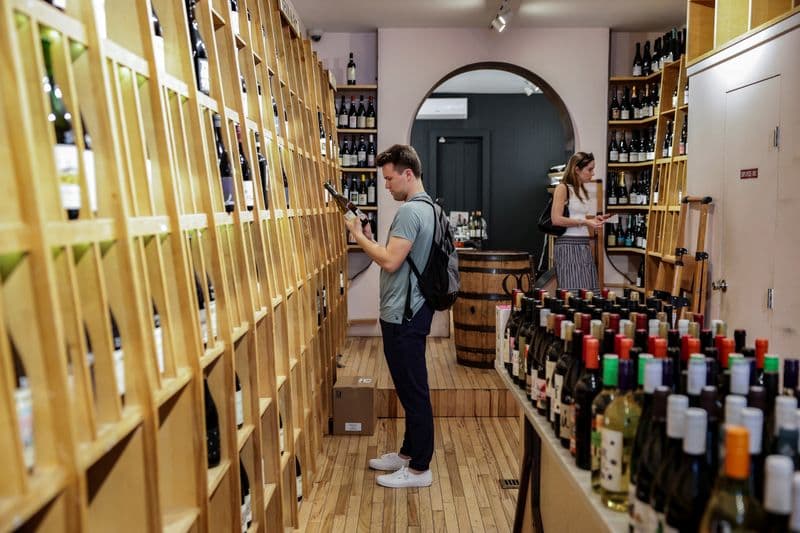
Chris Leon walks through a Brooklyn basement like he’s searching for buried treasure. In a way, he is. Dusty bottles of Barolo and Burgundy line the walls—European wines that entered the United States years ago, before tariffs turned fine imports into financial liabilities. Leon runs Leon & Son, a small wine shop in one of New York’s most discerning neighborhoods. And right now, he’s not looking to importers for inventory. He’s looking to America’s own wine cellars.
“There’s a lot of wine here already,” Leon told me during a recent conversation. “A lot of really good wine.” His solution to Trump’s tariff storm? Skip the ports entirely. Buy domestic collections. Sell through online auctions. It’s a workaround born from necessity, but it reveals something larger about how small businesses adapt when trade policy rewrites the rules overnight.
Leon’s shop makes 90 percent of its revenue from European imports. That business model worked fine until tariffs began piling up on French champagne, Italian reds, and Spanish riojas. First came a 15 percent levy under an EU-U.S. trade deal implemented last August, according to Reuters reporting. Then in February, the Supreme Court struck down an earlier round of Trump tariffs—only for the administration to immediately replace them with new levies of at least 10 percent on European goods. The policy whiplash left importers scrambling.
Trump’s argument centers on trade deficits. The United States, he claims, has been played by foreign partners who sell more than they buy. His tariffs aim to rebalance that equation. But on the ground, in places like Leon’s shop, the effects look less like economic recalibration and more like survival improvisation.
Leon isn’t the only one pivoting. Across the country, wine retailers are switching to domestic alternatives or hunting for cheaper imported brands from regions not yet hit by tariffs. Some are absorbing costs to keep prices stable. Others are passing increases directly to customers, risking loyalty in a market where a five-dollar bump can send buyers to the next shelf. The U.S. wine industry warned last year that tariffs would inflict damage. Now that damage is quantifiable, and businesses are adapting in real time.
What makes Leon’s approach distinct is its reliance on a secondary market that’s always existed but rarely served as a primary supply chain. He’s sourcing bottles from private collectors who stockpiled European wines before tariffs kicked in. Some are sitting in temperature-controlled basements in Manhattan. Others are tucked away in restaurant cellars, remnants of old menu pairings that no longer fit current offerings. One upcoming auction features Italian labels no longer in production, held in a personal collection for years. These aren’t distressed sales. They’re strategic repositioning.
Vanessa Price, a wine director and author of Big Macs & Burgundy, sees platforms like Leon’s as a fresh evolution of an old model. Traditional auction houses like Christie’s and Sotheby’s have long sold fine wines to collectors. But those venues can feel inaccessible, even intimidating, to casual buyers. Newer platforms lower the barrier. They demystify the process. “There is still plenty of room to come in and shake things up,” Price said. “Because it’s still such a mysterious world for so many people.”
That democratization matters, especially now. As tariffs push retail prices higher, auctions offer a route to European wines without the added levy. The bottles were imported pre-tariff. They’re already in the country. No customs fees. No new trade restrictions. Just a transaction between Americans, facilitated by someone like Leon who knows how to find the wine and connect it to buyers willing to pay.
But this model has limits. The supply of pre-tariff European wine is finite. Eventually, those cellars empty. And if tariffs remain in place long-term, the auction strategy becomes a stopgap rather than a solution. Leon knows this. He’s not pretending auctions will replace traditional importing. He’s betting they can supplement it long enough to keep his business afloat while policy settles—or doesn’t.
There’s also a broader question about what these tariffs accomplish. Wine isn’t steel or semiconductors. It’s not a national security concern or a strategic industry. The European Union isn’t flooding American markets with subsidized Bordeaux to undercut domestic producers. U.S. wineries and European importers have coexisted for decades in a market where consumer choice drives demand. Tariffs disrupt that equilibrium without clear benefit to American vintners, many of whom also rely on imported equipment and materials now subject to separate levies.
According to data from the Wine Institute, the United States imported roughly $6.6 billion worth of wine in recent years, with Europe accounting for a significant share. Those imports support jobs in logistics, retail, hospitality, and distribution. When tariffs raise prices, demand softens. Restaurants trim wine lists. Shops reduce inventory. The ripple effects extend beyond importers to the entire ecosystem built around wine commerce.
Leon’s auction model might work in Brooklyn, where wine culture runs deep and collectors exist in density. But in smaller markets, where expertise and inventory are thinner, retailers face harsher choices. Some will exit the European wine business entirely. Others will consolidate, stocking only the most popular labels and abandoning niche offerings. Diversity contracts. Selection narrows. Consumers lose access to variety, and small producers in Europe lose American buyers.
I spoke with a sommelier in Manhattan who described similar challenges. She’s seen wholesale prices jump 20 percent on certain French wines since tariffs took effect. Her restaurant absorbed some costs initially, hoping policy would reverse. It didn’t. Now she’s redesigning the wine list, favoring California and Oregon over Burgundy and Rhône. It’s not what she wants. It’s what the numbers allow.
What strikes me most about Leon’s story isn’t the cleverness of the auction idea. It’s the fact that it’s necessary at all. Trade policy should create predictability, not chaos. Businesses need time to adjust, clear signals about what’s coming, and rationale that connects policy to outcome. Instead, tariffs have oscillated—imposed, struck down, reimposed—leaving retailers guessing month to month.
Leon will hold his first auction soon. He’s optimistic about interest. Collectors want access. Buyers want value. And he’s offering both, tariff-free. But he’s also clear-eyed about the future. “We’re figuring it out as we go,” he said. That’s the reality for thousands of businesses navigating a trade landscape that shifts faster than inventory cycles.
For now, the wine is in American basements. And people like Leon are finding it, bottle by bottle, auction by auction. It’s not a permanent fix. But it’s a way forward when the old path gets blocked.