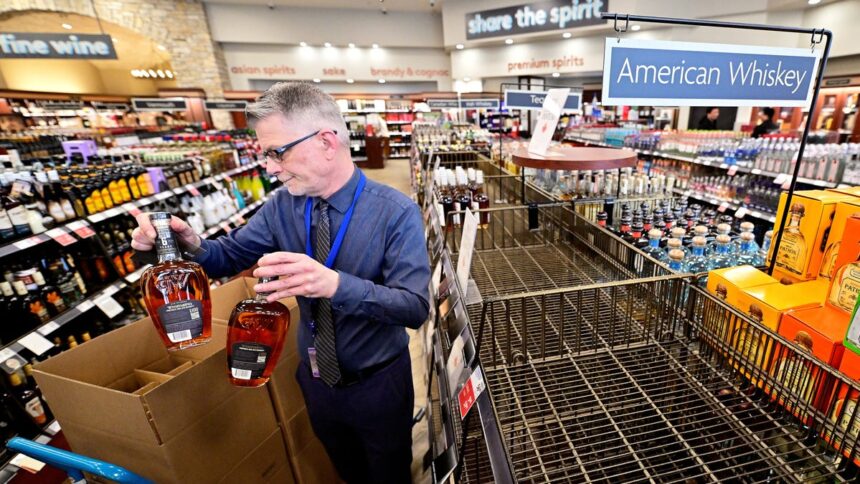
I watched American bourbon disappear from Ontario liquor stores last spring, shelf by shelf, like a slow-motion diplomatic breakdown playing out in glass bottles. What started as emergency tariffs imposed by President Donald Trump in April 2025 turned into a $90 million hit to U.S. liquor exports by year’s end—a warning shot that trade wars don’t just hurt farmers and manufacturers.
The numbers tell a story of retaliation and miscalculation. According to a report from the Distilled Spirits Council of the United States, exports fell 3.8% in 2025, breaking a 25-year streak of growth that had multiplied sales fivefold. From $478 million in 2000 to $2.37 billion last year, American spirits had become a quiet export success. Then came the tariffs, and with them, the backlash.
Canada hit hardest, pulling American whiskey, bourbon, and vodka from provincial liquor stores starting in March. Imports from the U.S. dropped more than 70% over the next nine months. Only Alberta and Saskatchewan have since reversed their bans. The rest of the country stayed firm, leaving American distillers locked out of one of their top markets. Chris Swonger, CEO of the council, said the decline exposed how fragile trade relationships can be when policy shifts without warning. “When American spirits compete on a level playing field, exports grow, jobs are created and local economies thrive,” he said in a statement.
Trump’s emergency tariffs, imposed April 2 under the 1977 International Emergency Economic Powers Act, were designed to pressure trading partners into new deals and shrink U.S. trade deficits. The idea was leverage—use tariffs to bring countries to the table. But the Supreme Court ruled in February that the president lacked the authority to impose them unilaterally under that statute. Trump pivoted, imposing 10% temporary tariffs under different legal grounds while his administration pursued longer-term duties through national security and trade deficit investigations.
The European Union didn’t wait to see how it played out. Threatened with 30% retaliatory tariffs on American whiskey, some producers scrambled to ship extra inventory in late 2024, hoping to beat the deadline. That surge artificially inflated 2024 numbers, making 2025’s 35% drop in EU exports look even steeper. The retaliatory tariffs have been suspended through August, but the damage lingers. European buyers are cautious, and American distillers are left wondering if the reprieve is temporary or a sign of something more stable.
Without the Canadian collapse, U.S. spirits exports would have actually grown 2.5% last year, the council noted. Brazil, the United Kingdom, and Australia all increased their purchases of American liquor, proving that demand exists when politics stay out of the way. But those gains couldn’t offset the losses in Canada and Europe, two markets that had been reliable growth engines.
The White House didn’t immediately respond to requests for comment about the export decline. That silence reflects a broader tension in Trump’s trade strategy—using tariffs as both revenue tools and negotiating weapons, even when the immediate fallout hits American businesses. Distillers, unlike tech companies or defense contractors, don’t have the political clout to shape policy. They’re collateral damage in a larger game.
What’s striking is how quickly retaliation happens in the alcohol trade. Spirits are luxury goods, easy to replace with domestic or alternative imports. Canadian provinces didn’t hesitate to yank American brands. European buyers didn’t wait to see if threats were real. In trade disputes, liquor exports are low-hanging fruit for retaliators because they’re visible, symbolic, and politically safe to target. No one loses sleep over pulling Jack Daniel’s from a shelf when diplomatic tensions rise.
Swonger’s call for “stable, tariff-free trade” isn’t just industry boilerplate. It reflects a reality that small and mid-sized distillers understand better than policymakers in Washington. Export markets take years to build—distributor relationships, brand recognition, regulatory approvals. They can vanish in weeks when tariffs trigger retaliatory bans. The 25-year growth trajectory that the industry celebrated is now a cautionary tale about how quickly momentum reverses.
The August deadline for the EU’s suspended tariffs looms as a test. If Trump’s team strikes a broader trade deal with Brussels, American whiskey might regain its footing. If not, expect another round of uncertainty and lost sales. Meanwhile, Canadian provinces show no signs of fully restoring access, and distillers are left hoping that Alberta and Saskatchewan’s reversals signal a thaw rather than an exception.
For workers in Kentucky, Tennessee, and other distilling hubs, this isn’t abstract policy. It’s jobs, wages, and rural economies that depend on export demand. The irony is that Trump’s tariffs were sold as pro-American, protecting domestic industries. But when trading partners hit back, the costs land on American producers who had nothing to do with the trade deficits that justified the tariffs in the first place.
The liquor industry’s $90 million loss is modest compared to steel or agriculture. But it’s a signal. Trade policy driven by emergency declarations and legal gray areas creates chaos that outlasts the policy itself. Even after the Supreme Court slapped down Trump’s initial tariffs, the damage rippled through 2025 and into this year. Markets don’t reset overnight. Trust, once broken, takes time to rebuild. And in the meantime, American bourbon sits in warehouses instead of on foreign shelves.