Markets have adapted to President Donald Trump’s tariff strategy, known as the “TACO trade,” but the label persists as new economic and geopolitical tensions emerge. What began as investor shorthand for a predictable cycle of threats and retreats has evolved into something more complicated, with consequences that reach far beyond trading floors. The pattern has reshaped how global capital responds to U.S. policy signals, and it may now be colliding with crises that don’t follow the same script.
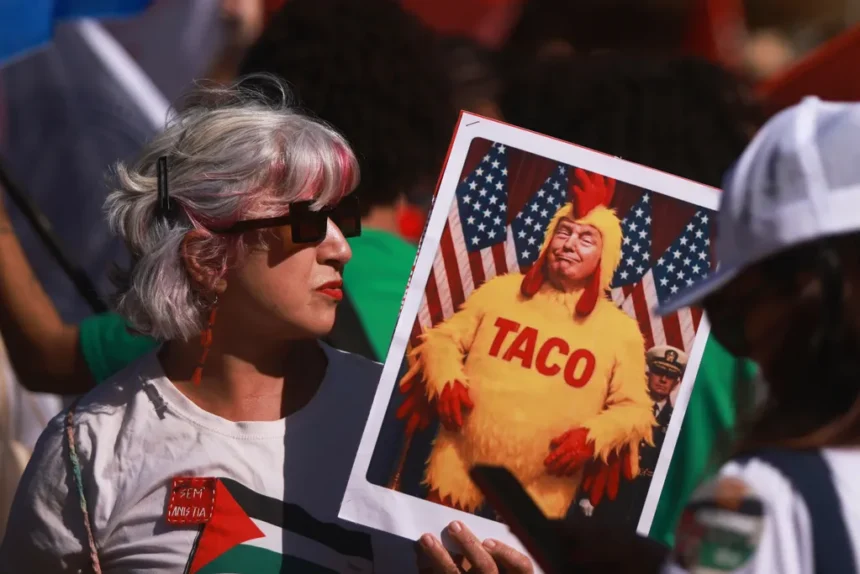
The term surfaced in late spring 2025, whispered first among traders in lower Manhattan before spreading to cable news chyrons. TACO: Trump Always Chickens Out. It described a rhythm that had become routine. The president would announce sweeping tariffs, markets would drop, then within days or weeks he’d delay implementation or carve out exemptions. Stocks would recover. Repeat. By summer, the pattern was so ingrained that major announcements barely moved the Dow. Investors had learned to wait for the walkback.
Trump himself has rejected the label with visible frustration. “I chicken out? Oh, I’ve never heard that,” he told reporters last year, insisting his adjustments represented shrewd negotiation rather than capitulation. His supporters argue the same, framing the approach as strategic flexibility rather than weakness. But his critics, including the Democratic National Committee, have weaponized the phrase. Last July, they parked a taco truck decorated with images of Trump in a chicken costume outside Republican headquarters in Washington. The symbolism wasn’t subtle.
Behind the mockery lies a genuine shift in market psychology. When Trump first rolled out reciprocal tariffs in early 2025, he framed them in stark terms. “Whatever countries charge the United States, we will charge them,” he declared. The announcement sent shockwaves through equity markets as investors braced for a global trade war. Days later, he escalated further, targeting Canada, Mexico, and China with measures explicitly tied to fentanyl smuggling. The S&P 500 tumbled. Then came April 2, 2025, what Trump christened “Liberation Day.” He imposed sweeping tariffs across dozens of trading partners and declared a national economic emergency. Markets cratered.
But within seventy-two hours, key portions of those tariffs were paused for ninety days to allow for negotiations. Stocks rebounded. The cycle was complete, and a template was established. Trump would threaten, markets would panic, then relief would arrive in the form of delays or exemptions. By June, when the administration floated new tariffs on semiconductors and industrial machinery, the market reaction was muted. Investors had learned to discount the initial threat. They were pricing in the reversal before it even happened.
A Republican operative, speaking on condition of anonymity to discuss internal strategy, described this as intentional. “Trump has always used aggressive opening positions as leverage, whether on trade or foreign policy, and then adjusted based on evolving conditions,” the source explained. The volatility itself becomes a tool, creating urgency among trading partners while leaving room to claim victory through incremental deals. Markets, in this view, are just one variable among many. “All presidents pay attention to market signals, but Trump tends to weigh them alongside political, strategic, and geopolitical considerations,” the source added.
By late summer 2025, the pattern had become even more pronounced. Announcements of tariffs on furniture, cabinets, and consumer electronics produced barely a ripple. Timelines slipped quietly. Exemptions multiplied. Investors stopped reacting to the rhetoric and started tracking implementation dates, assuming most threats would dissolve before taking effect. The TACO trade had become self-reinforcing. The more markets ignored the threats, the less immediate economic pressure Trump faced to follow through.
That dynamic now faces its most significant test yet, and this time the stakes extend beyond trade balances and quarterly earnings. In a six-to-three decision handed down in late March, the Supreme Court ruled that Trump lacked authority under the 1977 International Emergency Economic Powers Act to impose broad tariffs on most U.S. trading partners. The administration quickly pivoted, invoking a separate statute to implement a blanket ten percent tariff across the board. The ruling added a legal dimension to what had been largely a market-driven feedback loop, introducing constraints that don’t bend to negotiation.
The White House pushed back hard against the TACO narrative in a statement to the Washington Examiner. “This eggheaded analysis is disconnected from the plain reality that the President has consistently and skillfully used tariffs, diplomacy, and overwhelming military action to safeguard the national and economic security of the American people, from historic peace deals to unprecedented trade deals,” said White House spokesman Kush Desai. The statement reflects the administration’s insistence that what critics call inconsistency is actually tactical agility.
But the sharpest challenge to the TACO framework has nothing to do with tariffs at all. Earlier this month, Trump announced on Truth Social that the United States would pause “any and all military strikes” targeting Iran’s energy infrastructure following what he described as “very good and productive conversations.” Markets surged on the news, with energy stocks rallying and Treasury yields dropping as investors priced in reduced geopolitical risk. Then the rally stalled. Iranian officials publicly denied that any direct negotiations had taken place, casting doubt on the substance of Trump’s claims.
In a subsequent exchange with reporters, Trump doubled down, describing the talks as “very, very strong” and pointing to “major points of agreement.” He suggested there was a “very serious chance” of a comprehensive deal. Yet conflicting signals continued to emerge from Tehran, where officials insisted communication, if it existed at all, occurred only through intermediaries. On Monday, Trump posted again, claiming the U.S. was in “serious discussions with A NEW, AND MORE REASONABLE, REGIME” to end the conflict. Hours later, he threatened to “blow up all Iranian energy infrastructure” if no deal materialized.
For investors accustomed to the TACO playbook, the Iran situation presents a fundamentally different challenge. Tariffs are policy tools that can be dialed up or down with relative ease. Delays, exemptions, and phase-ins provide off-ramps that allow both sides to claim partial victories while avoiding economic catastrophe. Military escalation in the Persian Gulf operates under no such logic. The consequences of miscalculation are immediate, irreversible, and far more severe than a quarterly earnings miss.
Marko Kolanovic, JPMorgan’s former quantitative strategist, issued a blunt warning. The recent swings around Iran are a “net negative for markets,” he argued, because “manipulation will cause liquidity to disappear and real problems will stay.” With conflicting signals from both Washington and Tehran, investors are left to focus on hard indicators. Chief among them: whether oil continues flowing through the Strait of Hormuz, a narrow waterway that carries roughly one-fifth of the world’s petroleum supply. Unlike tariff threats, which markets have learned to treat as provisional, the closure or militarization of Hormuz would trigger immediate supply shocks with global ramifications.
The TACO label, initially a market meme, has thus evolved into something more significant. It reflects a broader uncertainty about which Trump threats are negotiating tactics and which represent genuine red lines. That ambiguity may serve the administration’s interests in some contexts, keeping adversaries and allies alike off balance. But it also carries risks. If markets and foreign governments consistently assume de-escalation is inevitable, Trump loses the credibility that makes the initial threat effective. A GOP strategist, speaking anonymously, acknowledged this tension. “If markets start assuming de-escalation is inevitable, that could actually reduce immediate pressure, but it also risks misreading his intentions,” the source said. “Trump’s unpredictability is part of the leverage.”
The political ramifications are likely to hinge less on the negotiating style itself and more on tangible outcomes. “MAGA supporters see a president willing to push hard and rethink tactics that can read as strength,” the GOP source noted. “Critics frame it as inconsistency, but the bigger impact will depend on results.” If Trump secures favorable trade deals or averts military conflict without sacrificing core objectives, the TACO label may fade as a political liability. But if the strategy produces economic disruption or geopolitical miscalculation, the same pattern that once reassured investors could become a symbol of recklessness.
For now, markets remain in a state of watchful uncertainty. The TACO trade conditioned investors to expect reversals, and that expectation has dampened volatility around tariff announcements. But Iran is not a tariff schedule. The stakes are higher, the variables more volatile, and the room for error far narrower. Whether Trump can apply the same strategy to a potential military confrontation without triggering the consequences he’s managed to avoid in trade remains an open question. The answer will shape not only market dynamics but also the broader perception of his presidency as he heads toward the 2026 midterms. Markets have adapted to Trump’s TACO strategy, but the world beyond Wall Street operates under different rules.