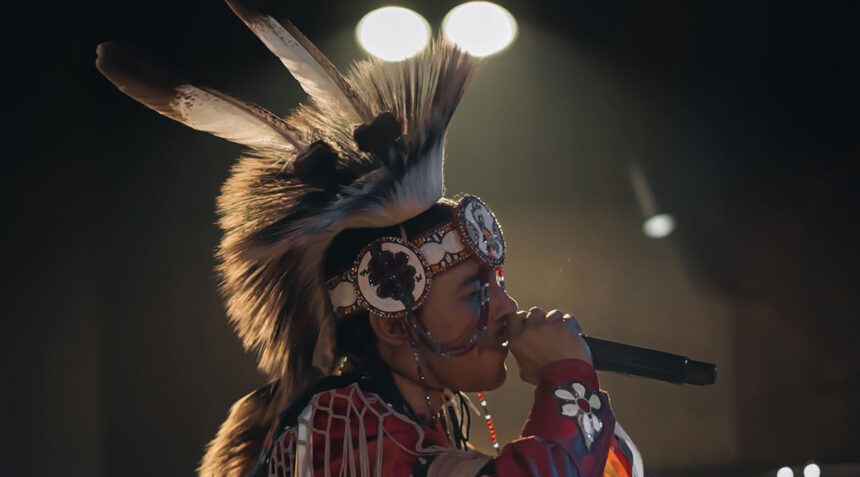
The late afternoon sun cuts low through the powwow grounds somewhere in Saskatchewan, and over the PA system, a name rings out at the winner’s table. Tony Tootoosis hears it and freezes for a second. Two years earlier, he wasn’t even a dancer. Five years before that, he was somewhere else entirely—lost, as he puts it, in the sauce. Now he’s standing in regalia, heart pounding, realizing that the life he thought he’d never have is unfolding right in front of him.
Born Anthony Tootoosis on Poundmaker First Nation and raised between Thunderchild, Saskatchewan, and Edmonton, Alberta, Tony grew up straddling worlds. The streets shaped him. So did the music—punk rock guitar lessons from a friend, heavy metal phases, pop experiments, and always, always rap. His older brother and his crew would battle in cyphers, and Tony, still a kid, soaked it all in. That mashup of influences became the DNA of his sound: raw, versatile, unapologetic.
But music wasn’t always tied to culture. For years, it was just output—a way to process life, to survive it. Then, about nine years ago, his daughter brought him to a family reunion powwow. Tony didn’t plan to dance. He didn’t even have an outfit. But his late uncle, Aaron McGillivray, handed him regalia meant for one of his sons and asked him to step into the circle. That moment cracked something open. Tony got sober. He put down alcohol and drugs. He started seeing himself differently, not just as an artist but as someone with a responsibility to his community.
What followed was a slow, intentional rebuild. Tony realized he had a niche audience within Indigenous communities, people who connected not just with his beats but with the humour, the references, the lived experience woven into his lyrics. He leaned into that. His music began to reflect Indigenous culture more openly, blending powwow rhythms with street narratives, comedy with commentary. He calls himself Tony Toosick now, and the name fits—part playful, part defiant, entirely his own.
Performing became a kind of ceremony for him. There’s a particular energy he talks about, the way adrenaline and fear feel identical in the body, and how he learned to channel that into something electric on stage. Sometimes it’s a packed venue. Sometimes it’s a handful of people in a community hall. Either way, Tony shows up fully. For him, performance is alchemy—taking nothing and turning it into everything.
His recent album is a testament to that range. Twenty songs. Acoustic tracks, love songs, diss records, heavy bangers. He produced, recorded, mixed, and mastered every track himself. It’s not just a flex—it’s a blueprint. Tony wants people to know that this is accessible, that stepping out of your comfort zone and learning something new is how you grow. He didn’t go to school for audio engineering. He just started, failed, tried again, and kept going.
Last year was a breakout season on the powwow trail. Tony didn’t expect to place, let alone hear his name called repeatedly at the winner’s table. The first song on his album opens with real recordings from those moments—proof that transformation isn’t abstract. It’s documented. Powwow culture gave him a second life, and now he’s using music to push even further. Volume 2 is already in the works, along with an EP dropping in a couple of weeks. He couldn’t stop writing even if he tried.
Beyond music, Tony is building a clothing brand called Powwow Famous and pressing skateboards. Skateboarding has always been part of his identity, another space where he felt free, and now he’s merging that world with his cultural work. It’s not about chasing trends. It’s about creating products and platforms that reflect who he actually is—a powwow dancer, a skateboarder, an audio engineer, an activist who speaks his mind and stands up for what’s right.
Tony describes himself as a free person, and there’s weight to that word. Freedom, for him, isn’t just about doing what you want. It’s about reclaiming parts of yourself that were buried or stolen, and then using them to build something real. Sobriety, education, and culture—those are his pillars now. They’re not buzzwords. They’re the scaffolding holding up everything else.
When you listen to his music on Spotify or Apple Music under Tony Toosick, you hear all of it. The humour. The heartbreak. The powwow drums layered under hip hop beats. The street slang next to Cree references. It’s messy and polished at the same time, which is exactly the point. Tony isn’t trying to fit into anyone’s box. He’s building his own.
He’s also unusually generous with his presence. If you see him in public, he says, come say what’s up. Take a picture. He means it. There’s no pretense, no distance between the artist and the person. That authenticity is what draws people in, and it’s what keeps them listening.
Tony Tootoosis is making moves, yes, but more than that, he’s making space. Space for Indigenous artists to be multidimensional. Space for sobriety to be cool. Space for powwow culture and skateboarding and hip hop to exist in the same breath. He’s proof that you can turn your life around, that you can honor your roots while reaching for something new, and that stepping out of your comfort zone is where the real magic happens.
From the streets to the stage, one song and one step at a time, Tony is showing what’s possible when you stay true to yourself and your culture. Keep your head up, he says. Keep moving forward. Always speak your truth.