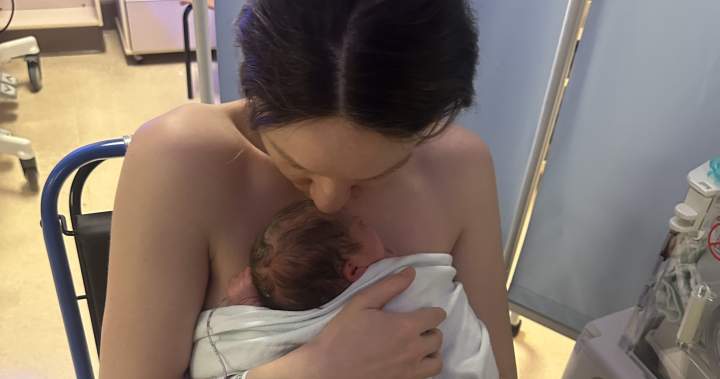
Natasha Olauson went into labour expecting her third child. She came home without her uterus.
The 33-year-old B.C. woman delivered her daughter by emergency C-section at Royal Columbian Hospital on Feb. 17. Within three weeks, she lost her ability to have more children. She says she feels mutilated. She says doctors didn’t listen.
Her story raises questions about maternal care in a province where health resources are stretched thin. It also highlights what happens when patient concerns get dismissed by those meant to protect them.
Olauson knew something was wrong from the start. She’d been through two previous emergency C-sections. She’d dealt with infections before. Her body was telling her the same thing was happening again.
“I felt like I had an infection and a hematoma brewing already,” she told Global News. “When you’ve had one before, you know what it feels like.”
She pushed for antibiotics. Doctors eventually agreed. But her condition continued to decline.
An ultrasound in early March showed retained placental tissue still inside her body. That’s a known complication. It can lead to infection, bleeding, and worse. Olauson was sent to Langley Memorial Hospital for treatment.
She underwent an emergency dilation and curettage procedure. That’s a surgical scraping meant to clear the uterine lining. The next morning, she woke in unbearable pain.
“Most pain I’ve ever lived in my life,” she said. “I can’t even comprehend.”
Then came the bleeding. It wouldn’t stop. Doctors performed an emergency hysterectomy to save her life. At 33, Olauson’s childbearing years ended on an operating table.
“I was not done having children,” she said.
She went home. Days later, she was rushed to Surrey Memorial Hospital. The pain persisted. So did her questions.
Could this have been prevented? Would earlier intervention have saved her uterus? Did anyone really hear her when she spoke up?
Fraser Health won’t comment on individual cases. Dr. Kirsten Niles, the regional division head of obstetrics, issued a careful statement. She said care teams have stayed in touch with Olauson. She expressed regret that the experience wasn’t positive. She promised a thorough review.
“We are thoroughly reviewing this person’s care journey to understand how we can improve the patient experience,” Niles said.
That review will examine internal processes. It will look for gaps. It may recommend changes. But for Olauson, no review will restore what she lost.
Her case isn’t isolated. Across Canada, maternal health advocates have long warned about systemic failures in obstetric care. Women of colour, Indigenous women, and those in rural areas face higher risks. So do women with previous complications.
Retained placenta occurs in roughly one to three percent of deliveries, according to the Society of Obstetricians and Gynaecologists of Canada. It’s more common after C-sections. Early diagnosis matters. So does aggressive treatment.
When placental fragments stay behind, infection risk climbs fast. Endometritis, sepsis, and hemorrhage can follow. In rare cases, hysterectomy becomes the only option to stop life-threatening bleeding.
But timing is everything. Delayed diagnosis can turn a manageable complication into a catastrophic outcome.
Olauson says she raised concerns immediately after delivery. She described symptoms she’d experienced before. She asked for specific interventions. She believes her warnings were minimized or ignored.
That pattern is disturbingly common. Research shows women’s pain is often underestimated in clinical settings. A 2021 study in the journal Pain Medicine found that female patients wait longer for pain medication than men. Their symptoms are more likely to be attributed to emotional or psychological causes.
For mothers recovering from childbirth, this bias can be especially dangerous. Postpartum complications require swift action. When providers dismiss patient reports, outcomes worsen.
Olauson’s experience also reflects broader pressures on B.C.’s health system. Emergency departments are overcrowded. Staffing shortages persist. Resources get stretched across multiple sites.
Royal Columbian, Langley Memorial, and Surrey Memorial are all part of Fraser Health. The region serves nearly two million people. It includes some of the fastest-growing communities in Canada. Maternity wards handle thousands of deliveries each year.
High volume doesn’t excuse poor communication. It shouldn’t mean patients feel unheard. But it does create conditions where mistakes happen more easily.
Olauson’s case will likely become part of Fraser Health’s quality improvement process. That’s standard after adverse events. Hospitals review what went wrong. They look for system failures, not just individual errors.
The goal is to prevent future harm. But for families living through these events, systemic reviews feel distant and cold.
Olauson says she feels like less than a woman now. That language matters. It reflects deep trauma, not just physical loss. Hysterectomy, especially unexpected and unwanted, can affect mental health, identity, and relationships.
Support services exist, but they’re not always offered proactively. Counselling, peer support groups, and follow-up care can help. So can honest acknowledgment from providers when things go wrong.
Olauson decided to speak publicly. She wants other women to know they’re not alone. She wants the system to change.
“Change doesn’t happen by people staying silent,” she said.
Her words carry weight. Patient advocacy has driven improvements before. Public pressure can push institutions to act faster and more transparently.
Fraser Health says it’s examining processes. That’s a start. But real accountability means more than internal reviews. It means listening when patients speak. It means acting on early warning signs. It means acknowledging when care falls short.
Olauson’s daughter is healthy. That’s something. But the cost of that delivery will shape the rest of her mother’s life. The physical scars will heal. The emotional ones may not.
Her story deserves attention beyond Fraser Health’s corridors. It speaks to larger questions about how we value maternal health. About who gets heard in medical settings. About what happens when systems fail the people they’re meant to protect.
For now, Olauson is focusing on recovery. She’s caring for three children while processing profound loss. She’s navigating a health system that left her feeling invisible.
She’s also making sure her voice gets heard. That takes courage after trauma. It also takes a belief that speaking up can make a difference.
Whether Fraser Health’s review leads to meaningful change remains to be seen. What’s certain is that Olauson’s experience shouldn’t be repeated. No mother should leave the hospital feeling mutilated. No patient should have to fight to be believed.