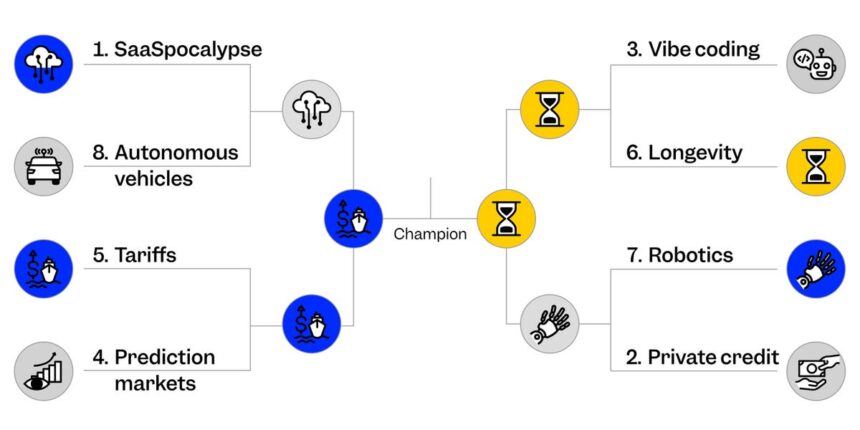
When you’re standing in the checkout line watching your grocery total climb, you’re probably not thinking about anti-aging peptides. But here’s the weird part: both tariffs and longevity science are reshaping how you spend money, how companies operate, and what the next decade of business looks like. And right now, readers are being asked to pick which one matters more.
Business Insider’s business-focused March Madness bracket started with eight major trends. After weeks of voting, nearly 300 people have whittled it down to an unlikely championship match. On one side: tariffs, the fifth seed that knocked out the tournament favorite. On the other: longevity, a sixth seed that’s outlasted the robotics craze. Both are underdogs. Both hit close to home. And both are forcing businesses to rethink everything from supply chains to retirement planning.
The tariff story has been running on a loop for over a year now. It kicked off last April on what the administration called Liberation Day, when sweeping import taxes landed on goods from China, Europe, and beyond. The promise was simple: protect American jobs and bring manufacturing home. The reality turned messier. Prices went up on everything from electronics to clothing. Small importers scrambled to find new suppliers or ate the costs. Larger corporations passed the burden straight to consumers, then blamed inflation when margins tightened.
Fast forward to today, and the Supreme Court just threw a curveball. Parts of those tariffs got struck down, opening the door for potential refunds. Companies that paid extra are now figuring out if they can claw back some cash. Consumers are wondering the same thing, though the path to actually seeing that money remains murky. Meanwhile, trade policy stays unpredictable. New tariffs pop up, old ones get renegotiated, and businesses are stuck planning for a future where the rules keep shifting.
The ripple effects are everywhere. A mid-sized furniture importer in North Carolina told me last month that his entire pricing model has been rewritten three times in the past year. He’s not alone. Supply chain managers are diversifying sourcing to hedge against sudden policy changes. Some companies are reshoring production, but that takes time and capital. Others are just absorbing the chaos and hoping for clarity that never quite arrives.
What makes tariffs so disruptive isn’t just the money. It’s the uncertainty. Businesses thrive on predictability. When you can’t forecast your input costs six months out, you can’t plan hiring, expansion, or R&D spending. And when that hesitation spreads across thousands of companies, the entire economy starts moving in slow motion. The Federal Reserve has cited trade policy as a headwind to growth. Analysts at Goldman Sachs and JPMorgan have downgraded forecasts partly because of tariff-related drag. This isn’t abstract policy. It’s showing up in earnings calls and GDP reports.
Now consider the longevity side of this matchup. At first glance, it seems softer, more aspirational. But dig deeper and you find an industry that’s quietly becoming a multi-billion-dollar force. We’re not just talking about anti-aging creams anymore. Companies are developing senolytic drugs that target aging cells. Startups are raising nine-figure rounds to research cellular reprogramming. Venture capitalists who used to chase social media apps are now funding labs working on NAD+ boosters and metformin derivatives.
The science is moving fast. Researchers at Harvard and Stanford are publishing studies showing that biological age can be reversed, at least in mice. Human trials are underway. The idea that you could live to 100 with the health profile of someone in their 60s isn’t science fiction anymore. It’s a testable hypothesis with serious funding behind it. And when serious money flows into a sector, businesses follow.
But longevity isn’t just about pills and lab work. If people are living longer, healthier lives, the entire lifecycle of consumer behavior shifts. Retirement planning gets complicated when 70 is the new 50. Financial advisors are recalculating withdrawal rates. Insurance companies are adjusting actuarial tables. Real estate markets are feeling the effects too. Aging populations used to downsize. Now they’re staying in larger homes longer, or moving into communities designed for active seniors who might have another 30 years ahead of them.
Healthcare is the obvious frontline. Medicare spending projections assume people decline steadily after 65. What happens if that curve flattens? On one hand, you could reduce chronic disease costs by keeping people healthier longer. On the other, you might just stretch out expensive end-of-life care over a longer timeline. Hospitals, pharmaceutical companies, and insurers are all gaming this out. The business models that work today might not work in 2040.
Then there’s the workforce angle. If people stay healthy and capable into their 70s and beyond, do they keep working? Some will want to. Others won’t have a choice, especially if Social Security and pensions weren’t designed for 40-year retirements. Companies will need to rethink age diversity, benefits, and career progression. The startup world loves young founders, but what if the most experienced talent pool is also the longest-lived?
So why did these two trends rise to the top of a bracket that also included AI, robotics, and the so-called SaaSpocalypse? Part of it is immediacy. Tariffs are affecting prices right now. Longevity promises are getting real investment and real results. But there’s something else. Both trends force us to confront uncertainty in deeply personal ways. Tariffs make the cost of living unpredictable. Longevity makes the length and quality of life negotiable. And both have massive implications for how businesses operate, plan, and compete.
The SaaS collapse, for context, was the top seed going into the final rounds. Investors have soured on unprofitable software companies, and the easy venture money has dried up. But readers voted it out decisively in favor of tariffs. Maybe that’s because SaaS struggles feel more like an inside-baseball story for the tech world. Tariffs hit everyone. Same reason robotics, despite its flashy potential, lost to longevity. Robots are coming, sure. But living longer? That’s universal.
What makes this final matchup compelling is the contrast in timelines. Tariffs are immediate, reactive, and politically charged. Longevity is gradual, scientific, and aspirational. One is about navigating instability. The other is about planning for a future that looks radically different from the past. Both require businesses to adapt, but in completely different ways.
If tariffs win, it signals that readers see trade policy and economic volatility as the dominant force shaping business strategy right now. If longevity takes it, it means people are looking past the quarterly chaos toward deeper, structural shifts in how we age, work, and spend.
Either way, the vote matters. Not because a bracket determines reality, but because it reflects what people think matters most. And in a world where business trends move faster than most of us can track, knowing where attention is focused tells you something important about where the next wave of innovation, investment, and disruption is heading.
So cast your vote. Decide whether the immediate pain of tariffs outweighs the long-term promise of longevity. Both are reshaping the business landscape. Only one can win the bracket.